
A VAT return is not the only compliance requirement for a bus tour in Slovenia. A foreign operator fully responsible for passengers transported in Slovenia generally must register for Slovenian VAT and file monthly returns. Returns and payments are generally due by the last working day of the month following the reporting period. To understand the role of a VAT agent for bus tours in Slovenia, first establish who is responsible for the passengers and which parts of the journey take place in Slovenia.
It is reasonable to focus on the return deadline, but VAT records and other declarations may also matter. This article explains how passenger transport is treated, which records and reports may apply, and what filing periods and deadlines to plan for. It also explains how the Slovenia route report and tax report fit into the process, so you can understand reporting obligations before and after a trip.
Key Takeaways
- Identify which company is fully responsible for passengers, since this affects whether Slovenian VAT registration and reporting apply.
- Understand how the distance travelled in Slovenia can affect VAT treatment for passenger transport that crosses borders.
- Learn which VAT records and supporting trip documents matter, including the retention period set out by the Financial Administration of the Republic of Slovenia.
- See how to assess an agent’s fit by looking at the practical reporting tasks involved before and after a journey.
- Find out how route reports, tax reports, and VAT registration can support bus operators with their Slovenian obligations.
VAT return filing frequency and deadlines
Slovenian VAT reporting involves periodic returns, tax payments, and supporting records. For bus operators, the reporting period determines how often to file and which journeys the records need to support.
Filing frequency
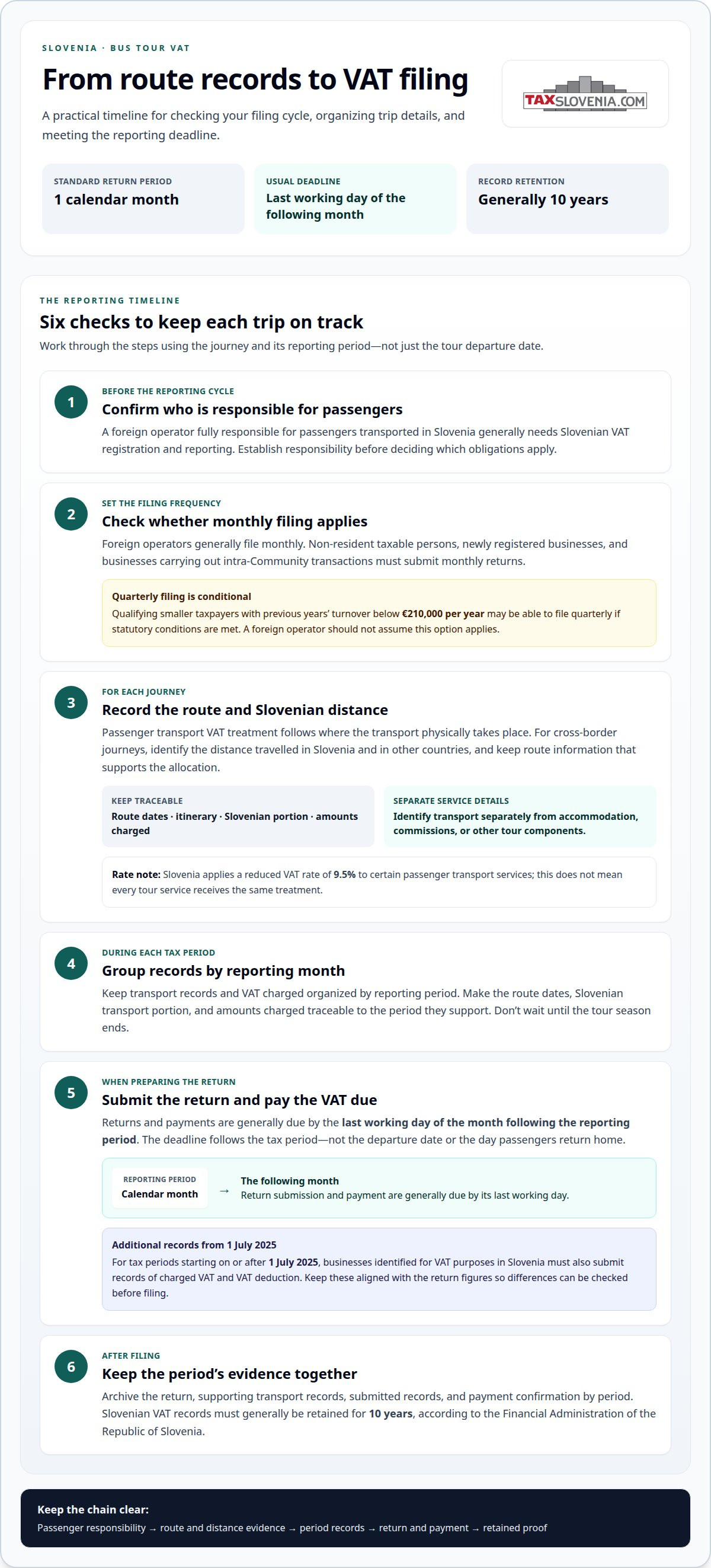
Slovenia’s standard VAT return period is one calendar month, and foreign operators generally file monthly. Organize transport records and VAT charged by reporting period, rather than waiting until the end of the tour season.
Non-resident taxable persons and newly registered businesses must submit monthly returns. Businesses carrying out intra-Community transactions also file monthly, regardless of turnover. These rules are especially relevant when an operator’s routes connect Slovenia with other EU member states.
Quarterly filing may be available to qualifying smaller taxpayers. Businesses with previous years’ turnover below €210,000 per year may file quarterly if they meet the statutory conditions. A foreign bus operator should not assume this option applies simply because its Slovenian activity or passenger numbers are limited. Its status and transaction pattern affect the filing period.
For example, a non-resident operator carrying passengers in Slovenia should plan for monthly reporting, even if it runs only occasional tours. A business with cross-border transactions must also account for the monthly filing rule. A VAT agent can help establish the reporting cycle during registration, before trips generate records that need to be assigned to a return.
Monthly reporting requires a consistent format for trip data. Keep route dates, the Slovenian portion of transport, and amounts charged traceable to the relevant tax period. If a tour includes accommodation, a commission, or a margin-based arrangement, keep the underlying transaction details clear. This helps distinguish passenger transport from other tour components when reporting.
From tax periods starting on or after 1 July 2025, businesses identified for VAT purposes in Slovenia must submit records of charged VAT and VAT deduction. This adds a records submission alongside the return process. The records should correspond to the same period and figures used in the VAT return, so differences can be investigated before filing.
Filing deadlines
A filing deadline is the final date for submitting the return and paying the VAT due for a reporting period. In Slovenia, returns and payments are generally due by the last working day of the month following that period. This timing matters because completing a trip does not itself close the filing obligation.
For a monthly period, identify the month being reported and plan submission and payment for the last working day of the following month. For example, the return for a calendar-month period is due the month after that period ends. The deadline follows the reporting period, not the operator’s departure date or the date passengers return home.
Businesses registered for Slovenian VAT must submit periodic returns and pay tax to the Financial Administration of the Republic of Slovenia. Plan payment alongside return preparation. Preparing the return on time without making the required payment leaves the period incomplete.
Keep the return, supporting transport records, and payment confirmation together by period. The Financial Administration of the Republic of Slovenia states that Slovenian VAT records must generally be retained for 10 years. A clear archive makes it easier to trace an amount from a filed return back to the passenger journey and the records submitted for that period.
How is VAT calculated on passenger transport within Slovenia and across borders?
For passenger transport, the route matters because VAT treatment follows where the transport physically takes place. A bus journey crossing Slovenia’s border must therefore be considered by country, rather than automatically treated as one domestic service.
Slovenia applies a reduced VAT rate of 9.5% to certain passenger transport services. This rate does not mean every tour service receives the same treatment. A package may also involve accommodation, commissions, or other services, each with its own tax considerations. Keep those components identifiable so the passenger transport can be assessed separately from other charges.
For cross-border transport, the EU rules described for passenger transport determine taxation according to the distance travelled within the EU. Identify which part of the route takes place in Slovenia and which parts take place in other member states. Keep route information that supports allocating the distance between countries.
For example, a coach carrying passengers from another EU member state through Slovenia continues to provide transport while travelling in Slovenia. Assess the Slovenian portion in relation to the distance covered there. Consider the remaining route in the country or countries where that transport takes place. A single ticket does not remove the need to identify the journey’s different territorial portions.
Article 48 of the Directive describes passenger transport as a service whose place of VAT taxation depends on where transport physically occurs and the distance covered. Slovenia’s tax office issued a notice in August 2016 about passenger transport performed in Slovenia and related registration and reporting obligations. Together, these points make route evidence important for deciding which part of a journey belongs in Slovenian VAT reporting.
Route records should connect each tour to its itinerary, dates, passenger service, and distance travelled in Slovenia. If a ticket or invoice covers accommodation or a commission as well, make the charged transport service distinguishable. These details help allocate transport activity across EU member states and prepare tax records.
International transport may qualify for Slovenia’s 0% VAT rate, but the treatment applies to qualifying transport, not automatically to every journey that crosses a border. The distinction between qualifying international transport and a passenger service taxed according to its physical route is important. Operators need to consider the service performed and the route covered before applying a rate.
BusinessEurope has noted the administrative challenge of applying VAT according to distance travelled for road, rail, and coach operators. A route report can organize the Slovenian segment and supporting journey details for tax reporting. This is useful when a tour crosses borders, includes multiple service components, or requires support for the VAT treatment assigned to its transport portion.
What penalties and risks apply for late VAT registration or incorrect bus-tour VAT reporting?
A key compliance risk is treating taxable passenger transport in Slovenia as outside the company’s VAT obligations. A foreign transport company fully responsible for passengers transported in Slovenia generally must register and report under Slovenian VAT law. If registration is delayed, Slovenian activity may be left out of the company’s VAT reporting.
Responsibility for the passenger service matters. A company that only hires out a vehicle, while another company is responsible for carrying passengers, is treated differently from the transport operator. A travel agency may itself be responsible for passengers. Contracts, invoices, and the actual service should consistently show who arranged and supplied the transport.
For example, a coach operator may contract with a tour agency but remain fully responsible for carrying the passengers. The contract’s counterparty alone does not determine which business must register. If the operator reports the journey under the wrong company, its records may not explain the reported activity. Aligning the service arrangement with trip documentation helps avoid this mismatch.
Reporting can also be incorrect if the wrong part of a cross-border journey is assigned to Slovenia. If a return trip passes through Slovenia, the route and transport performed there should be reflected consistently in the relevant records. Omitting the Slovenian segment from a route description can make the tax report inconsistent with the passenger service actually provided.
Other errors concern the amounts and transactions shown in a return. A difference between invoices, journey records, and reported figures can make it harder to substantiate how VAT was calculated. From tax periods starting on or after 1 July 2025, records of charged VAT and VAT deduction are also required for businesses identified for VAT purposes in Slovenia. Consistency between those records and the return matters.
Late or inaccurate reporting can create financial and administrative exposure. The operator may need to identify affected journeys, reconstruct transaction records, and address amounts omitted or reported incorrectly. The task is harder when dispatch schedules, passenger invoices, and accounting entries use different route descriptions or tax periods.
To reduce these risks, keep a clear file for each reporting period. It should connect the operator’s role, passenger service, route, invoice, and reported amount. For a cross-border tour, retain enough route detail to distinguish the Slovenian transport segment from the remaining journey. The Financial Administration of the Republic of Slovenia states that Slovenian VAT records must generally be retained for 10 years.
Consider registration before the first taxable passenger transport in Slovenia, rather than after several trips have accumulated. Foreign businesses making taxable supplies generally must register from their first taxable supply unless the reverse-charge mechanism fully applies. Establish who is responsible for passengers, identify the taxable Slovenian activity, and keep reporting evidence aligned with that activity.
How can bus tour operators compare Slovenian VAT agents and verify their credentials?
Compare agents by the Slovenia-specific tasks they handle, the records they use, and the reports they prepare. A general VAT service may not address route details for cross-border passenger transport. For example, an operator travelling through Slovenia needs reporting that connects the Slovenian route segment with relevant tax records. A VAT agent for bus tours in Slovenia should be able to explain how these tasks fit together.
Match the service scope to your compliance stages. VAT registration addresses entry into the Slovenian system, while route reporting and tax reporting relate to journey information and subsequent filings. Clear service descriptions distinguish these tasks instead of presenting “VAT support” as one undefined activity. Compare what each service covers and how it relates to your operating model.
Consider credentials separately from service scope. Identify the legal entity responsible for the engagement and the person or team handling the work. Review documentation about professional status and authority to act, and read the engagement terms to understand who prepares and submits filings. A title alone does not explain the scope of work or each party’s responsibilities.
Ask how the agent handles the details of a bus tour. A useful explanation should show how it records the operator’s role, itinerary, Slovenian route portion, and information used to prepare reports. For example, the process should distinguish passenger transport from a separate vehicle-hire arrangement, because responsibility for passengers affects the VAT analysis. A VAT agent for bus tours in Slovenia should explain this distinction in practical terms.
Compare the reporting workflow as well. Understand what information is used before a trip, how route details are organized, and how the resulting tax report relates to the operator’s records. A practical process connects each journey’s route information, invoices, and reported figures. This matters when an itinerary includes Slovenia and other EU member states.
Use the same criteria for each candidate, then compare the answers side by side:
- Slovenian scope: Does the service cover VAT registration and reporting needs for foreign passenger transport operators?
- Route treatment: Does the process capture the Slovenian segment of a cross-border journey?
- Reporting records: Can the agent explain how trip and invoice details support its reports?
- Responsibilities: Do the engagement terms identify who prepares and submits filings?
- Credentials: Are the legal entity, responsible contact, and professional-status documents clearly identified?
Look for precise, consistent answers rather than broad assurances. If an agent describes a report, its purpose and the information it uses should be clear. If it describes representation, the engagement terms should explain the work covered and each party’s responsibilities. This helps distinguish a defined compliance process from a general service description.
Assess the proposed support against your actual operations, including whether your company is responsible for passengers or only supplies a vehicle. A VAT agent for bus tours in Slovenia is a suitable fit when its documented work addresses your relevant registration, route-reporting, and tax-reporting needs. Comparing these tasks gives you a practical basis for deciding whether the service suits your tours.
TaxSlovenia and TaxCroatia
TaxSlovenia and TaxCroatia helps foreign bus operators with Slovenian VAT registration and trip-related reporting. Its Slovenia route report supports the route information needed before a journey, while its Slovenia tax report supports reporting after trips. These services are relevant when your company is responsible for passengers transported in Slovenia and needs a clear process for its local obligations.
If your tours also involve Croatia, TaxSlovenia and TaxCroatia provides VAT registration there too. The appropriate support depends on the countries where your transport operates and the reporting tasks involved. Contact TaxSlovenia and TaxCroatia to discuss your bus tours and the Slovenian VAT support you need.
Set up a clear process for your next Slovenian tour
Your next step is to connect your operating model with the records and reporting process you need. Before your next journey, gather the route plan, passenger-service arrangements, and records used by your finance team. This gives a VAT agent for bus tours in Slovenia practical context for handling your case and helps connect route information to tax reporting.
TaxSlovenia and TaxCroatia supports foreign bus operators with Slovenian VAT compliance. If your company is planning routes through Slovenia or reviewing its current reporting arrangements, discuss the relevant requirements and the support your operations need.
Contact TaxSlovenia and TaxCroatia to discuss your Slovenian bus-tour reporting needs. A clear process can help your team prepare for its next trip with greater confidence.
Frequently Asked Questions
Are any other declarations required?
Yes, additional declarations can apply when the operator makes particular EU transactions. For example, Slovenian VAT-registered businesses submit EC Sales Lists for supplies of goods and certain services to VAT-registered customers in other EU member states. A special report also applies to specified local sales under Article 76.a of the Slovene VAT Act. Intrastat filings may apply when annual thresholds set by Slovenian statistical authorities are exceeded.
Does a non-established business need to appoint a fiscal representative in order to register?
Non-established status and fiscal representation are separate questions from VAT registration. A foreign operator making taxable supplies in Slovenia generally must register from its first taxable supply unless the reverse-charge mechanism fully applies. A VAT agent can assist with registration and reporting, but that does not automatically mean the agent is appointed as a fiscal representative. Consider the operator’s establishment and any formal role required separately.
How often do returns have to be submitted?
Foreign operators generally submit Slovenian VAT returns monthly. This applies to non-resident taxable persons and newly registered businesses. Businesses carrying out intra-Community transactions also file monthly, regardless of turnover. For example, an operator newly registered before its first Slovenian tour should plan by monthly tax period, rather than wait until the season ends. Prepare returns and the supporting journey records on the same reporting cycle.
Is there a registration limit for the tax?
For a foreign bus operator, the key issue is generally whether it makes a taxable supply in Slovenia, not whether it reaches a turnover threshold. Foreign businesses making taxable supplies generally register from their first taxable supply unless reverse charge fully applies. The €60,000 threshold relates to Slovenian-established businesses and taxable turnover within a 12-month period. A foreign company should not assume that threshold governs its own registration.
When must a foreign bus tour operator register for VAT in Slovenia?
A foreign operator generally must register from its first taxable supply in Slovenia, unless the reverse-charge mechanism fully applies. For passenger transport, first establish which company is fully responsible for carrying passengers. For example, a company that only hires out a vehicle may have a different VAT position from the operator supplying passenger transport. The contract and actual operating arrangement help identify which business makes the relevant supply.
Can a Slovenian fiscal representative act as a VAT agent for a non-EU tour operator?
A provider’s ability to assist with VAT registration and reporting is distinct from formal appointment as a fiscal representative. For a non-EU tour operator, establish which role is required and ensure the engagement documents describe the representative’s legal capacity. TaxSlovenia and TaxCroatia provides VAT registration and reporting support for foreign bus companies in Slovenia, but those services alone do not define a statutory representative appointment.
Is a VAT agent or fiscal representative mandatory for US bus tour companies in Slovenia?
US nationality alone does not determine whether a company makes taxable supplies in Slovenia. Foreign businesses generally register from their first taxable supply unless the reverse-charge mechanism fully applies. Appointing a fiscal representative is a separate legal question from using an agent for registration or reporting support. A US operator should first identify its role in the passenger transport and the nature of its Slovenian supply.
What services can a Slovenian VAT agent provide to foreign bus tour operators?
Services may include VAT registration, route-report preparation, and tax reporting for journeys in Slovenia. These tasks address different stages: registration establishes the operator’s VAT position, route information relates to planned journeys, and tax reporting follows transport activity. TaxSlovenia and TaxCroatia offers VAT registration in Slovenia, a Slovenia route report, and a Slovenia tax report for foreign bus companies operating international passenger transport.


