

Cross-border bus journeys don’t automatically remove Croatian VAT obligations. Croatia bus tax requirements for UK operators include VAT registration and accounting for Croatian VAT on supplies made in Croatia. Since January 2021, UK travel businesses have been required to register and account for Croatian VAT on those supplies rather than use a margin-scheme calculation. Some international and intra-community passenger transport is subject to 0% VAT, so the treatment depends on the service and route.
It’s understandable to find the rules difficult to apply when a journey crosses borders or includes different services. This article explains which VAT requirements may apply to UK-established tour operators, including registration and reporting, and what compliance risks and penalties may follow if obligations are missed.
You’ll learn why passenger transport can receive different VAT treatment from other supplies and which reporting responsibilities apply after a trip. This can help you identify the rules relevant to your operations and understand how Croatian VAT support fits into the process.
Key Takeaways
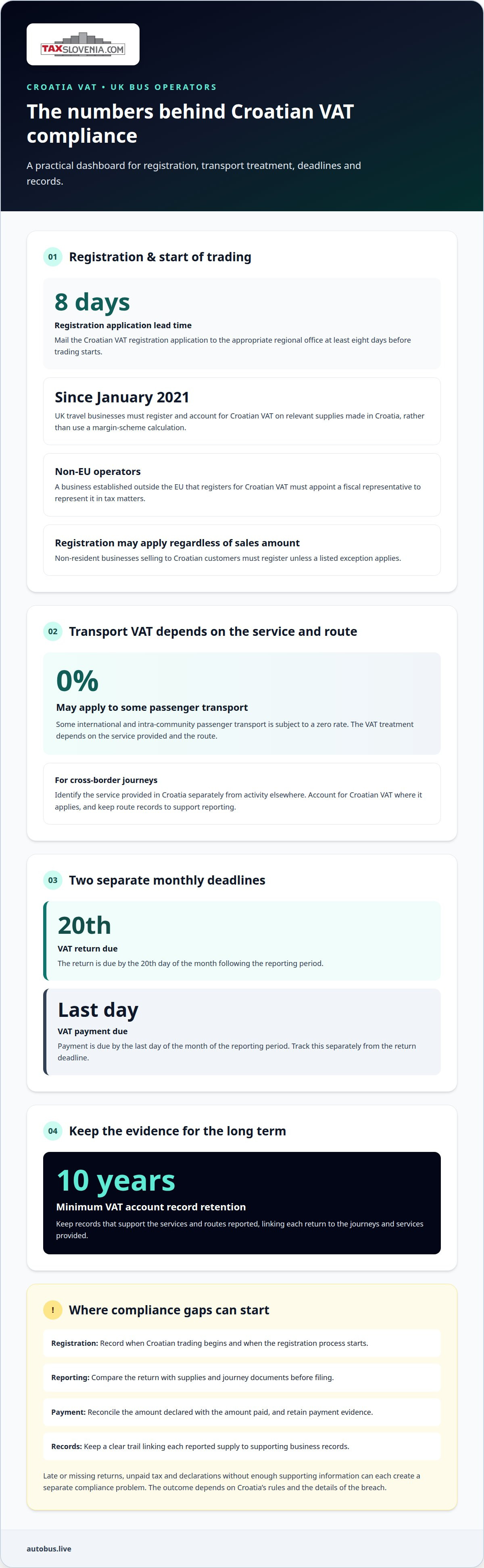
- UK-established tour operators may need Croatian VAT registration and must account for Croatian VAT on supplies made there.
- Some international and intra-community passenger transport may qualify for a 0% VAT rate, so the service and route affect the treatment.
- According to the Croatian Tax Administration, monthly VAT returns are due by the 20th day of the month following the reporting period.
- Learn how missed registration, reporting or payment obligations can create compliance risks, and what to consider for cross-border bus journeys.
Croatia VAT requirements for UK-established tour operators
For UK bus operators, meeting Croatian VAT rules may involve registering, appointing a fiscal representative, filing returns and keeping records. The rules depend on the services you provide in Croatia, so both what you do and the journey route matter.
Taxes on Passenger Transport
Passenger transport tax rules cover how services provided in Croatia are treated and reported for VAT. They matter because, since January 2021, UK travel businesses have had to account for Croatian VAT on services they provide there, rather than use a margin-scheme calculation. Non-resident businesses selling to Croatian customers must also register, whatever their sales amount, unless a listed exception applies.
Croatian VAT registration applications must be mailed to the appropriate regional office at least eight days before trading starts. So, a UK business should consider registering before it starts providing relevant services, rather than treating registration as a task to complete after a trip.
Do UK bus operators need a Croatian tax representative or fiscal agent? A business established outside the EU that registers for Croatian VAT must appoint a fiscal representative, a local person or business that represents it for tax matters. This rule applies to UK operators registering under the non-EU rule.
VAT on Cross-Border Journeys
VAT rules for cross-border journeys depend on the service provided and which parts of the operation take place in Croatia. For an international journey, identify the service provided in Croatia separately from activity elsewhere, then account for Croatian VAT where it applies. Clear route records help support your VAT reporting.
Croatian Tax Administration says monthly VAT returns are due by the 20th day of the month after the reporting period. VAT payments are due by the last day of the month of the reporting period, so keep track of the return and payment deadlines separately.
Croatian Tax Administration requires VAT account records to be kept for at least 10 years. Keep records that support the services and routes you report, so you can link each return to the journeys and services provided.
What permits and documents do UK bus operators need to run tours or regular services in Croatia? UK businesses providing services there must follow local rules, including any required authorisations or licences. Business travellers and service providers may also need a visa, work permit or other documents.
Do Brexit rules change Croatian tax or permit requirements for UK bus operators? Since January 2021, UK travel businesses have had to register for Croatian VAT and account for Croatian VAT on services they provide there, rather than use a margin-scheme calculation. UK operators must also follow applicable Croatian rules for services and documents.
Do UK buses need to pay Croatian road tolls, motorway charges, or vehicle taxes? VAT registration does not determine whether tolls or motorway charges apply. Croatia’s special tax on diesel motor vehicles is based on average CO2 emissions and the vehicle’s sale price.
When assessing Croatia bus tax requirements for UK operators, break VAT compliance into registration, reporting, payment and record keeping. This makes it easier to connect ongoing requirements with the services provided and routes operated.
VAT risks and penalties
For a UK operator, VAT risk can start before filing a return. If services are supplied in Croatia but the required tax steps are missed, the operator may not have a clear record of what it has done. Treat registration, reporting, payment and record keeping as connected steps. Missing one can affect later filings, not just the journey that first revealed the issue.
Consider possible penalties as well as the VAT that needs to be paid. The risk is not limited to paying the wrong amount: a late filing, missing return, unpaid tax or a declaration without enough supporting information can each create a separate problem. Do not assume that rules in another EU country explain how penalties work in Croatia. The requirements depend on Croatia’s rules and the details of each breach.
For example, an operator might record a Croatian journey in its route system but fail to include it in the VAT return. That leaves a reviewer with less information about how the service was supplied and reported. Keep trip records, sales records and filing information together, and resolve discrepancies before submitting a return.
- Registration gaps: Record when Croatian trading begins and when the VAT registration process starts.
- Reporting errors: Compare the return with the supplies and journey documents before filing.
- Payment mismatches: Reconcile the amount declared with the amount paid, and retain evidence of the payment.
- Weak records: Keep a clear trail linking each reported supply to the business records that support it.
These steps can help identify an issue while journey and transaction details are still available. If a return needs correction, preserve the original figures and supporting documents, then record what changed and why. This creates a clear record of the correction instead of leaving an unexplained difference between the return and the operator’s records.
Published penalty figures do not apply to every breach. The type of failure, tax involved and operator’s response can affect the outcome. A UK business should not budget around a figure copied from another country or a different tax situation. Focus first on meeting requirements and keeping evidence to support each filing.
Where Croatian registration is the unresolved step, Croatian VAT registration support can help set up the process. A registered operator can then organize its reporting and payment steps around the services it supplies in Croatia.
What taxes and VAT apply to UK bus operators providing passenger transport in Croatia?
UK bus operators may need to account for Croatian VAT on services provided in Croatia, as well as certain vehicle-related taxes. The rules depend on the service and route, and some vehicle taxes also depend on the vehicle’s features.
Croatia’s general VAT rate is 25%. Some international and intra-community passenger transport is taxed at 0%, so operators should tell qualifying transport apart from other services. A tour package can include transport, accommodation or other services; don’t assume they all have the same VAT treatment.
Since January 2021, UK travel businesses have had to register for VAT in Croatia and account for Croatian VAT on supplies made there, rather than use a calculation based on their profit margin. Businesses based outside Croatia that sell to Croatian customers have no minimum sales threshold for registration, subject to listed exceptions. The EUR 60,000 threshold applies to a Croatian business whose supplies exceed that amount in the previous or current calendar year. It is not a general registration threshold for a UK operator.
Vehicle-related taxes and insurance
Croatia also charges a special tax on diesel motor vehicles, based on average CO2 emissions and the vehicle’s sale price. Fully electric vehicles, vehicles with 0 g/km CO2 emissions and vehicles at least 30 years old are not taxed under this special vehicle tax. These rules concern the vehicle, not the VAT rate on passenger transport.
Insurance premiums have separate special taxes. Croatia applies a 15% special tax to the amount stated in the contract for obligatory motor vehicle insurance premiums, and a 10% special tax to the amount stated in the contract for comprehensive motor vehicle insurance premiums. Keep these charges separate from VAT when reviewing vehicle-related costs.
Separate the tax categories
For practical accounting, group each amount by what it relates to: passenger transport, another service in a travel package, a vehicle or an insurance premium. For example, the tax on a diesel coach is worked out differently from VAT on a passenger journey. Keeping these categories separate helps prevent vehicle charges from being included incorrectly in transport VAT calculations.
Registration and reporting rules also depend on the supplies made in Croatia. Identify which services are provided there, how each is classified, and whether any vehicle or insurance charge applies. This gives you a clearer basis for handling Croatian VAT and other relevant taxes, without treating every journey or cost as the same tax item.
Eligible Croatian taxpayers may file VAT returns every three months if they have no transactions with EU taxpayers and their total supplies of goods and services in the previous year do not exceed EUR 110,000. This rule sets how often they can file; it is not a general registration threshold for UK operators.
Keep this eligibility test separate from the registration rules above, and check that you meet the conditions before filing every three months.
What is Croatia's VAT rate for international and domestic bus passenger transport?
Croatia’s general VAT rate is 25%, while a 0% rate applies to some international passenger transport, including travel between EU countries. The route matters: calling a journey international doesn’t automatically mean it qualifies for the 0% rate. Operators need to tell the difference between qualifying transport, domestic journeys and other services provided alongside transport.
For domestic passenger transport, check which Croatian VAT rules apply rather than assuming the rate for international transport applies. The 0% rate applies to some international journeys, including travel between EU countries, but not to all bus journeys. So, a trip that starts and ends in Croatia shouldn’t be treated as qualifying for 0% just because the operator is based in the UK.
International journeys need a closer look at both the route and the service provided. A trip across borders may include a section in Croatia, but that alone doesn’t establish the VAT rate for the whole service. Keep the journey details together with the VAT treatment you apply.
How to distinguish the rates
- 25%: Croatia’s general VAT rate and the starting point for domestic passenger transport.
- 0%: Applies to some international journeys, including travel between EU countries, rather than every journey across a border.
- Separate services: Don’t automatically apply the same rate to transport and other parts of a tour.
For example, a UK operator arranging a bus journey within Croatia shouldn’t apply 0% just because the company is based abroad. For a journey across borders, the operator should record where it starts and ends and the route it takes, then connect those details to the transport service provided. These records make it easier to explain the VAT treatment chosen.
Invoices and route records should tell the same story. If an invoice combines transport with other tour services, keep information showing what each charge covers. This helps separate passenger transport from other services and reduces the risk of applying one rate to an entire package without checking its parts.
Choosing the VAT rate is separate from VAT registration and filing returns. A 0% rate doesn’t, by itself, mean registration isn’t needed. UK operators should check registration and reporting requirements separately, then record the rate used for each relevant service. This ties the rate decision to the service and route, rather than the operator’s nationality or a broad description such as “tour”.
In practice, first identify whether the journey is domestic, international or between EU countries, then identify the specific transport service. Apply the 25% general rate if the 0% treatment doesn’t apply, and record why a qualifying transport service receives the 0% rate. This gives each journey a clear VAT record.
How is Croatian VAT calculated for bus journeys that cross borders?
Start by identifying the passenger transport service provided and the journey’s route. Croatia’s VAT rules depend on whether the transport qualifies for the 0% rate or is charged at the general 25% rate. Crossing a border alone does not determine the rate, and a UK operator’s place of establishment does not decide how the service is classified.
For a taxable supply, a service or sale on which VAT is due, the basic calculation is the amount subject to VAT multiplied by the applicable rate. At 25%, that means applying 25% to the relevant amount. Where a journey qualifies for the 0% rate, no VAT is charged on that transport. The operator still needs to classify the service correctly and keep records to support that choice.
Some international and intra-community passenger transport, transport between EU countries, is subject to 0% VAT. This does not mean every journey crossing a national border qualifies. The route details, passenger transport service and related records should support the classification, or decision about which VAT rules apply. Domestic transport should not be given the 0% rate just because the operator or passengers have international connections.
For a journey that includes travel inside and outside Croatia, keep the itinerary and the service provided clear. The available rules identify qualifying international and intra-community transport but do not provide a formula for splitting the fare by distance. Do not make up a split based only on kilometres. Apply the relevant rate based on how the service is classified, and keep route information that explains your decision.
A practical review can follow these points:
- Identify the service: Separate passenger transport from accommodation or other tour components.
- Map the route: Record the journey’s origin, destination and Croatian portion.
- Classify the transport: Work out whether it is domestic, international or between EU countries.
- Apply the rate: Use 25% as the general rate or 0% where the transport qualifies.
- Keep supporting records: Link route details, invoices and reported supplies.
For example, a UK tour combining a bus journey and accommodation should not automatically receive one VAT treatment as a single package. Transport and accommodation are separate parts of the service. Records should show what was provided and how the route supports the VAT treatment chosen for passenger transport.
Consistent records also connect the VAT calculation to the return. If an invoice describes a cross-border journey but the route record shows only a domestic service, explain the difference clearly in your records. A recorded classification gives you a clear basis for the rate applied, without assuming that every international itinerary receives the same treatment.
For help documenting Croatian journeys, arrange a Croatia route report to support route-based VAT records.
TaxSlovenia and TaxCroatia
TaxSlovenia and TaxCroatia helps foreign bus operators with Croatian VAT registration and reporting. Its Croatia route report and Croatia monthly tax report support journey-related and ongoing reporting requirements, while VAT registration in Croatia covers the registration step.
Turn to TaxSlovenia and TaxCroatia when your operations involve passenger transport in Croatia and you need help managing these tax processes. The service focuses on tax requirements in Croatia and Slovenia, not passenger transportation. Contact TaxSlovenia and TaxCroatia to discuss support for your Croatian VAT requirements.
Make Croatian compliance part of your operating routine
Managing Croatia bus tax requirements for UK operators is easier when tax administration is built into trip planning. Establish a consistent process for connecting each trip’s commercial details with its accounting records. This gives your team a clear starting point for reviewing how services were supplied and recorded, rather than reconstructing decisions after preparing a filing.
Assign responsibility for keeping the process consistent across your business. Operations staff can maintain journey information, while finance staff use it to prepare and review tax records. Clear handovers help keep important details with the transactions they relate to. When routes or services change, update both the records and the internal process.
If you need support with Croatian or Slovenian tax administration, TaxSlovenia and TaxCroatia can help with relevant registration and reporting services. Contact TaxSlovenia and TaxCroatia to discuss a practical next step for your operations. A steady process can help your team manage cross-border work with greater clarity.
Frequently Asked Questions
Does a UK bus operator need to register for Croatian VAT when carrying passengers in Croatia?
UK travel businesses supplying services in Croatia generally need Croatian VAT registration and must account for Croatian VAT on supplies made there. The obligation has applied since January 2021, rather than allowing UK businesses to use a margin-scheme calculation. A 0% rate for qualifying transport does not itself remove registration requirements. Non-EU businesses registering for Croatian VAT must also have a fiscal representative.
How do UK bus operators report and pay Croatian VAT, and what are the deadlines?
Operators file Croatian VAT returns electronically and pay the VAT due separately. According to the Croatian Tax Administration, monthly VAT returns are due by the 20th day of the month following the reporting period. VAT payments are due by the last day of the month of the reporting period. Keep a reconciliation between the return, payment and trip records so each reported supply can be traced to its journey.
What penalties apply for failing to comply with Croatian bus tax and VAT requirements?
Penalties may arise when an operator misses a VAT filing or payment, or reports supplies inaccurately. The potential consequences depend on the compliance failure, so do not rely on a single assumed penalty amount. For example, if a journey is omitted from a return, preserve the route and sales records and document any correction. This clarifies what was reported and how the issue was addressed.


