

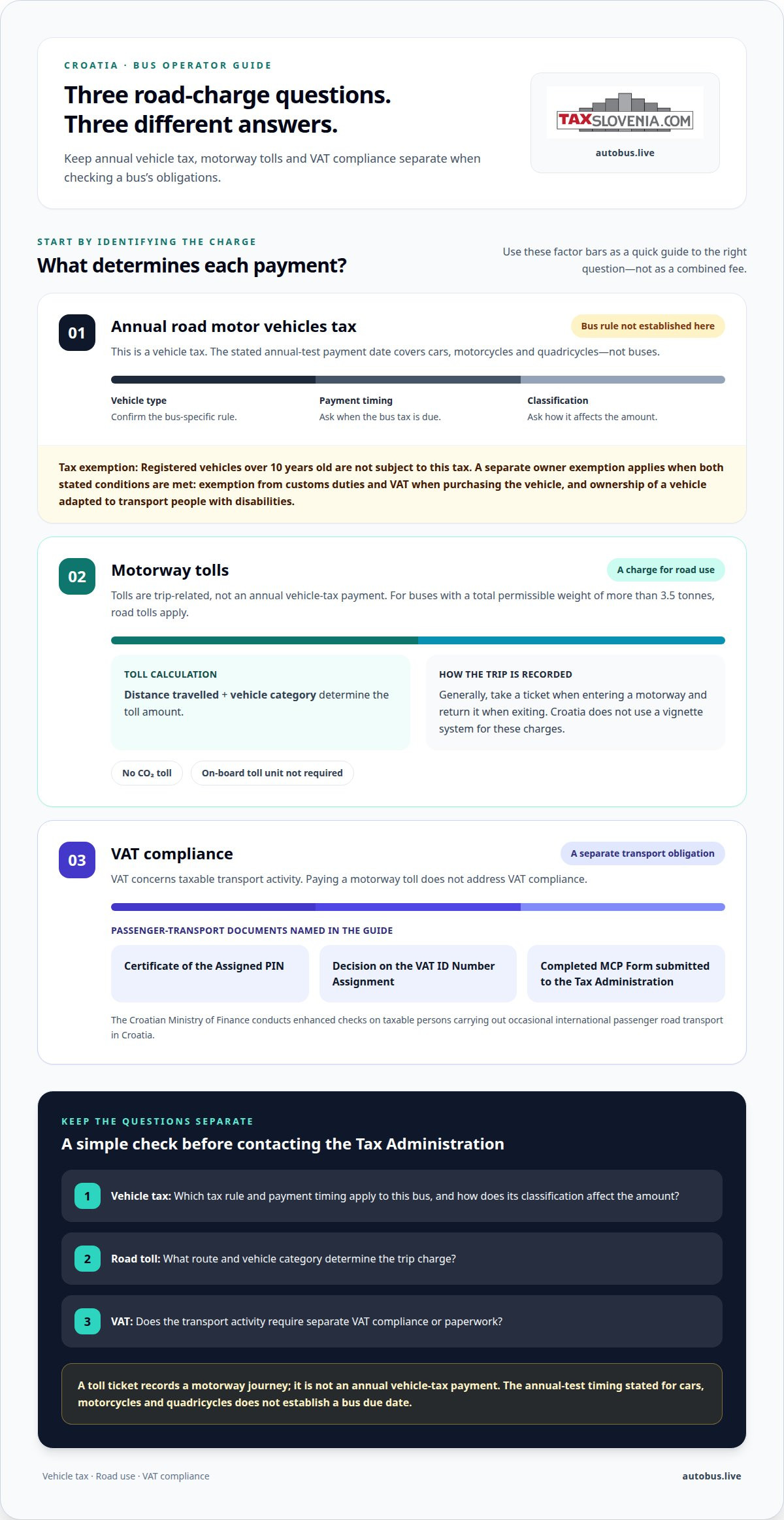
For registered cars, motorcycles and quadricycles in Croatia, road motor vehicles tax is payable annually on the date of the statutory annual test, when the log book is renewed. This timing rule does not establish a bus’s due date. To understand how to pay bus tax in Croatia, operators should distinguish vehicle tax from motorway tolls and ask the Croatian Tax Administration which payment obligation applies to their bus.
It’s understandable to expect one clear annual deadline, especially when planning cross-border passenger services. This guide explains what the Croatian annual tax timing rule does and does not cover, how it differs from road tolls, and what to ask the Tax Administration about payment.
The guide also explains the practical difference between vehicle tax and Croatia’s route-based tolls, so you can identify which payment question applies to your bus.
Key Takeaways
- Separate annual road motor vehicle tax from motorway tolls, which are calculated by route and vehicle category.
- The annual payment timing stated for cars, motorcycles and quadricycles does not establish a bus payment date.
- Identify which vehicle-tax and toll questions apply to your bus before contacting Croatia’s Tax Administration about payment.
- Foreign passenger transport operators can use the article’s guidance to understand Croatian road charges and tax obligations.
- For Croatian VAT registration support, TaxSlovenia and TaxCroatia provides a service relevant to foreign bus operators.
What taxes and fees apply to buses in Croatia?
Road motor vehicles tax is a vehicle tax, separate from charges for using Croatian roads. Before identifying a payment obligation, distinguish this tax from motorway tolls. The stated annual payment date for cars, motorcycles and quadricycles does not establish a bus’s payment date. For anyone asking how to pay bus tax in Croatia, identifying the charge is the first practical step.
Road tolls are charges for using certain Croatian roads, and their calculation depends on route and vehicle category. Buses with a total permissible weight of more than 3.5 tonnes are subject to road tolls. Croatia does not use a vignette system for these charges. Instead, drivers generally take a toll ticket when entering a motorway and return it when exiting, allowing the toll to be calculated.
The toll amount is based on the distance travelled and the vehicle category. Treat tolls as trip-related road charges, not as annual vehicle tax. Croatia has no CO₂ toll. An on-board toll unit is not required to use toll roads, so whether a bus has one does not determine its tax obligation.
Road motor vehicles tax exemptions are rules that remove the tax obligation for qualifying vehicles or owners. Registered vehicles over 10 years old are not subject to this tax. An owner is also exempt if both conditions below apply:
- The owner was exempt from customs duties and value-added tax when purchasing the vehicle.
- The owner has a vehicle adapted for transporting people with disabilities.
These conditions describe exemptions from road motor vehicles tax, not exemptions from tolls. For example, a vehicle’s age may affect its tax status, while using a tolled motorway remains a separate matter.
VAT is separate from road motor vehicles tax and motorway tolls. The Croatian Ministry of Finance conducts enhanced checks on taxable persons carrying out occasional international passenger road transport in Croatia to verify compliance with Croatian VAT regulations. This distinction matters because paying a road toll does not address VAT compliance.
Vehicles transporting passengers in Croatia must carry the Certificate of the Assigned PIN, the Decision on the VAT ID Number Assignment, and the completed MCP Form submitted to the Tax Administration. These documents relate to passenger transport and VAT compliance, not the calculation of motorway tolls. Keeping the categories separate helps operators identify whether a question concerns vehicle tax, a road charge, or VAT paperwork.
As a practical first step, classify each charge by purpose: annual vehicle tax concerns the vehicle, a toll concerns road use, and VAT concerns taxable transport activity. Then address each relevant obligation separately. The rules above explain toll treatment and certain vehicle-tax exemptions, but the annual-test date stated for cars, motorcycles and quadricycles should not be applied to buses without a bus-specific basis.
Keeping these categories separate also makes clear that the absence of a CO₂ toll in Croatia does not itself establish an exemption from road motor vehicles tax. An owner qualifies for that tax exemption when exempt from customs duties and value-added tax when purchasing the vehicle and owning a vehicle adapted for transporting people with disabilities. This exemption is distinct from the conditions governing motorway tolls.
How is annual road tax calculated for a bus in Croatia?
Road motor vehicles tax is a vehicle tax, distinct from motorway tolls. Croatia’s available tax figures cover cars, motorcycles and quadricycles, not buses, so they cannot be used as a bus tax rate. A car’s engine-power band and age do not establish the annual tax for a bus.
A tax category is the vehicle classification used to determine which tax rules apply. The listed Croatian tax examples give amounts for registered cars and motorcycles by engine power and age, and for quadricycles by engine power. They provide neither a bus amount nor a bus calculation formula. Do not estimate a bus’s annual vehicle tax by choosing a similar-looking car category.
Motorway tolls are separate charges calculated using the route and vehicle category. Buses with a total permissible weight of more than 3.5 tonnes are subject to road tolls. Drivers take a ticket when entering a motorway and return it when leaving, so the distance travelled contributes to the toll calculation. This does not calculate annual road motor vehicles tax.
The distinction matters for practical accounting. A bus travelling on a motorway may incur a route-based toll, while its annual vehicle-tax treatment remains a separate question. A toll ticket records a particular road journey, not an annual tax amount. Keep these items separate in transport records, and do not treat one payment as proof of the other.
Vehicle age is relevant to one stated tax rule: registered vehicles over 10 years old are not subject to road motor vehicles tax. This is an exemption condition, not a calculation formula for buses. The rule does not provide a rate for younger buses, nor does it explain how a bus’s annual amount would otherwise be determined. Do not substitute a car rate to fill that gap.
The annual payment date also needs careful interpretation. For a car, motorcycle or quadricycle, road motor vehicles tax is payable annually on the date of the statutory annual test, when the log book is renewed. That rule names those vehicle types. It does not establish a bus’s payment date and should not be applied to a bus without a bus-specific basis.
Before contacting the Croatian Tax Administration about a bus-specific calculation, separate the task into two questions:
- Ask which road motor vehicles tax rule and payment timing apply to the bus.
- Ask how the vehicle’s classification affects the tax amount.
- Keep any motorway toll calculation separate, using the route and vehicle category.
This approach avoids two common errors: using a passenger-car figure for a bus and confusing a road toll with annual tax. It also helps you put a clear question to the Tax Administration. Provide the vehicle details needed to identify the applicable bus category, then follow the payment information provided for that tax obligation. A toll amount cannot answer the annual vehicle-tax question.
No annual tax amount or calculation formula for buses is provided. Registered vehicles over 10 years old are exempt, but the tax for younger buses cannot be determined from the stated information.
You cannot calculate a bus’s annual road motor vehicles tax from the listed car, motorcycle or quadricycle rates. Ask the Croatian Tax Administration which tax rule applies and how the bus’s classification affects the amount.
Where can bus owners pay vehicle tax in Croatia?
A payment point is the office or channel that accepts a specific tax payment. For a bus in Croatia, ask the Croatian Tax Administration where and how to pay its road motor vehicles tax. The available annual payment timing rule covers cars, motorcycles and quadricycles, not buses. Do not assume the same payment location or process applies to a bus.
Start by identifying the charge you need to settle. Road motor vehicles tax concerns the vehicle, while a motorway toll concerns a particular journey. A toll ticket collected at a motorway entrance and returned at the exit is not an instruction for paying annual vehicle tax. Keeping the records separate helps direct your question to the right payment process.
When contacting the Croatian Tax Administration, state that your question concerns road motor vehicles tax for a bus. Include the vehicle’s registration country and the details needed to identify its classification. Ask which payment channel applies, where payment is accepted, and what reference or payment information is required. This keeps the response focused on the bus, rather than on a car, motorcycle or quadricycle.
Ask about payment timing in the same inquiry. The annual-test date rule applies to cars, motorcycles and quadricycles when their log books are renewed. It does not establish a bus deadline. Request the applicable due date and payment instructions directly from the Croatian Tax Administration instead of relying on a passenger-car example.
Keep each answer linked to the correct obligation. If the authority gives payment details for road motor vehicles tax, record them separately from motorway toll records and VAT paperwork. For example, a motorway toll receipt documents road use, while the Certificate of the Assigned PIN, the Decision on the VAT ID Number Assignment, and the completed MCP Form submitted to the Tax Administration relate to passenger transport requirements. None is proof of annual vehicle-tax payment.
A clear inquiry can follow these steps:
- Identify the vehicle as a bus and specify that the question concerns road motor vehicles tax.
- Ask the Croatian Tax Administration for the payment location or channel and the applicable due date.
- Request the payment reference and any instructions needed to make the payment correctly.
- Keep the authority’s payment details with the bus’s tax records, separate from route toll receipts.
If you manage several vehicles, make each inquiry specific to the bus concerned. Its registration details can help distinguish it from other vehicle classes, while the company’s transport activity may raise separate VAT questions. Croatia’s enhanced checks on taxable persons carrying out occasional international passenger road transport concern VAT compliance, not where vehicle tax is paid.
In short, ask the Croatian Tax Administration where and how to pay bus-specific road motor vehicles tax. Do not use a toll booth as a vehicle-tax payment channel or apply the annual-test procedure for cars, motorcycles and quadricycles to a bus. Request the bus’s payment instructions directly and keep the response with the relevant tax records.
Ask the Croatian Tax Administration where and how to pay a bus’s road motor vehicles tax, and request its due date and payment instructions.
Do foreign-registered buses pay Croatian road or vehicle taxes
A foreign-registered bus is registered outside Croatia and operates on Croatian roads. Its registration country alone does not answer every tax question. Distinguish Croatian road tolls from annual road motor vehicles tax, then consider VAT obligations separately. Each charge has a different purpose and depends on different facts.
A road toll is a charge for using a tolled road in Croatia. The stated rule is based on vehicle weight, not the bus’s registration country. On motorways, drivers take a ticket on entry and return it on exit, so the toll reflects the route travelled.
Road motor vehicles tax is a separate vehicle-related tax. The information available here does not establish a specific annual tax rule or calculation for foreign-registered buses. The annual statutory-test payment date applies to cars, motorcycles and quadricycles, and should not be treated as the bus rule. Likewise, the stated exemption for registered vehicles over 10 years old does not, by itself, resolve the tax position of a foreign-registered bus.
For vehicle tax, contact the Croatian Tax Administration with the bus’s registration country and vehicle details. Ask whether Croatian road motor vehicles tax applies, which rule determines the amount, and where to pay. Ask separately about the due date. This keeps the inquiry focused on the bus rather than relying on car or motorcycle examples.
VAT is a separate compliance matter from road charges and annual vehicle tax. The Croatian Ministry of Finance conducts enhanced checks on taxable persons carrying out occasional international passenger road transport in Croatia to verify compliance with Croatian VAT regulations. A foreign registration plate does not remove the need to understand VAT requirements connected with passenger transport activity.
Vehicles transporting passengers in Croatia must carry the Certificate of the Assigned PIN, the Decision on the VAT ID Number Assignment, and the completed MCP Form submitted to the Tax Administration. These documents relate to passenger transport compliance; they are not proof of vehicle-tax or motorway-toll payment. Keep each record with the relevant obligation.
Use these steps to direct each question:
- For motorway use, identify the bus’s total permissible weight and the route travelled.
- For annual vehicle tax, give the Croatian Tax Administration the bus’s registration and vehicle details, then ask about applicability, amount, payment channel, and due date.
- For international passenger transport, address VAT compliance separately from tolls and vehicle tax.
For example, a foreign-registered bus weighing more than 3.5 tonnes may incur Croatian road tolls when using tolled roads. That fact does not establish its annual vehicle-tax treatment. Nor does settling a toll resolve VAT compliance. Treating these as separate questions gives operators a clearer basis for handling Croatian road use and tax obligations.
For annual vehicle tax, give the Croatian Tax Administration the bus’s registration country and vehicle details. The car figures below are examples only and do not establish a bus’s tax or tax amount.
In Croatia, a registered car with engine power up to 55 kW and less than 2 years old is subject to a road motor vehicles tax of 40,00 EUR. A registered car with engine power up to 55 kW and between 2 and 5 years old is subject to a tax of 33,00 EUR; between 5 and 10 years old, the tax is 27,00 EUR. A registered car with engine power over 55 kW and up to 70 kW that is less than 2 years old is subject to a tax of 53,00 EUR. For a registered car with engine power over 70 kW and up to 100 kW that is less than 2 years old, the tax is 80,00 EUR. For a registered car with engine power over 100 kW and up to 130 kW that is less than 2 years old, the tax is 119,00 EUR. These car amounts should not be used as a bus calculation.
TaxSlovenia and TaxCroatia: VAT registration in Croatia
TaxSlovenia and TaxCroatia provides VAT registration in Croatia for foreign bus companies operating international passenger transport. This service is relevant when Croatian operations raise VAT registration requirements, separate from motorway tolls and vehicle tax.
The Croatian Ministry of Finance conducts enhanced checks on taxable persons carrying out occasional international passenger road transport to verify compliance with Croatian VAT regulations. VAT registration support can help address this part of your Croatian compliance, alongside the vehicle-tax questions discussed above.
If you need support with VAT registration in Croatia for your passenger transport activity, contact TaxSlovenia and TaxCroatia.
Set up your next compliance step
Planning how to pay bus tax in Croatia starts with directing the vehicle-tax question to the Croatian Tax Administration and keeping it separate from VAT registration needs. Once you understand the relevant Croatian obligations, consider whether your company also needs support with its Slovenia operations. The next administrative step depends on where your passenger transport operates and which reporting tasks apply.
TaxSlovenia and TaxCroatia offers VAT registration in Slovenia, a Slovenia route report, and a Slovenia tax report. These services are relevant if your transport activity also involves Slovenia, and are separate from Croatian bus vehicle-tax payments.
For support with the appropriate tax or reporting service, contact TaxSlovenia and TaxCroatia and outline the countries and compliance tasks relevant to your operations. A clear description of your next requirement helps you move forward with the right administrative work.
Frequently Asked Questions
How do I pay?
Ask the Croatian Tax Administration which payment method and reference apply to your bus. State that the payment concerns road motor vehicles tax, then provide the vehicle details needed to identify it. If your records include both motorway toll receipts and tax documents, make clear that your question is about vehicle tax, not a journey’s toll. Keep the payment instructions with the records for that bus.
When is bus vehicle tax due in Croatia, and how often is it paid?
The annual-test payment date described for cars, motorcycles and quadricycles does not establish a bus’s due date or payment frequency. Ask the Croatian Tax Administration for the bus-specific timing and whether payment is annual. Provide the vehicle details and record the applicable deadline separately from route toll payments. This avoids applying another vehicle type’s schedule to your bus.


