

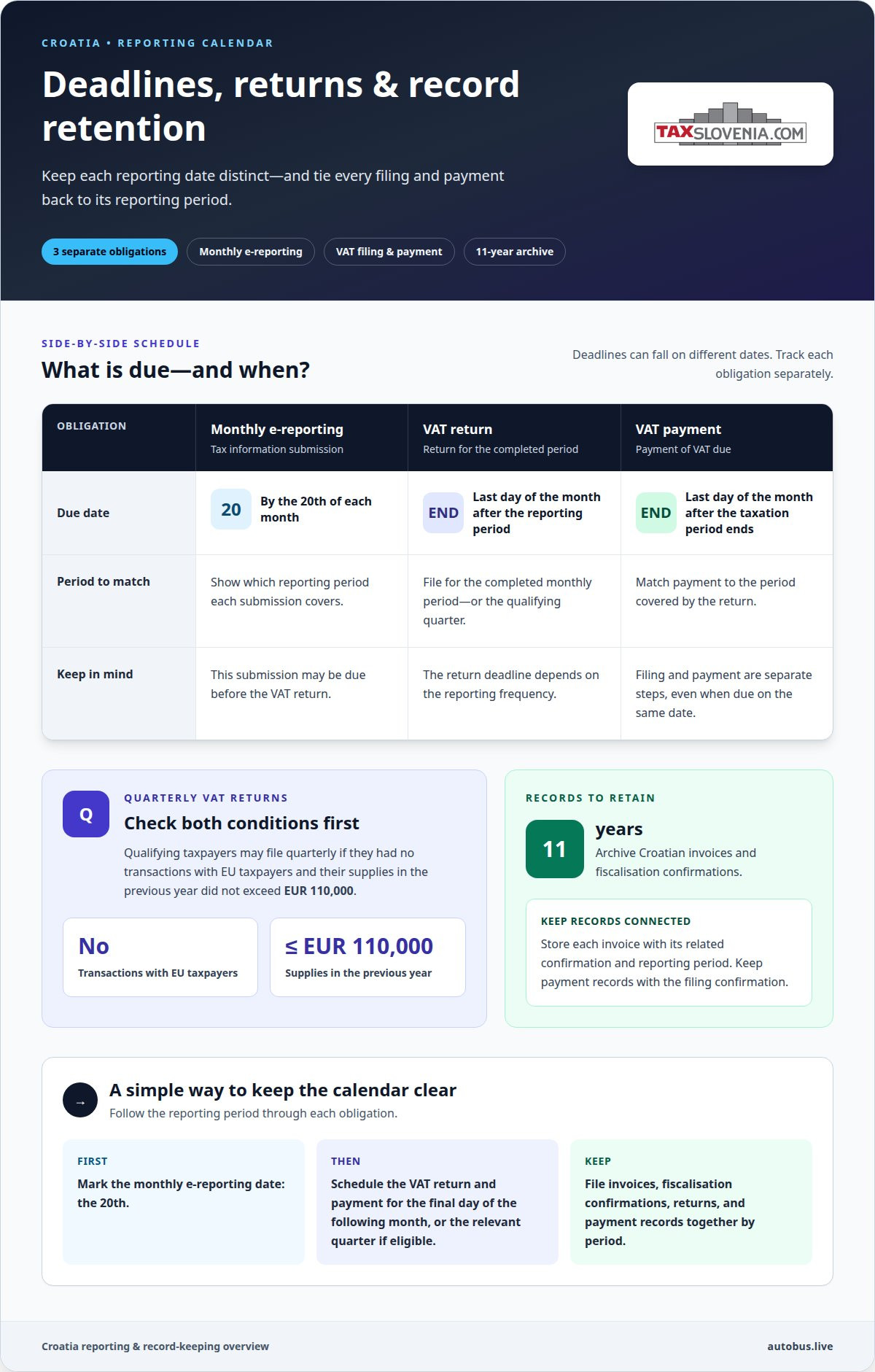
Keeping track of Croatia’s reporting deadlines and record-keeping duties can be difficult. Monthly e-reporting submissions are due by the 20th of each month, while monthly VAT returns and payment are generally due by the last day of the following month. Invoices and fiscalisation confirmations must be archived for 11 years. This guide helps you navigate these requirements.
For foreign passenger carriers, Croatia bus tour tax reporting fees are only one part of planning a tour. Organise reporting around the trips operated, keep supporting invoices and confirmations together, and apply the relevant VAT treatment to each transport activity.
This guide explains the reporting timetable, invoice archiving and the compliance risks that can arise when duties are missed. It also covers how VAT rules apply to foreign passenger carriers and what to consider when planning reporting support. Any service fee depends on the reporting needs, including the reporting frequency and registration work involved, and is provided after a quote request.
Key Takeaways
- Determine whether your reporting schedule is monthly or whether your business qualifies for quarterly VAT returns.
- Assess registration duties by considering your Croatian supplies, customer types and how the services are arranged.
- Classify bus transport and sightseeing services correctly before applying the relevant VAT treatment.
- Understand the rules that apply to foreign passenger carriers and when Croatian VAT registration or reporting support may be relevant.
Reporting deadlines and invoice archiving
Croatia has separate deadlines for VAT returns, other monthly e-reporting, VAT payments, and record retention. Track each obligation by reporting period because the deadlines do not all fall on the same day.
VAT Return Filing Deadlines
A VAT return deadline is the final date for submitting a return for a completed taxation period. Croatian taxpayers generally file monthly VAT returns electronically by the last day of the month following the reporting month.
For example, a return for a monthly reporting period is due by the final day of the next month. Qualifying taxpayers may file quarterly if they had no transactions with EU taxpayers and their supplies in the previous year did not exceed EUR 110,000. These conditions affect filing frequency, so they should be considered before setting a recurring return schedule.
VAT Reporting Deadlines
VAT reporting deadlines are the dates for submitting required tax information, which can differ from the VAT return date. Croatian monthly e-reporting submissions are due by the 20th of each month.
This means a business may have a monthly reporting submission due before its VAT return. A practical calendar should show both dates separately and identify the period each submission covers. Keeping the reporting period visible helps prevent a filing date from being confused with the month in which a bus tour took place.
VAT Payment Deadlines
A VAT payment deadline is the final date for paying the VAT due for a taxation period. Croatian VAT must be paid by the last day of the month following the end of the monthly or quarterly taxation period.
Match each payment to the period covered by the return and save the payment record with the filing confirmation. For quarterly taxpayers, calculate the deadline from the end of the relevant quarter. Filing and payment are separate steps, even when their deadlines coincide.
Invoice Archiving
Invoice archiving is the retention of invoices and supporting fiscalisation confirmations for later reference. Businesses must archive Croatian invoices and fiscalisation confirmations for 11 years.
Keep each invoice with its related confirmation and reporting period. A consistent archive makes it easier to trace a tour-related transaction from its supporting document to its filing. Retain the underlying records as well as the submitted return.
Comparing Croatia with Neighboring Countries
Croatia sets specific dates for returns, monthly e-reporting, payments, and record retention. When comparing obligations across countries, consider filing frequency, deadlines, payment rules, and archive requirements separately, rather than treating operating fees as a single comparable charge.
For a cross-border tour, map the obligations separately for each country on the route. The reporting workload depends on the jurisdictions involved and the operator’s reporting arrangements, not simply on the distance travelled.
Compliance risks and implementation options
A compliance risk arises when a tax obligation is missed or classified incorrectly, affecting registration, reporting, or invoicing. For a foreign bus operator, first distinguish passenger transport from travel services sold as a package. Croatian rules can treat travel-agent operations differently from a carrier’s transport service.
A VAT registration threshold is the supply value that triggers entry into Croatia’s VAT system for a domestic taxpayer. A domestic taxpayer must enter the system when supplies exceed EUR 60,000 in the previous or current calendar year. This threshold should not be applied automatically to every foreign operator; the taxpayer’s status and activity are relevant.
Reverse charge is a VAT mechanism under which the customer accounts for VAT on a qualifying supply. Article 75, Paragraph 2 provides for reverse-charge treatment when a non-EU travel agent, not registered for Croatian VAT, supplies services to a Croatian taxable person. In that situation, the supplier’s registration position and the customer’s taxable status shape the reporting treatment.
The Croatian Tax Administration clarified special VAT procedures for travel agencies and tour operators from non-EU countries on June 9. A separate registration route applies when a non-EU travel operator sells Croatian services to non-taxable customers: it must register for Croatian VAT or register in an EU member state to use the OSS procedure under Articles 119 to 125 of the Croatian VAT Law. Customer type therefore needs to be classified before selecting a reporting route.
Fiscalisation is the electronic reporting process connected with invoices. From 1 January 2026, Croatia requires mandatory e-invoicing and real-time reporting in the B2B and B2G spheres. In self-billing arrangements, fiscalisation must occur within five working days after invoice issuance. Operators using self-billing need a process that captures the issue date and routes each invoice for timely fiscalisation.
An implementation option is an in-house compliance system that manages invoice data, reporting, and submission records. The initial build of such a Croatian e-invoicing system is estimated at six to 12 months. That development period makes early planning important for businesses preparing internal workflows, staff responsibilities, and system changes before the requirements apply.
Organise reporting around clear procedures and responsibilities, whether your team handles the work internally or uses administrative support. Identify customer types, the service supplied, and the invoicing process, then map each category to its registration and reporting route. Keep return confirmations, invoice records, and fiscalisation confirmations together so transactions can be traced from sale through reporting.
These checks help distinguish registration issues from invoicing or reporting issues. The appropriate process depends on the operator’s transactions, customer types, and billing arrangements.
VAT rules for foreign passenger carriers
A foreign passenger carrier is a taxable person not established in Croatia that conducts occasional international road passenger transport there. Croatian VAT rules set specific instructions for these carriers, so both the service and the operator’s place of establishment matter.
Bus tours do not automatically charge or collect tourist tax from passengers under the VAT rules discussed here. VAT and tourist tax are separate matters. Identify the service and the responsible party before describing a passenger charge as tourist tax.
A passenger-carrier VAT rule concerns transport supplied in Croatia by an operator established elsewhere. For occasional international road transport, distinguish the carrier’s passenger transport from accommodation or other services arranged as part of a tour. Clear service descriptions help keep the tax treatment consistent in records and invoices.
The travel-agent special scheme is a VAT method for qualifying travel services, not a general rule for every bus tour. It applies to taxpayers who deal with customers on their own account and use goods or services supplied by other taxpayers for travel services. Taxpayers who work only as intermediaries are excluded from Croatia’s special VAT procedures.
Article 187 of Croatia’s VAT Ordinance is one provision identified for travel-agency VAT calculation. Paragraph 6 of Article 187 states that the special travel-agent taxation scheme does not apply when the taxpayer’s headquarters or permanent establishment providing the service is outside the European Union. Croatia amended Article 187 of its VAT Ordinance with effect from January 5, 2021. The carrier’s establishment and role therefore matter when distinguishing transport from packaged travel services.
A passenger-luggage VAT exemption is an exemption for qualifying goods carried by passengers. The total supply value must exceed EUR 100 including VAT, and the goods must be transported outside the EU within three months after the month in which the supply was carried out. Both conditions matter. A carrier reviewing a luggage-related transaction should keep the supply details and evidence of the transport outside the EU together.
Accommodation is a separate service whose VAT place of taxation follows the location of the hotel under Article 19 of Croatia’s VAT Act. For example, accommodation in a Croatian hotel is treated differently from a bus journey merely passing through the country. If a tour combines transport and hotel services, identify each component before applying the rules.
For a practical review, classify the operator as a carrier, travel-service supplier, or intermediary. Record where the operator is established, who contracts with the customer, and whether another taxpayer supplies travel services. These details help determine which Croatian VAT rules apply without treating every tour as the same transaction.
What is Croatia's VAT rate for bus tours and sightseeing services?
A VAT rate is the percentage applied to a taxable supply. Croatia’s general VAT rate is 25%, but a bus tour’s treatment depends on what the operator supplies and whether special travel-service rules apply.
For a straightforward taxable service, the general rate provides the starting point. Croatia’s standard VAT rates include 0%, 5%, 13%, and 25%. The reduced rates and zero rate apply to specified supplies, so a rate used for another service should not automatically be applied to passenger transport or sightseeing.
A sightseeing service is an organised activity that gives passengers access to a tour or visit. Assess its VAT treatment by identifying the actual supply, rather than relying only on terms such as “tour” or “excursion” in a booking description. Keep the service description consistent across the itinerary, invoice, and tax records.
A combined tour supplies more than one travel-related service together, such as bus transport and hotel accommodation. The components and the way the package is treated affect the VAT analysis, so do not automatically apply the accommodation rate to the transport element.
Croatia’s travel-agency rules are relevant when a taxpayer deals with customers on its own behalf and uses goods or services supplied by other taxpayers for travel services. Articles 91 to 94 of Croatia’s VAT Act and Article 187 of its VAT Ordinance generally regulate VAT calculation for travel-agency operations. These provisions concern qualifying travel services, not every carrier’s separate bus journey.
A single-service package is a package treated as one supply for VAT purposes. In Croatia’s travel-package example, accommodation is treated as the main service and taxed at 13% when the package is treated as a single service. This example illustrates how the main service can affect a package’s treatment; it does not establish a 13% rate for bus tours.
Accommodation VAT follows the location of the hotel under Article 19 of Croatia’s VAT Act. A hotel stay in Croatia is therefore distinct from transport through Croatia. When an itinerary includes both, record the service components clearly so the accommodation example is not confused with the bus service.
To classify a sightseeing sale, first establish whether the invoice covers passenger transport alone or a package involving other suppliers. Then determine whether the operator acts as a carrier, intermediary, or travel-service supplier. These details help establish whether the general rate or a relevant special treatment applies.
For budgeting, keep VAT due on the service separate from administrative reporting fees. The VAT amount depends on the taxable supply and its applicable treatment; reporting costs relate to the work required to meet filing obligations. Separating these amounts makes invoices and tour-level cost records easier to understand.
How are Croatia bus tour taxes reported and paid, and when are deadlines?
A VAT return is an electronic filing that reports VAT for a taxation period. Croatian taxpayers generally submit monthly returns by the last day of the month following the reporting month. VAT payment is due by the last day of the month after a monthly or quarterly taxation period ends.
A reporting period is the span of activity covered by a return. Begin by identifying whether the applicable period is monthly or quarterly, then group the relevant transactions and records accordingly. Qualifying taxpayers without transactions with EU taxpayers, whose previous-year supplies did not exceed EUR 110,000, may file quarterly. This affects the return and payment calendar.
Monthly e-reporting is a separate submission timetable. Croatian monthly e-reporting submissions are due by the 20th of each month, so a calendar should distinguish this date from the VAT return and payment deadlines. For each submission, record the reporting month, submission date, and confirmation. This makes it easier to trace a filing to the period it covers.
Payment reconciliation means matching the VAT paid with the amount reported for the same period. After filing, record the return total and related payment together. For a quarterly period, use the quarter-end to determine the following-month payment deadline. For a monthly period, match the payment to that month’s return.
An excess VAT credit is the amount by which deductible VAT exceeds VAT due. Croatia’s Tax Administration must refund excess VAT within 30 days of the VAT return being submitted, and no later than 90 days after a tax inspection is initiated. Keep the filed return and related records together to connect a refund to its reporting period.
Invoice records support the figures included in the return. Croatian invoices and fiscalisation confirmations must be archived for 11 years. A practical archive can group documents by reporting period and retain invoice confirmations alongside the corresponding transaction records. This helps link reported amounts to their underlying records if a return needs review.
A reporting calendar is a schedule that tracks submissions, payments, and supporting records by period. Set separate entries for the 20th monthly e-reporting deadline, the return deadline, and the related payment deadline. Add the relevant month or quarter to each entry, rather than relying on a single recurring reminder.
For bus operators, reporting is easier to follow when each Croatian transaction can be traced from its source record to the return and payment. Use consistent period labels across invoices, filing confirmations, and payment records. Repeat the same steps each cycle, following the business’s applicable monthly or quarterly period.
TaxSlovenia and TaxCroatia
TaxSlovenia and TaxCroatia provides VAT registration in Croatia for foreign bus operators. Registration is a practical step when an operator’s activities require it before managing local reporting duties. Keep the registration records with the tax documents and filings to establish a clear starting point.
For operators running tours across borders, obligations depend on where services are supplied and how the business operates. TaxSlovenia and TaxCroatia also prepares route reports before trips and tax reports after journeys in Slovenia, helping companies manage reporting requirements across both countries.
If you need support with Croatian VAT registration for your passenger transport activities, contact TaxSlovenia and TaxCroatia to discuss the next step.
Plan the next reporting cycle
Use your next reporting cycle to turn the rules into a clear internal process. Assign responsibility for classifying each service, maintaining supporting records, and coordinating submissions. This makes it easier to budget for Croatia bus tour tax reporting fees alongside the administrative work, without confusing service charges with VAT payable.
For operators working across Croatia and Slovenia, TaxSlovenia and TaxCroatia provides VAT registration in Slovenia, a Slovenia route report, and a Slovenia tax report. These services support the Slovenian side of cross-border operations while you manage Croatian requirements separately.
If you need help identifying an appropriate next step for your business, contact TaxSlovenia and TaxCroatia. A defined process can make the next reporting cycle easier to organise.
Frequently Asked Questions
How can your business achieve compliance in Croatia?
Before assigning Croatian tax treatment, identify each service, customer type, and transaction. Keep the contract, itinerary, invoice, and evidence of third-party travel services together. For example, distinguish a transport-only booking from a package that includes accommodation. This classification helps clarify whether the carrier or another party has the relevant reporting responsibility.
What happens if you’re not compliant?
If a compliance issue arises, address the underlying filing or payment matter under the applicable Croatian tax rules. The response depends on what went wrong, such as an omitted transaction, inaccurate classification, or missed submission. Keep the affected records and correspondence together, identify the reporting period, and correct the underlying process. The consequences depend on the specific breach.
What taxes apply to bus tours in Croatia?
VAT is the main tax consideration addressed for Croatian bus-tour transactions, but the applicable treatment depends on the supply. Croatia’s general VAT rate is 25%, alongside specified rates of 0%, 5%, and 13%. For operators budgeting Croatia bus tour tax reporting fees, distinguish the tax due on a service from the administrative costs of reporting. A transport-only service should not automatically receive a rate associated with accommodation or another supply.
Are bus tour operators in Croatia required to register for VAT?
Registration depends on the operator’s status, supplies, and customer type. Croatia’s EUR 60,000 threshold applies to a domestic taxpayer whose supplies exceed that amount in the previous or current calendar year; it is not a blanket test for every foreign carrier. A foreign operator should assess whether it supplies Croatian services to taxable or non-taxable customers and whether its activity triggers local registration or another reporting route.
What tax reporting obligations apply to foreign bus tour operators in Croatia?
Foreign operators need to identify which Croatian VAT obligations apply to their activities and keep records supporting the treatment used. The relevant distinction may be whether the business supplies passenger transport, acts only as an intermediary, or sells travel services using other suppliers. A transport invoice and a package itinerary, for example, provide different context. Include Croatia bus tour tax reporting fees in operational budgets, separately from VAT payable.
What penalties apply for late or incorrect tax reporting by Croatian tour operators?
Penalties depend on the specific reporting breach and the Croatian rule that applies. Late submission, incorrect information, and unpaid VAT are different issues, so one penalty amount cannot cover every case. Identify the affected return or transaction, retain the related records, and address the error through the appropriate tax process. Do not estimate a penalty based on another operator’s circumstances.


