
A VAT filing error can create more than a correction for a bus operator. In Slovenia, penalties for incorrect bus VAT filing depend on the breach, and late VAT returns can lead to fines ranging from €2,000 to €125,000. Incorrect, incomplete, or misleading returns can also attract penalties.
It’s understandable to want a clear picture of the risk when reporting cross-border journeys involves unfamiliar tax requirements. This article explains which filing errors may lead to sanctions, why penalties vary, and what practical steps can help reduce the risk.
You’ll also learn how filing deadlines and reporting obligations fit together, where errors can arise, and what accurate, timely reporting involves for international bus operations in Slovenia.
Key Takeaways
- Understand how the type of VAT filing error and the business’s legal status can affect potential penalties.
- Learn why accurate invoices and complete VAT records matter, and how long Slovenian VAT records generally need to be retained.
- See how filing periods, deadlines, and electronic reporting fit together in Slovenia’s VAT compliance process.
- Recognize how incorrect VAT treatment and repeated noncompliance can create additional tax and penalty risks.
- Find out how VAT registration, route reports, and tax reports can support foreign bus companies operating in Slovenia.
Penalties for incorrect or incomplete returns
Incorrect Slovenian VAT returns can lead to fines. The amount depends on the type of taxpayer and the kind of mistake. Filing complete, on-time returns and keeping supporting records can help operators catch and correct errors early.
Penalties for Missing VAT Returns
A missing VAT return is one that a taxpayer does not submit on time or in the required way. Late filing can lead to a fine of €2,000 to €125,000, depending on the taxpayer’s legal status. A missed return can lead to a separate penalty, even if no VAT would have been due.
Underreported VAT and Incorrect Refunds
Underreporting VAT means reporting less VAT than is due. An incorrect refund claim asks for money the taxpayer is not entitled to. Slovenian rules allow fines for VAT returns that are incorrect, incomplete, or misleading. For bus operators, mistakes in reported income, expenses, or VAT they claim back can make a return inaccurate.
Do not assume the fine is a fixed percentage of the underreported amount. It depends on the type of mistake and the taxpayer category. An incorrect return may also prompt a closer look at the reported figures and supporting records.
Calculating Fines by Taxpayer Type
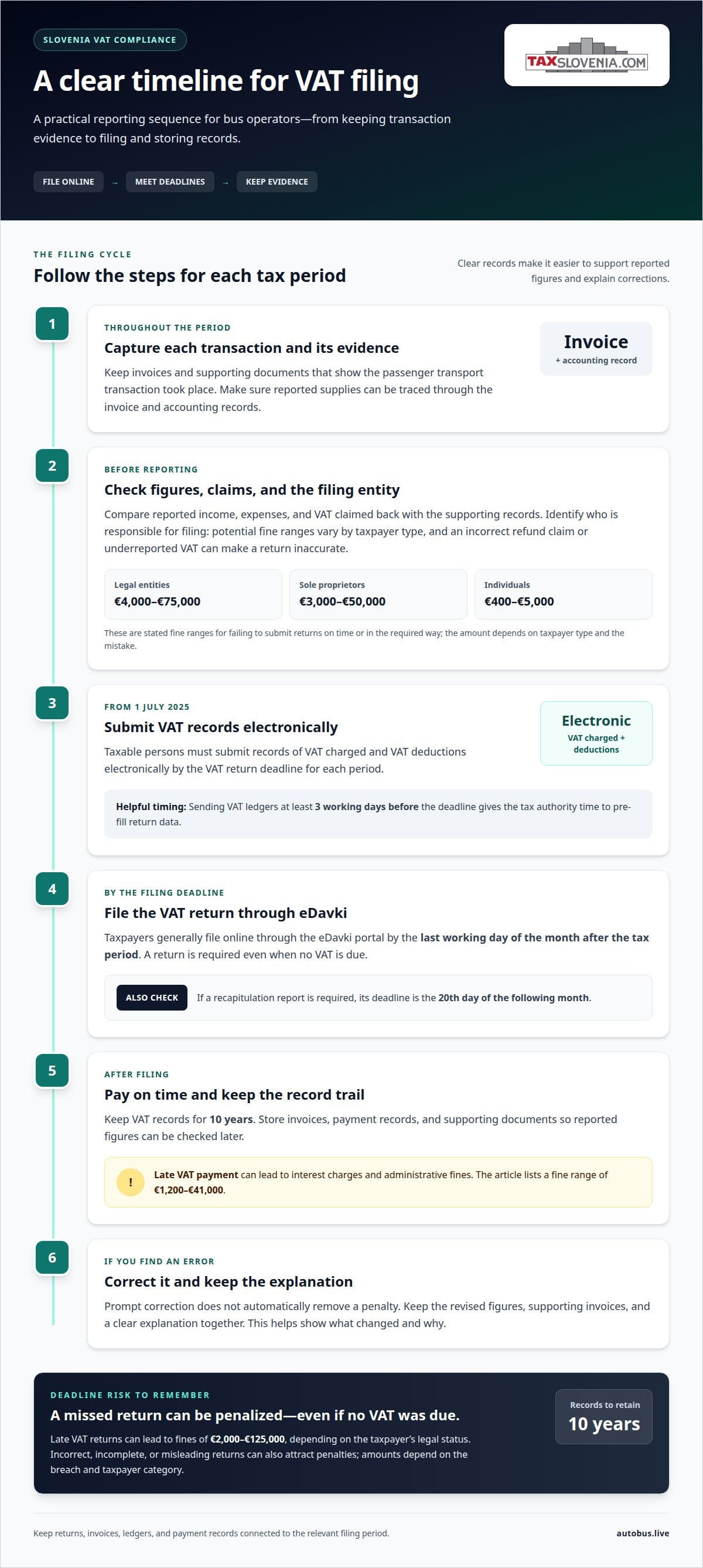
Slovenian fines vary for businesses, sole traders, and individuals who do not submit returns on time or in the required way. Legal entities face fines of €4,000 to €75,000; sole proprietors face €3,000 to €50,000; individuals face €400 to €5,000. These ranges show why it matters to identify who is responsible for filing when assessing an error.
For passenger bus transport, Slovenia’s standard VAT rate is 22%, and its reduced rate is 10%. These general rates do not determine the VAT treatment of every passenger transport transaction, so the route and transaction details matter when preparing a return.
Voluntary Disclosure and Prompt Correction
Prompt correction means fixing an error once you find it, rather than leaving incorrect figures in a filed return. Correcting the return does not automatically remove a penalty. Keep the revised figures, supporting invoices, and an explanation together so it is clear why you made the change.
Taxpayers generally file VAT returns online through the eDavki portal by the last working day of the month after the tax period. Taxpayers who must submit a recapitulation report must file by the 20th day of the following month. Slovenian taxpayers must file a return even when no VAT is due.
From 1 July 2025, taxable persons must submit records of VAT charged and VAT deductions electronically by the VAT return deadline for each period. Sending VAT ledgers at least three working days before that deadline gives the tax authority time to pre-fill return data. Keep VAT records for 10 years, according to PISRS, Slovenian Legal Information System.
Late VAT payment can lead to interest charges and administrative fines; the listed fine range is €1,200 to €41,000. The Financial Administration of the Republic of Slovenia handles VAT administration, including filing requirements. If you disagree with a penalty decision, check the appeal process and deadline stated in the decision. Use the return, invoices, and payment records to support your case.
Minor, serious, and very serious VAT infringements
For a bus operator, a VAT infringement could mean reporting the wrong figures, keeping incomplete records, or using invoices that don’t meet the rules. The terms “minor,” “serious,” and “very serious” describe how severe a breach is, but each term does not come with a fixed fine. In Slovenia, the possible fine depends on the type of breach and the taxpayer’s legal category, such as the kind and size of the business.
Invoice and record-keeping duties are just as important as filing the return. A company that doesn’t issue or keep invoices that meet VAT rules may face penalties under Slovenian VAT legislation. For example, if passenger transport is recorded without the invoices or other documents to support it, it may be difficult to prove the transaction took place. This is a separate issue from whether the return was filed quarterly or on another schedule.
For VAT accounting and record-keeping breaches, businesses that are legal entities, that is, organizations treated as separate from the people who run them, may face fines from €4,000 to €75,000. Medium-sized or large-sized companies may face fines from €10,000 to €125,000. These ranges show why a company’s classification matters when working out the possible consequences of a records breach. They are not automatic fines for every error.
The responsible person, the individual in charge of the company’s compliance, may also face a separate fine. For a legal entity, the stated range is €1,000 to €10,000; for a medium-sized or large-sized company, it is €1,200 to €10,000. This means a VAT accounting or record-keeping problem can affect both the organization and the person responsible for making sure it follows the rules.
To assess an error, first identify what happened and which records support the transaction. Separate an incorrect supply value from a missing invoice or an incomplete ledger entry, then connect each issue to the relevant filing period and taxpayer. This gives a clearer picture than relying on broad labels such as “minor” or “serious.”
VAT registration does not remove the need to make sure transaction records match the returns. A foreign operator should be able to trace each reported supply through its invoice and accounting records. If an entry is corrected, keep the revised information with its supporting documents. This shows what changed and helps distinguish a one-off reporting error from a wider record-keeping problem.
Review invoices, accounting entries, and reported transactions together. Possible fines vary substantially by company size and the responsible person’s status, so assuming every infringement has the same consequence can give a misleading picture of the risk. Clear documentation helps show the nature and scope of an error.
VAT filing and compliance practices
Slovenian VAT compliance involves registering, filing returns, keeping VAT records, and paying on time. Keeping these steps in sync helps international bus operators avoid leaving out taxable transactions from a trip or reporting them in the wrong period.
The Financial Administration sets filing requirements when a business registers for VAT. It may change them if the business’s turnover or activities change. Returns are generally filed monthly. Businesses with taxable turnover of no more than €210,000 per year file quarterly. Newly registered businesses file monthly during their first 12 months, and non-resident companies file monthly. This means a company’s filing schedule isn’t based only on its trip schedule.
Taxpayers file VAT returns online through the eDavki portal. Under Article 88 of Slovenia’s Value Added Tax Act, returns are due by the last working day of the month after the tax period. Taxpayers who must also submit a recapitulation report, a summary of certain cross-border transactions, file it by the 20th day of the following month. A return is still required even when no VAT is due for that period.
From 1 July 2025, taxable persons must submit electronic records of the VAT they charge and the VAT they deduct by the VAT return deadline for each tax period. Slovenian VAT ledgers, which record these amounts, are generally submitted monthly, along with VAT returns. If the tax authority sets a quarterly or annual return deadline, the ledgers follow that schedule. This means ledger reporting follows the taxpayer’s assigned filing schedule.
Submitting VAT ledgers at least three working days before the return deadline allows the tax authority to fill in some return details in advance. The process is straightforward: organize transaction records, submit the ledger, then prepare the return using the available data. Check that the pre-filled details match the business’s own records, including taxable sales and deductible VAT.
OSS (One Stop Shop) or IOSS (Import One Stop Shop) VAT calculations can be corrected only within the specified deadline. An overpayment may instead be reclaimed under general tax-procedure rules. For other Slovenian VAT returns, the correction process depends on the type of return. So, if you find an error, the filing method and reporting period matter.
Payment has its own deadline. VAT due is generally payable by the last working day of the month after the reporting period. A bank transfer counts as paid on the day the payment service provider processes the order, not the day the taxpayer sends it. Allow for processing time and holidays when scheduling payment. Late payment may lead to interest charges and administrative penalties.
Before filing, make sure the return, ledger, invoices, and payment record all match the same tax period. For example, a quarterly filer should use the same quarter for the ledger and return, and check that each reported charge relates to the correct taxable sale. Keeping these records together helps ensure consistent reporting in Slovenia.
Incorrect application of VAT
Using the wrong VAT treatment can affect an invoice, the amount reported, and the return for that period. In Slovenia, the standard VAT rate is 22%, and the reduced rate is 10%. But you can’t tell which treatment applies to passenger transport just by looking at those rates.
Keep the details of the transaction separate from the details of the route. A bus journey may include different services or charges, so the invoice description should say what was actually provided. For example, don’t put a transport charge and a separately recorded service under one description if they are different transactions. Clear descriptions make it easier to check how VAT was handled.
Invoicing errors can happen when a business uses a rate that doesn’t fit the transaction or records a taxable supply as exempt. A “taxable supply” is a sale or service on which VAT is due. “Exempt” means VAT isn’t charged. These aren’t the same thing. The return should match the treatment in the original records, not a label copied from an earlier invoice or documents from another country.
For each reporting period, review these points:
- Identify the service shown on each invoice and the related transaction.
- Check that the VAT treatment and rate match that service.
- Compare invoice totals with the amounts in the accounting records.
- Confirm that each transaction is included in the right return period.
- Keep each invoice with its supporting records for later review.
This review can help you find where an incorrect charge started. If the invoice is wrong, changing only the VAT return can leave your records inconsistent. If the invoice is correct but the return entry is different, the issue may be with transferring data or reporting it. Finding the cause helps you make a more accurate correction.
For cross-border bus operations, don’t assume that a VAT decision made in one country also applies in another. A route may cross several jurisdictions, but this section covers Slovenian VAT treatment. Keep Slovenian transaction entries separate from records prepared for other countries, and note the reporting period for each entry.
Slovenia’s Value Added Tax Act, VAT-1, came into force on 1 January 2007. But the Act doesn’t make every transport invoice clear on its own. The transaction and its documents still need to be handled consistently. One useful check is to review new types of invoices before using them regularly, especially when a charge or service description changes.
When you find an error, work out whether it involves the transaction type, rate, invoice, or return entry. Then make sure the supporting records match the correction. Otherwise, the original mismatch may remain even after you change a figure.
Sanctions for repeated noncompliance or tax evasion
Repeated VAT problems may attract more attention than a one-time mistake. In Slovenia, repeated noncompliance or tax evasion may lead to additional sanctions. The Financial Administration introduced a stricter VAT penalty policy effective January 2024, with a focus on habitual late filers, even after reminders. For a foreign bus operator, repeatedly missing filing deadlines or leaving reporting gaps can raise wider compliance concerns.
A repeated problem is a pattern, not just one incorrect figure on a return. For example, regularly submitting incomplete records or filing returns late can make it harder for a registered operator to show that each period was reported accurately. The number of errors alone does not determine the risk. The type of breach and whether it continues after reminders also matter.
Keep a clear record of what happened in each reporting period. Track missed submissions, incorrect transaction entries, unpaid VAT, and refund claims without supporting documents separately. Note the issue, the period involved, the correction made, and the documents that support it. This gives you a clear history instead of leaving repeated discrepancies unexplained.
For cross-border bus operations, organize records by country and filing obligation. Keep Slovenian returns separate from returns filed in other member states. If the operator also files monthly, link each return to the relevant invoices, ledger entries, and payment information. Since a threshold or change in taxable activity can affect filing arrangements, keep the reason for the assigned reporting cycle with the related records.
When an error happens again, address its cause as well as the individual entry. For example, if a refund figure repeatedly differs from the supporting records, check how information moves from invoices into the return. If returns are repeatedly late, look for where the process breaks down, such as missing journey records or unresolved transaction classifications. These checks can help make reporting more consistent, but they do not erase earlier breaches or guarantee a particular penalty outcome.
Good documentation also helps show the difference between a correction and an unexplained repeat error. Keep the original figures, revised entries, and supporting records together. A clear audit trail can show when you found the discrepancy and what you did next. This is especially useful when several reporting periods or transport transactions are under review.
Repeated noncompliance is a reason to review the process across affected periods, not just fix the latest return. Review your Slovenia VAT reporting process to identify recurring filing and record-keeping gaps.
TaxSlovenia and TaxCroatia
TaxSlovenia and TaxCroatia supports foreign bus companies with VAT registration and tax reporting for operations in Slovenia and Croatia. For operations in Slovenia, the company prepares route reports before trips and tax reports after journeys, as well as handling VAT registration. Companies operating in both countries can also use its Croatia VAT registration service.
These services help organize registration and reporting obligations, but they do not determine or remove a penalty imposed by the Slovenian tax authority. If an error has occurred, the return and supporting records remain central to addressing it. Contact TaxSlovenia and TaxCroatia for support with VAT registration, route reports, or tax reporting for bus operations in Slovenia and Croatia.
Set up a clearer compliance process
Reducing the risk of penalties for incorrect bus VAT filing in Slovenia starts with making VAT reporting part of journey planning, rather than leaving it until records are difficult to assemble. Clear responsibilities, consistent transaction records, and a defined review before submission can help your team spot gaps earlier.
If your company is preparing to operate in Slovenia or reviewing its reporting arrangements, connect those needs with the appropriate registration and reporting support. TaxSlovenia and TaxCroatia handles this administrative work for foreign bus companies, including VAT registration, route reports before trips, and tax reports after journeys in Slovenia. For support, contact the team by email at [email protected].
Contact TaxSlovenia and TaxCroatia to discuss the support relevant to your Slovenia operations. A clear process gives your team a practical foundation for handling its tax obligations with greater consistency.
Frequently Asked Questions
What Does This Mean for Your Business?
A VAT filing error can affect both your return and the records that support it. For example, if an invoice for a journey doesn’t match the transaction you reported, you may need to correct the difference and explain it. Identify the tax period and transaction involved, then keep the related documents together. This helps show what the issue affects and supports consistent reporting in Slovenia.
What Happens if You Don’t Comply?
Not following the rules can lead to fines, and repeated VAT problems may bring additional penalties in Slovenia. The Financial Administration introduced a stricter penalty policy effective January 2024, focusing on people and businesses that often file late, even after reminders. So, a pattern of missed returns or unresolved reporting issues can matter beyond one filing period. Keep a record of each issue and the steps you take to address it.
What are VAT penalties?
VAT penalties are fines for breaking VAT rules, such as not submitting a return or giving incorrect information. A penalty is separate from the VAT you owe: correcting the amount due does not, by itself, remove a penalty. The type of breach and whether you file as a company, sole proprietor, or individual help determine which fine range may apply under Slovenian rules.
What are the penalties in Slovenia for filing an incorrect VAT return?
Slovenia can impose penalties when VAT returns are incorrect, incomplete, or misleading. The consequences depend on what went wrong and whether you file as a company, sole proprietor, or individual, as each may face different fine ranges. Additional tax may be assessed based on problems in a VAT return for up to 5 years. For operators, penalties for incorrect bus VAT filing in Slovenia make accurate supporting records important.
Are VAT penalties different for deliberate tax evasion versus an unintentional error in Slovenia?
The consequences can depend on what happened and the circumstances. Repeated failures to follow the rules or tax evasion may lead to additional penalties. The fine ranges vary by whether you file as a company, sole proprietor, or individual and by the VAT rule involved; there isn’t one set fine for every deliberate or accidental error. Keep invoices, ledgers, and correction records showing what you reported and how you handled any difference.
What are the penalties for late or missing VAT returns in Slovenia?
Filing late can lead to a fine from €2,000 to €125,000. For not submitting returns on time or in the required way, the stated ranges are €4,000 to €75,000 for legal entities, €3,000 to €50,000 for sole proprietors, and €400 to €5,000 for individuals. You still need to file a return if no VAT is due for the period.
Do Slovenian VAT penalties apply to errors in VAT filings for bus transport services?
Yes. A company’s VAT filing duties cover its taxable transactions in Slovenia, including relevant passenger bus transport activity. So, an error involving a journey, invoice, or VAT amount can create the same type of filing risk as an error in another business transaction. Keep route and transaction documents with the related VAT records so you can trace reported figures to services provided in Slovenia.
Can taxpayers correct an incorrect Slovenian VAT return, and what are the deadlines and procedures?
Correct an error as soon as you find it, and keep the revised figures, supporting invoices, and an explanation together. Making a correction does not automatically remove a penalty. OSS or IOSS calculations can be corrected only within the specified correction deadline, while you may reclaim an overpayment by following the usual tax rules for handling these claims.


