

Cross-border coach operators don’t automatically follow the same VAT registration rule as Croatian businesses. Croatia’s EUR 60,000 threshold applies to domestic taxpayers whose supplies exceed that amount in the previous or current calendar year; for a foreign operator, the key question is whether its activities in Croatia create a registration obligation. EU law allows member states to require non-established businesses to appoint a representative, so the need for a tax representative for coach operators in Croatia depends on the operator’s circumstances and the applicable Croatian rules.
It’s understandable to want a clear answer before planning routes or handling Croatian tax filings. This guide explains which circumstances can trigger VAT registration, how fiscal representation fits into the process, and what responsibilities a representative may carry, including potential liability for VAT debts. It also distinguishes the registration question from the representative’s role, so you can see which obligations apply to your business and what steps may follow.
Key Takeaways
- Identify how your Croatian transport activities affect VAT registration, rather than relying only on the threshold for domestic businesses.
- Understand the appointment process and the information needed to organize fiscal representation for your business.
- Assess a representative’s responsibilities carefully: Croatian law can make the representative jointly liable with the non-resident for VAT debts.
- Use Croatian VAT registration support when your operations create a registration obligation and you need help with the administrative process.
Circumstances requiring VAT registration in Croatia
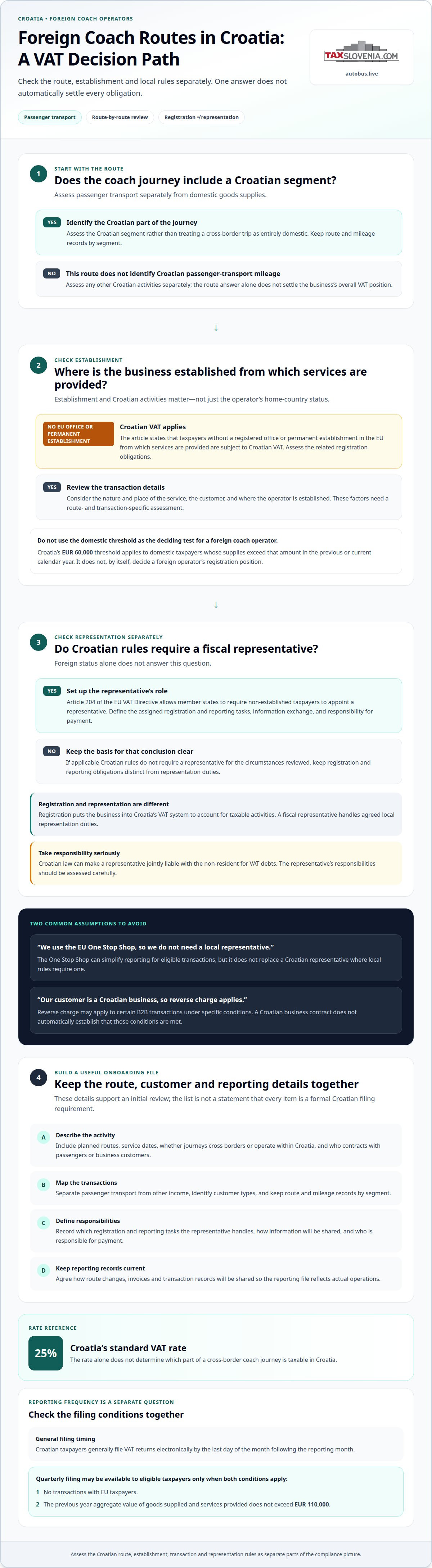
Croatian VAT registration depends on the operator’s activities, establishment and customers, not just its home-country status. For coach services, assess passenger transport separately from domestic goods supplies, since the rules for goods do not automatically apply to passenger transport.
Foreign Operator Representation Requirements
A fiscal representative is a local representative who handles specified VAT obligations for a foreign business. Article 204 of the EU VAT Directive allows member states to require non-established taxpayers to appoint one. That means foreign status alone doesn’t settle the question: the operator’s establishment and Croatian activities matter. A tax representative for coach operators in Croatia may therefore be required where the Croatian rules apply.
The EU VAT One Stop Shop can simplify reporting for eligible transactions, but it doesn’t replace a Croatian representative where local rules require one. Article 194 also allows reverse charge for certain B2B transactions under specific conditions; a contract with a Croatian business doesn’t automatically establish that those conditions are met.
Croatian VAT Registration Rules
Croatian VAT registration is the process of entering Croatia’s VAT system to account for taxable activities there. The EUR 60,000 threshold applies to Croatian domestic taxpayers when supplies exceed that value in the previous or current calendar year. Foreign coach operators shouldn’t assume this domestic threshold decides their registration position.
For a foreign operator, relevant factors include the nature and place of the service, the customer, and where the operator is established in the EU. Taxpayers without a registered office or permanent establishment in the EU from which services are provided are subject to Croatian VAT. Identify the business providing the service and the route before assessing whether registration is required.
Passenger transport by coach can involve a cross-border itinerary, so assess the Croatian part of each journey rather than treating every trip as entirely domestic. Keep route and mileage records by segment to support that assessment. The applicable Croatian standard VAT rate is 25%; the rate alone doesn’t determine which part of a cross-border journey is taxable in Croatia.
Registration and representation are separate parts of the compliance process. Registration supports VAT reporting and payment, while a fiscal representative handles agreed local representation duties. Failing to meet an applicable requirement can leave obligations outstanding; the consequences depend on the breach and its circumstances. The registration threshold alone does not determine a penalty amount.
Foreign directors submit home-state contribution evidence to Croatia’s tax authority upon court registration; demands arrive years later. Employers may have additional workforce-related compliance obligations, which should be assessed separately from VAT registration.
Appointment and onboarding process
Onboarding is the information-gathering and setup stage before VAT registration or reporting work begins. It gives the operator and service team a shared record of the business, its transactions, reporting needs and responsibilities. For a coach company, start with a route schedule that identifies Croatian journeys, customer types and planned service dates.
Appointment and VAT registration are connected, but they are separate administrative steps. Article 204 of the EU VAT Directive allows EU member states to require non-established taxpayers to appoint a representative. The operator should therefore establish whether representation applies to its Croatian activity, then organize the registration and representation process in sequence.
A practical onboarding file can clarify the scope of the work. Include the operator’s legal name and country of establishment, a description of its coach services, route records, customer details and expected transactions. These details support an initial review; this list does not mean every item is a formal Croatian filing requirement.
- Describe the activity. Set out whether journeys carry passengers across borders or operate within Croatia. Include examples of planned routes, service dates and the party that contracts with passengers or business customers.
- Map the transactions. Separate passenger transport from other income, such as any distinct service sold under a different contract. Identify whether customers are businesses or individuals, because the transaction type can affect VAT treatment.
- Define the mandate. Record which registration and reporting tasks the representative will handle, how information will be exchanged, and who is responsible for payment. Clear scope helps prevent assumptions about duties that were not assigned.
- Set up the reporting flow. Agree how route changes, invoices and transaction records will reach the person preparing returns. A new Croatian journey or amended contract should be communicated promptly so the reporting file reflects actual operations.
Reporting frequency is a separate issue from appointment. Croatian taxpayers generally file VAT returns electronically by the last day of the month following the reporting month. Eligible taxpayers may file quarterly if they have no transactions with EU taxpayers and their previous-year aggregate value of goods supplied and services provided does not exceed EUR 110,000. The eligibility conditions matter together, not as alternatives.
During setup, align the reporting calendar with journey records and payment arrangements. The tax administration process depends on the operator’s actual transactions and registration position. Organize route and contract information before the first Croatian reporting period so everyone involved can work from consistent records.
Choosing a Croatian fiscal representative
A Croatian fiscal representative is a local representative appointed to handle specified VAT matters for a foreign business. When choosing a representative, look for a clear process for Croatian registration, returns, payment records and communication about coach routes. The appointment should reflect the operator’s actual transactions, since duties are not identical for every foreign company.
Start by confirming whether representation is required for the activity. Non-EU businesses selling goods located in Croatia to Croatian or EU customers may need a representative, but that example does not by itself establish the rule for passenger transport. Article 204 of the EU VAT Directive allows EU member states to require representation by non-established taxpayers. Check how the Croatian rules apply to the operator’s services and establishment.
Then examine how the representative handles liability. Under Article 126 of the Croatian VAT Act, a fiscal representative is jointly and severally liable with the non-resident for VAT debts. Croatia has no distinct limited fiscal representation framework in its VAT legislation. A contract can assign practical tasks between the parties, but contractual limits don’t restrict the representative’s statutory liability to the Croatian Tax Administration.
Before making an appointment, define a mandate that covers the operator’s expected work. For example, an operator providing cross-border passenger journeys needs a process for sharing route information, invoices and service changes. Agree how records will be sent and how payment obligations will be communicated. Written responsibilities help both parties understand their roles.
- Registration scope: Define which Croatian activities and transactions the appointment covers, including any changes to planned routes.
- Reporting arrangements: Set out how VAT information, return preparation and deadlines will be managed. Croatian VAT returns are generally filed electronically by the last day of the month following the reporting month.
- Liability terms: Read the contract alongside Article 126. A private agreement cannot remove the statutory joint liability described in Croatian law.
- Refund support: Ask how refund matters fit into the mandate. Croatian practice may require a representative to submit refund claims for non-EU businesses claiming under the 13th Directive.
Do not assume that a transaction is exempt simply because the customer is a Croatian business or an EU member. Article 194 reverse charge may apply to certain B2B transactions under specific conditions, so the transaction and customer status need to be assessed. A representative should distinguish that treatment from the operator’s own passenger transport services.
Finally, align the appointment with the operator’s records and reporting calendar. Clear route documentation can help explain which services were provided and support accurate VAT reporting. Missed registration or filing duties can create compliance problems; a representative’s role and liability make a precise mandate especially important. Choose arrangements that state who provides information, handles filings and communicates payment requirements.
Fiscal representative responsibilities
A Croatian fiscal representative is a local party appointed to represent a non-resident for specified VAT matters. The appointment connects the foreign operator’s records and tax obligations with Croatian administration. For coach businesses, the agreed work may include organizing journey information, supporting VAT reporting and communicating about payments or refund claims.
Statutory liability is a central responsibility to understand before appointment. Under Article 126 of the Croatian VAT Act, the representative is jointly and severally liable with the non-resident for VAT debts. Croatia has no separate limited fiscal representation framework in its VAT legislation. A contract may divide tasks between the operator and representative, but it cannot limit liability to the Croatian Tax Administration.
Set out practical duties in the appointment agreement. Specify who prepares VAT information, submits returns, communicates with the tax administration and tracks payment obligations. For a coach operator, route records and contracts can connect each service with the relevant reporting period. These arrangements clarify responsibilities but do not override statutory obligations.
Croatian taxpayers generally file VAT returns electronically by the last day of the month following the reporting month. VAT payments are usually due by the end of the month following the reporting period. The agreed workflow should distinguish preparing and filing a return from arranging payment, rather than treating them as one task.
- Records: Coordinate the flow of invoices, route details and transaction data. A border-crossing journey may need clear route records to support the operator’s VAT reporting.
- Return administration: Organize the information needed for the applicable Croatian reporting period and manage the filing task assigned under the mandate.
- Payment coordination: Communicate the amount due and the payment process with the non-resident, while keeping the operator’s responsibility clear in the agreement.
- Refund claims: Croatian practice may require a representative to submit VAT refund claims for non-EU businesses claiming under the 13th Directive.
The representative’s role does not remove the operator’s responsibility to provide accurate information. Share a changed itinerary or corrected invoice through the agreed process so records reflect the actual transactions. If the company operates in several countries, Croatian VAT obligations still concern its Croatian activities. Annual accounts or income records do not replace the transaction details needed for Croatian VAT reporting.
Before work begins, document the scope, record exchange, filing responsibilities and payment communications. This helps each party understand what is expected during each reporting period and how to handle changes to services or transactions.
Tax representative for foreign coach operators in Croatia?
A tax representative is a local representative appointed to handle specified tax duties for a foreign business. Foreign coach operators don’t all face an automatic appointment requirement simply because they cross the Croatian border. Article 204 of the EU VAT Directive allows EU member states to require non-established taxpayers to appoint a representative, so Croatia’s applicable rules and the operator’s activities determine whether one is needed.
Start by separating two questions: whether the operator must account for Croatian VAT, and whether it must appoint a representative. Taxpayers without a registered office or permanent establishment in the EU from which services are provided are subject to Croatian VAT. This rule concerns VAT treatment; by itself, it does not mean every such operator must appoint a representative.
The specific activity matters. A foreign business selling goods located in Croatia to Croatian or EU customers may be required to appoint a fiscal representative. Coach companies generally provide passenger transport, so this goods-sale example is not a blanket rule for coach services. Assess the transport service, customer and operator’s establishment separately.
Use this practical sequence to assess registration and representation:
- Identify the operator’s establishment. Record the country where the business is established and whether it has a registered office or permanent establishment in the EU from which services are provided.
- Describe the Croatian activity. Separate passenger journeys from any distinct goods sales or other transactions. A contract and route records can help show what service the operator supplies.
- Assess the VAT treatment. Consider the service, customer and place of supply. Article 194 reverse charge may apply to certain B2B transactions under specific conditions, but a business customer alone does not settle the issue.
- Determine representation duties. Apply Croatia’s rules to the operator’s actual position before treating appointment as either automatic or unnecessary.
For a tax representative serving coach operators in Croatia, the mandate should match the operator’s real Croatian obligations. If representation is required, the parties should define who manages information, returns and communications. Under Article 126 of the Croatian VAT Act, the representative is jointly and severally liable with the non-resident for VAT debts. That statutory exposure makes the appointment more than a formality.
Review the assessment whenever routes, customers or contracts change. A new arrangement with a Croatian business may affect the transaction analysis, while a route change may alter the records needed for VAT reporting. Base registration and representation decisions on the operator’s actual services, not solely on its home-country registration or general assumptions about foreign businesses.
TaxSlovenia and TaxCroatia
TaxSlovenia and TaxCroatia helps foreign coach operators manage Croatian VAT administration when their activities require registration and reporting. Its services include VAT registration in Croatia, Croatia route reports and Croatia monthly tax reports. This support helps organize administration around the operator’s journeys and reporting needs; the operator’s circumstances determine whether a fiscal representative is legally required.
If your routes include Croatia and you need help with registration or tax reporting, TaxSlovenia and TaxCroatia can help. Contact the team to discuss your Croatian VAT requirements and the service that fits your operations.
Put your next route on a clear compliance path
Connect the tax decision with the journeys you plan to operate. Before adding routes or changing contracts, decide who will maintain the information needed for Croatian VAT reporting and how updates will reach them. A tax representative for coach operators in Croatia should have a defined role that reflects the operator’s actual activities and responsibilities.
TaxSlovenia and TaxCroatia also supports operators with VAT registration in Slovenia, Slovenia route reports and Slovenia tax reports. If your coach operations span both countries, coordinating administration across routes can help you plan the next steps with a clear view of each country’s requirements.
For help with the relevant registration and reporting steps, contact TaxSlovenia and TaxCroatia. A clear plan can make your next cross-border operating decision easier to manage.
Frequently Asked Questions
Who needs to register for VAT in Croatia?
VAT registration depends on whether a business makes taxable supplies in Croatia and where it is established. The EUR 60,000 threshold applies to Croatian domestic taxpayers when supplies exceed that amount in the previous or current calendar year. For a foreign coach operator, review the transport activity, customer and establishment rather than relying on that threshold alone. A tax representative for coach operators in Croatia may be needed when Croatian rules require representation.
Why appoint a tax agent?
A tax agent can handle agreed local VAT administration, such as preparing filings and communicating about reporting duties. This can give a foreign operator a defined point of contact for Croatian tax matters. The appointment also carries legal weight: Article 126 of the Croatian VAT Act makes a fiscal representative jointly and severally liable with the non-resident for VAT debts. The mandate should clearly set out tasks and information-sharing arrangements.
Which non-EU coach operators must appoint a Croatian tax representative?
Non-EU status alone does not establish that every coach operator must appoint a Croatian representative. Article 204 of the EU VAT Directive allows member states to require non-established taxpayers to appoint one. Non-EU businesses selling goods located in Croatia to Croatian or EU customers may be required to appoint a fiscal representative, but that example concerns goods, not coach passenger services. Assess the operator’s Croatian activity and applicable rules.
How can a coach operator appoint a tax representative in Croatia, and what documents are required?
Start by establishing whether representation applies, then agree the representative’s mandate and the division of VAT tasks. There is no complete document list here that establishes formal Croatian filing requirements. For a practical onboarding file, prepare the company’s legal details, its country of establishment, route schedules, relevant contracts, customer information and transaction records. These materials help explain the business activity and support an orderly registration and reporting process.
How does Croatia tax passenger transport by coach, including cross-border journeys?
Assess the Croatian segment of each journey rather than treating a cross-border trip as wholly domestic, and keep route and mileage records by segment. Where the operator is subject to Croatian VAT, the standard rate is 25%; taxpayers without an EU registered office or permanent establishment from which services are provided are subject to Croatian VAT.


