
The key to understanding Slovenia bus transport tax for EU companies is separating VAT on passenger services from tax on the vehicle itself. Certain passenger transport is subject to the 9.5% reduced VAT rate, while Slovenia’s standard VAT rate is 22%. A 0% rate applies to qualifying international transport.
It’s understandable to expect one rule to cover an entire journey, but VAT treatment can depend on the transport service and where it takes place. Motor vehicle tax is separate: in Slovenia, it applies to vehicles registered for the first time in the country.
This guide explains Slovenia bus transport tax for EU companies, including the VAT rates for domestic and international passenger transport and the factors involved in motor vehicle tax. It also covers how tax rules affect EU operators and what to consider when organizing reporting for routes and completed journeys.
Key Takeaways
- Learn how the 9.5% reduced rate, 22% standard rate and 0% rate for qualifying international transport relate to passenger services in Slovenia.
- See why VAT treatment for subcontractor services and invoices depends on the transaction and whether reverse charge applies.
- Understand when Slovenian motor vehicle tax may apply and which vehicle-related factors matter for its calculation.
- Recognize the potential financial consequences of late VAT returns or payments and the compliance steps that help reduce risk.
- Identify how Slovenia route reports, tax reports and VAT registration can support cross-border bus operators.
What taxes apply to bus transport services in Slovenia?
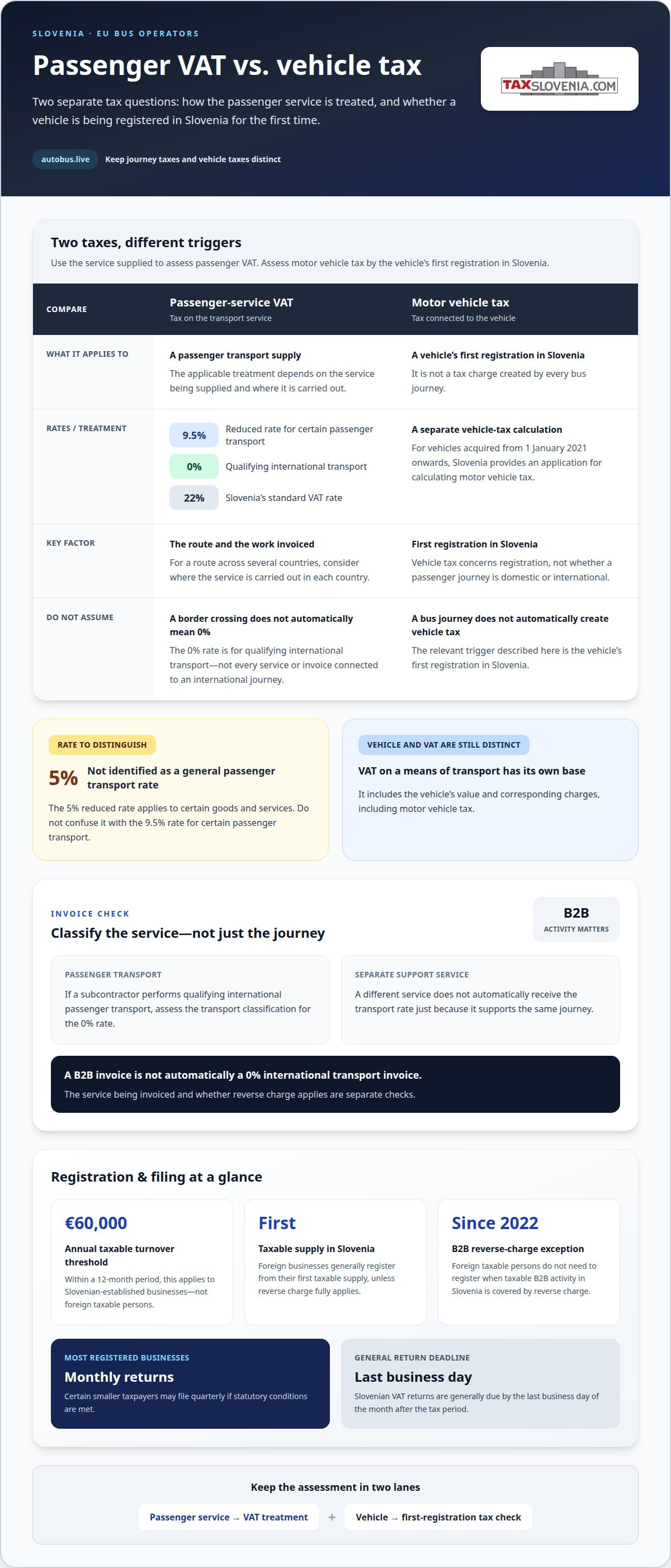
For EU operators, understanding Slovenia bus transport tax for EU companies starts with separating VAT on passenger services from tax on the vehicle itself. Slovenia’s standard VAT rate is 22%, and its reduced rates are 9.5% and 5% for qualifying supplies. Passenger transport may qualify for the 9.5% rate, while qualifying international transport is subject to a 0% rate. The applicable rate depends on the service being supplied.
A reduced rate is not automatic for every bus journey. The 5% rate applies to certain goods and services, but it is not identified as a general passenger transport rate. Operators should distinguish that rate from the 9.5% rate that applies to certain passenger transport. The 0% international transport rate also applies only to qualifying transport, not simply because a route crosses a border.
For an international journey, where the service is carried out matters. VAT treatment for services can depend on the country where they are performed. A route crossing several countries therefore requires operators to consider the transport service in each country, rather than treating the entire journey as automatically subject to Slovenia’s rules. The route and nature of the service help determine the applicable treatment.
VAT registration is a separate question from the rate charged. Slovenia’s €60,000 annual taxable turnover threshold within a 12-month period applies to Slovenian-established businesses, not foreign taxable persons. Foreign businesses generally need to register from their first taxable supply in Slovenia, unless the reverse-charge mechanism fully applies. For taxable B2B activity, foreign taxable persons do not need to register in Slovenia when the reverse-charge rules apply.
Filing obligations follow registration and the applicable tax period. Most VAT-registered businesses file returns monthly, while certain smaller taxpayers may file quarterly if statutory conditions are met. Slovenian VAT returns are generally due by the last business day of the month following the tax period. These filing periods are distinct from the VAT rate applied to a particular passenger service.
Vehicle tax must also be distinguished from VAT on transport. Slovenia’s motor vehicle tax applies to vehicles registered for the first time in the country. This does not mean every bus journey creates a vehicle tax charge. It concerns the vehicle’s first registration in Slovenia, while passenger-service VAT concerns the supply of transport.
For vehicles acquired from 1 January 2021 onwards, Slovenia provides an application for calculating motor vehicle tax. The tax calculation is a vehicle-related process, separate from deciding whether passenger transport qualifies for 9.5% or 0% VAT. VAT on a means of transport has its own base: it includes the vehicle’s value and corresponding charges, including motor vehicle tax.
For EU operators, it helps to keep journey-related VAT, registration, reporting, and vehicle tax as distinct items when managing tax in Slovenia. This makes it easier to identify which rule applies to each transaction rather than treating every cost connected with a bus as one tax obligation.
- Passenger service: assess whether the 9.5% reduced rate or 0% international rate applies.
- Cross-border route: consider where the service is carried out in each EU country.
- Vehicle: assess motor vehicle tax when it is registered for the first time in Slovenia.
What tax rules apply to Slovenian bus transport subcontractors and invoices between EU companies?
For an EU bus operator, start by identifying the service recorded on each invoice. A subcontractor may supply passenger transport, while another supplier may provide a different business service. Do not treat these supplies as identical simply because they support the same journey. The service description and work performed help establish the relevant VAT treatment.
Slovenia applies a 0% VAT rate to qualifying international transport. That rate concerns the qualifying transport service, not every invoice connected with an international bus journey. For example, an invoice for passenger transport and an invoice for a separate support service may require different VAT assessments. A cross-border customer or supplier alone does not make a service international transport.
The distinction matters when a main operator uses a Slovenian subcontractor. If the subcontractor performs qualifying international passenger transport, the transport classification is central to assessing the 0% rate. If the subcontractor supplies a different service, the operator should not assume that the same rate follows automatically. The service being invoiced, rather than the parties’ labels, is the relevant starting point.
Foreign businesses making taxable supplies in Slovenia generally must register for VAT from their first taxable supply, unless the reverse-charge mechanism fully applies. Since 2022, foreign taxable persons do not need to register for VAT in Slovenia when performing taxable B2B activity there. These rules make the transaction type important: a B2B service and a supply that does not qualify for the reverse charge can have different registration consequences.
In practical terms, an EU company should distinguish a taxable B2B activity from qualifying international transport. The first concerns the relationship and VAT treatment of a business service. The second concerns the nature of the passenger transport. A B2B invoice is not automatically a 0% international transport invoice, and a transport invoice does not by itself establish that reverse charge applies.
Clear invoice descriptions help connect tax treatment to the work performed. For example, an invoice identifying passenger transport on an international route is easier to assess than one labelled only “services.” Keep the contract, route details, and invoice description consistent, so the recorded supply can be understood as transport or another service. These records also help separate subcontractor costs from the operator’s passenger-service revenue.
When an invoice involves a Slovenian supplier and an EU business customer, assess the supply before deciding whether Slovenian VAT should appear. Establish whether it is qualifying international transport, another taxable service, or taxable B2B activity subject to reverse charge. Then apply the registration treatment relevant to that transaction. Avoid using the customer’s country or the journey’s cross-border nature as the only basis for the decision.
- Identify the service: passenger transport and other subcontracted services are not interchangeable for VAT purposes.
- Assess the rate: the 0% rate applies to qualifying international transport, not automatically to every related invoice.
- Assess registration: distinguish taxable B2B activity from other taxable supplies and consider whether reverse charge fully applies.
Slovenian tax compliance risks for foreign bus operators
For a foreign bus operator, missed VAT deadlines can create direct financial exposure in Slovenia. A late VAT return can incur a fine from €2,000 to €125,000. Late VAT payment can incur a separate fine from €1,200 to €41,000. These are different failures, so submitting a return does not itself resolve an unpaid VAT balance.
Reporting and payment are separate tasks. A company may submit a tax report but still pay late; payment does not replace the reporting requirement. Track the applicable tax period, report submission, and payment independently for each reporting period.
Slovenian VAT returns are generally due by the last business day of the month following the end of the tax period. For example, a return for a completed monthly tax period is due by the last business day of the following month. Most VAT-registered businesses file monthly, while certain smaller taxpayers may qualify for quarterly filing under statutory conditions.
The reporting frequency affects the operator’s compliance calendar. Set up a recurring process that follows the applicable reporting period and its deadline. Confirm which procedure applies to your operations and plan preparation and payment around it, rather than relying on a filing frequency used in another country.
Route operations can make records harder to organize. An operator may have several journeys, subcontractor invoices, and transport supplies within one reporting period. Separating transactions by service and route supports a clearer review of VAT treatment before reporting. It also helps check whether figures in the report match the underlying invoices and journey records.
Errors can arise when international transport, other services, and business-to-business transactions are grouped together. Those categories do not necessarily receive the same VAT treatment. A report built from an undifferentiated sales total can obscure how each supply was treated. Review invoice descriptions and transaction categories before submission to keep reported figures connected to the services performed.
Payment planning matters alongside preparation. A reporting deadline and a payment obligation are related, but they are not interchangeable. Build a period-based process that assigns responsibility for gathering figures, reviewing and submitting the report, and arranging payment. A clear sequence reduces the chance that completing one task is mistaken for completing the whole reporting cycle.
Foreign operators should distinguish their own taxable supplies from subcontractor invoices. The parties, service, and applicable VAT mechanism affect how a transaction is recorded. Match invoices to the correct reporting period to prevent delayed preparation and support a consistent review of reported amounts. This is particularly useful when journeys cross borders or involve multiple suppliers.
- Track two obligations: record VAT return submission and payment separately for each period.
- Use the correct calendar: align monthly or eligible quarterly filing with the applicable deadline.
- Review transactions: group invoices by service and route before preparing the return.
- Keep the process sequential: gather records, review figures, submit the return, then arrange payment.
Slovenia bus tax comparison with neighboring EU states
A fair comparison starts with the same service and tax category in each country. For bus operators, passenger transport VAT, vehicle tax, and road charges are separate cost items. Comparing Slovenia’s passenger-service VAT with another country’s vehicle tax would not show which route has the higher tax burden. Consider the service, route, and vehicle transaction separately.
Slovenia’s standard VAT rate is 22%, and its reduced rates are 9.5% and 5%. Qualifying international transport can receive a 0% rate. The European Union sets a 15% minimum for standard VAT rates and a general 5% minimum for reduced rates. These EU minimums provide context, but they don’t establish the rates for Croatia, Austria, Italy, or Hungary.
For a Slovenia-to-Croatia journey, for example, compare the VAT treatment of the passenger service in each country. Don’t assume crossing the border makes the entire journey subject to one national rate. The route and the services performed in each country can affect the comparison. Apply the same approach when an itinerary includes other countries.
The rate alone also doesn’t explain how much tax an operator ultimately reports. The 9.5% rate applies to certain passenger transport, while 0% applies to qualifying international transport. The classification of the service therefore matters alongside the country. A domestic passenger trip and a qualifying international transport service shouldn’t be placed in the same comparison column without considering their different treatment.
Vehicle taxes require a separate comparison. Slovenia’s motor vehicle tax concerns vehicles registered for the first time in Slovenia, rather than each passenger journey. For a fleet vehicle bought or registered in another country, distinguish the vehicle’s tax treatment from VAT on transport services. This keeps one-off vehicle-related costs separate from recurring journey-related tax reporting.
A practical route comparison can be organized around four items:
- Journey: list the countries where each passenger transport service is carried out.
- Service category: distinguish domestic passenger transport from qualifying international transport.
- Vehicle: record vehicle-related tax separately from passenger-service VAT.
- Reporting: compare each country’s return and payment process for the operator’s transactions.
For example, a route through Slovenia and Croatia may involve transport supplies in both countries, while the coach has a separate registration history. Treating all costs as a single “bus tax” can hide these differences. Separating the items makes it easier to see which tax relates to the journey and which relates to the vehicle.
Available figures support a clear comparison of Slovenia’s VAT rates with EU-wide minimums, but not a rate ranking against each neighbor. The relevant comparison depends on the same service category, tax period, and vehicle event across countries. A lower headline rate in one category would not by itself establish a lower overall tax burden for an operator.
For EU operators, the useful outcome is a country-by-country record that separates transport VAT, vehicle tax, and reporting obligations. This approach keeps Slovenia’s 22%, 9.5%, 5%, and qualifying 0% treatments in their correct context without treating neighboring countries as interchangeable.
TaxSlovenia and TaxCroatia
TaxSlovenia and TaxCroatia helps foreign bus operators manage tax requirements connected with journeys in Slovenia and Croatia. For Slovenian operations, its services include VAT registration, route reports before trips, and tax reports after journeys. These services help organize reporting around scheduled routes and completed journeys.
If your routes also involve Croatia, TaxSlovenia and TaxCroatia provides VAT registration, route reports, and tax reporting there, including monthly reporting. The next step depends on which country’s requirements apply and whether you need registration, a route report, or tax reporting after a journey. Contact TaxSlovenia and TaxCroatia to discuss the support relevant to your bus operations.
Plan tax processes alongside each route
A workable tax process starts before a journey and continues through its financial close. For EU operators, Slovenia bus transport tax for EU companies is easier to manage when route planning, invoicing, and accounting use consistent records. Assign responsibility for recording each journey and keeping related documents with the corresponding transaction. This makes later reporting more orderly and helps prevent route information from becoming separated from financial records.
Review how your Slovenia operations fit into your wider cross-border workflow. A process that works in another country may need adjustment for Slovenian reporting and service classifications. Keep relevant records connected to the route and reporting period they relate to, so your team can handle reporting in a planned sequence.
TaxSlovenia and TaxCroatia can support the Slovenian tax administration needs discussed in this guide. If you’re ready to discuss the next step for your operations, contact TaxSlovenia and TaxCroatia. A clear process can help your team approach upcoming journeys with greater confidence.
Frequently Asked Questions
What is Slovenia’s VAT rate for passenger bus transport, and when does it apply?
Slovenia applies a 9.5% reduced VAT rate to certain passenger transport services. The 0% rate applies to qualifying international transport, while the standard VAT rate is 22%. The reduced rate depends on the service qualifying as passenger transport; it does not automatically cover every charge connected with a bus. For example, assess a transport fare separately from a distinct service billed alongside the journey.
How is VAT handled for international bus journeys that pass through Slovenia?
A journey passing through Slovenia is not automatically subject to one VAT rate for its entire route. VAT treatment can depend on where services are carried out, and international transport may receive different treatment. The operator should distinguish the qualifying transport service from separate services supplied during the journey. A border crossing alone does not establish that every related invoice qualifies for 0% VAT.
What VAT rules apply to EU companies providing bus transport within Slovenia?
EU companies should first classify the supply as passenger transport or another service, then assess the applicable VAT treatment. Certain passenger transport may qualify for Slovenia’s 9.5% reduced rate. For taxable business-to-business activity, reverse charge can affect which party accounts for VAT. Keep the contract and invoice description consistent with the actual service, so the reported transaction reflects what the company supplied rather than a general label such as “transport services.”
Must a foreign EU bus operator register for VAT in Slovenia, and how?
Not every foreign EU operator must register for Slovenian VAT. Foreign businesses generally must register from their first taxable supply in Slovenia unless reverse charge fully applies; foreign taxable persons performing taxable B2B activity there do not need to register under the rule applying since 2022. Where registration is required, VAT registration in Slovenia is the relevant process. TaxSlovenia and TaxCroatia offers this registration service for foreign bus companies.
Can EU bus companies reclaim Slovenian VAT, and what are the deadlines and procedures?
EU-established businesses may generally submit a claim to reclaim Slovenian VAT by 30 September of the following year. This is a VAT refund claim, distinct from reporting VAT on the company’s own passenger transport supplies. For example, an operator reclaiming Slovenian VAT incurred during one year should account for the following-year deadline. The procedure is a claim for a refund; the deadline does not replace any separate VAT return obligations.


