

A workable bus plan for Croatia starts by matching each stop to a route and departure time. To prepare a bus trip notification for Croatia, organize the itinerary by travel date, boarding and arrival points, route, and planned schedule, then compare those details with the service you intend to operate. Buses are commonly used to travel between Croatian cities, and routes between Zagreb and Split and between Split and Dubrovnik run frequently.
Planning can be less straightforward when you’re unfamiliar with local routes or seasonal schedules. July and August are Croatia’s peak travel season, so the timing of a journey can affect which services fit your itinerary.
This guide explains how to plan bus routes and schedules, which practical details to organize for a trip, and how to travel around Croatia by bus. It also covers how route planning connects with the administrative reporting required for international passenger transport, helping you prepare both the journey and its paperwork in an orderly way.
Key Takeaways
- Organize the route, stops, travel dates, and schedule together so the trip details are clear before preparing a notification.
- Find out which authority or organization receives the notification based on the journey and the applicable requirements.
- Plan the submission process around the required channel and timing, rather than treating route planning and notification as separate tasks.
- Use the article’s guidance to distinguish official forms or online submission options from practical bus schedule planning.
- For foreign operators, consider how VAT registration in Slovenia fits alongside the administrative preparation for international passenger transport.
3. What information should a bus trip notification include in Croatia?
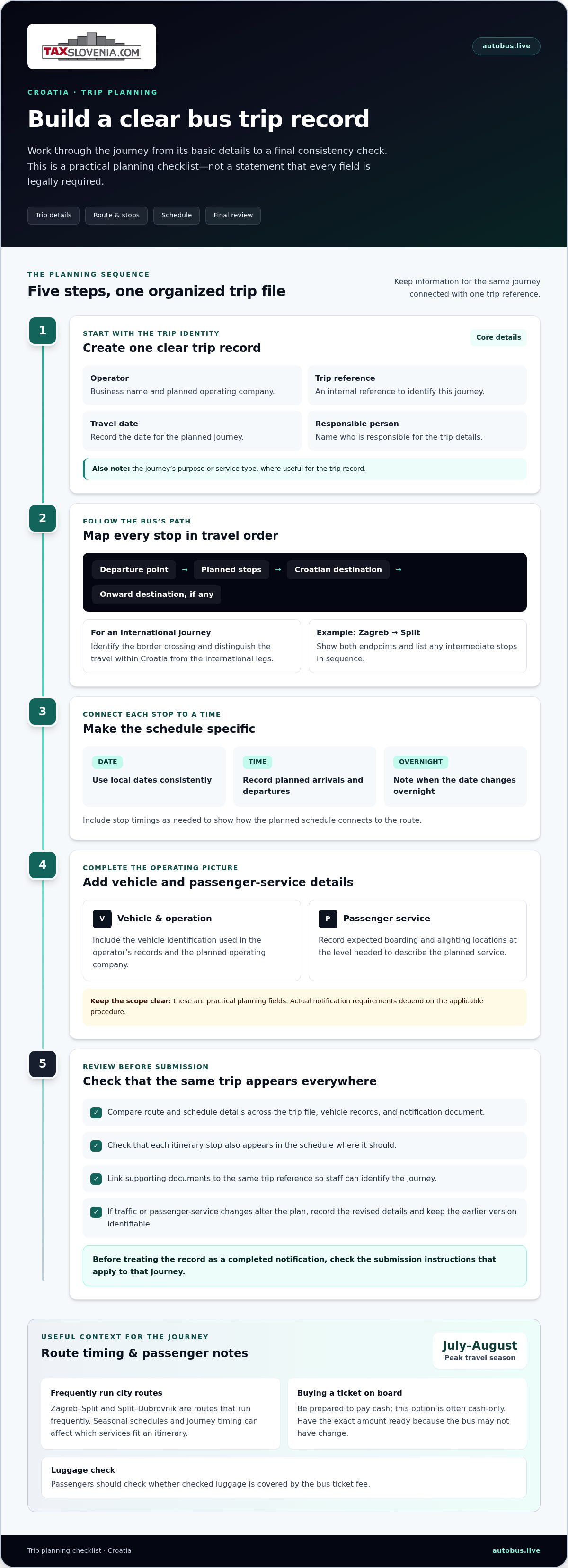
Start with a clear trip record for every planned journey in Croatia. Include the operator’s name, a trip reference, the travel date, and the person responsible for the details. These are practical planning fields, not a claim that Croatian rules require a particular form or exact set of fields. Actual notification requirements depend on the applicable procedure, so keep planning details separate from assumptions about legal obligations.
Next, map the route in the order the bus will travel it. Record the departure point, each planned stop, the destination in Croatia, and any onward destination outside the country. For example, a route from Zagreb to Split should show both endpoints and any intermediate stops in sequence. If a journey crosses a national border, identify the crossing point in the itinerary and distinguish travel within Croatia from the international legs.
Make the schedule specific enough to connect each stop with a planned arrival or departure. Use local dates and times consistently, and note any overnight change of date. A route sheet could show departure from Zagreb, a scheduled stop, and arrival in Split on the relevant travel date. If traffic or passenger-service changes affect the operating plan, record the revised details and keep the earlier version identifiable rather than silently replacing it.
- Operator and trip: business name, internal trip reference, and the journey’s purpose or service type.
- Vehicle and operation: vehicle identification used in the operator’s records, plus the planned operating company.
- Route: departure point, ordered stops, Croatian locations, and any international segment.
- Schedule: travel date, planned departure and arrival times, and stop timings.
- Passenger service: expected boarding and alighting locations, recorded at the level needed to describe the planned service.
Use these fields as a working checklist, not as a statement that every item is legally required. For instance, a route record for a Zagreb-to-Split service can bring the vehicle, schedule, stops, and operator details together. Keep supporting documents linked to the same trip reference, so dispatch and administration staff can identify the journey without confusing it with another service.
Before treating the record as a completed notification, compare it with the submission instructions for the journey. Check that the route and schedule match across the trip file, vehicle records, and notification document. This final review can catch practical inconsistencies, such as a stop appearing in the itinerary but not the schedule. It also keeps route planning distinct from the formal requirements covered in the following sections.
Passenger information can sit alongside the route and boarding details, helping travellers prepare for the service. Passengers should check whether checked luggage is covered by the bus ticket fee. Passengers buying a ticket on board in Croatia should be prepared to pay cash, as this option is often cash-only.
Passengers paying for a ticket on a Croatian bus should prepare the exact amount because the bus may not have change. Including these practical points with the trip information can help passengers know what to expect, while keeping the notification record focused on the planned journey and applicable submission instructions.
4. Which authority or organization must receive a bus trip notification in Croatia?
There isn’t one recipient for every bus trip, and the itinerary alone won’t identify it. The correct recipient depends on the document’s purpose: a transport notification, a route report, or a tax report. Treating these documents as interchangeable can send information to the wrong place. First identify the procedure the document supports, then use the recipient named for that procedure.
For a planned service, distinguish the transport operation from its tax administration. A route record describes the journey, while tax reporting addresses the operator’s tax obligations. A company operating a Zagreb-to-Split service should therefore keep the journey’s route documentation separate from any tax filing linked to the operation. The route and destination do not, by themselves, identify a government office.
Use these checks to identify the right receiving organization without guessing:
- Read the document title: identify whether it refers to a trip notification, route report, or tax report.
- Identify the procedure: establish whether the document concerns permission or notification for transport, or tax compliance.
- Use the named recipient: follow the authority or organization stated in the applicable procedure’s instructions.
- Match the filing to the trip: ensure that the route, date, and operating company relate to the same service.
For example, don’t automatically treat a document describing an international passenger journey through Croatia as a tax return. Likewise, don’t send a tax report to an organization simply because it appears in a transport document. Keep records for each filing purpose separate, and label them clearly in the operator’s trip file.
Tax reporting is a separate administrative process. Croatia route reports are prepared before trips, while tax reports relate to reporting after journeys. Monthly tax reporting is also available in Croatia. These services help distinguish the records, but they do not identify the recipient of a separate transport notification.
Before submission, compare the document’s stated purpose and recipient with the procedure that applies to the planned service. If the instructions name a particular authority or organization, use its exact name and submission channel. Keep a copy of the final document with the corresponding trip record. This makes it easier to connect later questions about a journey in Croatia with the paperwork prepared for that specific service.
There is no single recipient for every trip. Send the notification to the authority or organization named in the instructions for the applicable procedure.
5. How do you submit a bus trip notification for a bus journey in Croatia?
Start by identifying the document and the procedure it serves. A route report, a tax report, and a transport notification are different records. As explained above, don’t assume they have the same recipient. Before sending anything, match the document’s purpose to the instructions for the specific procedure.
Use a practical sequence to prepare the file. First, set aside the route information for the journey. Next, identify the official instructions naming the recipient and accepted submission channel. Then follow those instructions rather than choosing email, an online portal, or a paper form out of habit. The process for a Zagreb-to-Split service may differ from that for an international journey.
- Classify the document. Confirm whether it concerns transport, a route report, or tax reporting.
- Locate the applicable instructions. Find the submission method and recipient named for that procedure.
- Prepare the matching file. Use consistent operator, route, date, and schedule details.
- Submit through the stated channel. Follow the instructions for the relevant authority or organization.
- Retain the record. Keep the submitted version with the related trip documents.
For example, for a planned Zagreb-to-Split journey, compare the route and schedule with the document before submission. Correct any mismatches first. A stop shown in the route but omitted from the schedule can make the file difficult to interpret. Keep the final version separate from drafts so staff can identify the record that was submitted.
You can’t infer the submission channel from the route. An international journey involving Croatia does not establish whether a document should be filed online, by email, or on paper. The applicable procedure’s instructions determine the channel. Follow any stated format, naming convention, or supporting-document requirement, and avoid adding information the procedure does not request.
After sending the notification, save evidence of submission in the trip file. This could include a copy of the sent document and any receipt or reference issued through the channel used. If the schedule changes, keep a clear record of the revised version and how it relates to the original. This helps staff handle later questions about the same journey in Croatia.
Keep transport submissions separate from tax administration. A Croatia route report is prepared before a trip, while Croatia monthly tax reporting is a different administrative task. Make each document’s purpose clear in the trip file. This helps prevent an operational notification from being mistaken for a tax filing, or vice versa.
Travel details can help check whether a route and schedule are plausible, but they do not identify the filing channel. The Split-to-Mostar bus route follows the coast for the first 2-3 hours of the journey, and one reported journey took 4hr 20minute. A bus journey from Dubrovnik to Split takes around 4 hours 15 minutes. These examples show why a submitted schedule should reflect the particular journey rather than a general assumption.
Duration and fare details can support a consistency check, but they don’t replace the applicable submission instructions.
4. How far in advance must a bus trip notification be submitted in Croatia
Set the filing date according to the instructions for the specific notification. A journey to Zagreb, Split, or another Croatian destination does not, by itself, establish a submission deadline. First identify the document and procedure, then follow the timing specified for that process. Don’t use a bus ticket’s booking window as a substitute for an administrative filing deadline.
Keep the formal deadline separate from your company’s preparation schedule. The formal deadline comes from the applicable procedure; your internal schedule helps staff prepare in time. For a planned service between Zagreb and Split, assign responsibility for assembling the trip file while finalizing the itinerary. This gives the operator time to compare the planned journey with the submission instructions.
A practical timeline can use these checkpoints without assigning an unsupported legal deadline:
- When planning begins: identify the notification procedure and the instructions that set its timing.
- As the route is finalized: prepare the relevant trip record and check that its details are consistent.
- Before the stated deadline: submit through the channel required for that procedure.
- After submission: retain the submitted version and any reference or receipt with the trip file.
For a journey to Croatia that continues across a border, account for each leg when reviewing the timetable. A change to the departure date, stops, or destination may affect the filing details. Compare the revised itinerary with the original submission instructions, and handle changes according to the applicable procedure. Keep dated versions so staff can distinguish the current plan from an earlier draft.
Seasonal bus planning requires care, but it does not determine an administrative deadline. Croatia’s summer season, especially July and August, brings additional holiday bus routes to the Adriatic coast. If an operator adds a coastal service during this period, it should still follow the filing timeline set by the relevant notification procedure. Don’t assume a seasonal route creates a different deadline.
Use one calendar entry for the procedural deadline and another for internal preparation. Name the responsible staff member and link each entry to the correct journey record, such as a service from Zagreb to Split. If multiple journeys in Croatia operate on the same date, keep their files and submission records separate. This reduces confusion between routes and prevents an internal planning date from being mistaken for an official deadline.
The direct answer is to submit by the deadline in the instructions for the specific notification, not according to a general travel-planning interval. Identify the procedure first, record its deadline, and work backward to prepare the relevant trip file. This connects submission timing to the actual filing rather than assumptions about the bus journey.
Submit by the deadline in the instructions for the specific notification procedure. The itinerary alone does not establish how far in advance to file.
5. Are there official forms or online portals for bus trip notifications in Croatia
A bus route through Croatia does not, by itself, identify an official form or online portal. First identify the procedure that applies to the notification, then follow its instructions. A trip record or route report is not automatically the same document as a formal transport notification.
Use the procedure’s instructions to determine whether submission requires a form, portal, or another channel. Check the document’s exact title, issuing organization, intended purpose, and submission directions. A file mentioning Croatia is not enough to establish that it is the right form for a bus journey.
Before entering details, compare the form or portal with the planned service. For example, describe a Zagreb-to-Split itinerary consistently wherever the route and schedule are requested. Check that the operator name and journey details match your internal trip record. This is a practical accuracy check, not a substitute for the procedure’s instructions.
- Identify the procedure: establish what the notification is intended to document.
- Check the issuing organization: match its name to the instructions for that procedure.
- Review the submission method: follow the stated steps for a form, portal, or other channel.
- Save the final record: retain the submitted version and any receipt or reference provided.
A downloadable form and an online portal serve different submission processes. A form may need to be completed and delivered through a specified channel. A portal may ask the operator to enter information directly and provide a submission record. Use the method named in the relevant instructions. Don’t assume a document can be submitted through any available channel.
Keep operational and tax documents distinct. A Croatia route report relates to trip preparation, while tax reporting serves a separate purpose. Don’t treat a document used for one administrative task as the official transport notification unless the applicable instructions say so. For a journey with several stops, use the same route description across related records.
After submission, save the completed form or portal confirmation with the matching journey file. If an itinerary changes, preserve the submitted version and record the revised schedule separately. This makes it easier to see which details were filed and which belong to the updated plan. Use bus trip planning support to organize route information alongside the submission process.
Use the form or portal named by the specific procedure rather than assuming one standard channel covers every journey in Croatia. Identify the document’s purpose, follow its submission directions, and retain the resulting record with the trip paperwork.
The applicable procedure’s instructions determine whether to use a form, an online portal, or another submission channel.
TaxSlovenia and TaxCroatia: VAT registration in Slovenia
TaxSlovenia and TaxCroatia supports bus operators with tax-related tasks alongside their trip planning. If your operation requires VAT registration in Slovenia, the company provides that service. It also prepares Slovenia route reports and tax reports for operators managing journeys and reporting there. For trips connected with Croatia, it provides VAT registration, route reports before trips, and tax reporting after journeys, including monthly tax reporting. These services address tax and route-reporting tasks, not transport notifications or passenger bus transportation.
Consider this support when your company needs VAT registration in Slovenia or Croatia, or the listed Slovenia reports. Keep those requirements separate from the notification process described above, and use the applicable transport instructions for that filing.
To discuss these services, contact TaxSlovenia and TaxCroatia or visit autobus.live.
Put your next Croatia journey on a clear footing
As you prepare a bus trip notification for Croatia, treat route planning and filing as connected parts of operational preparation. Keep a clear record of the document’s purpose, intended recipient, and governing submission instructions. This gives your team a practical starting point for organizing future services.
For foreign bus operators with related Slovenian tax requirements, TaxSlovenia and TaxCroatia provides VAT registration in Slovenia, Slovenia route reports, and Slovenia tax reports. These services address tax and route-reporting work, while the applicable procedure guides transport notifications.
Outline the journeys and administrative tasks your operation needs to manage. Contact TaxSlovenia and TaxCroatia today to discuss services relevant to your Slovenia requirements.
With a defined process for each task, your team can prepare its next journey with greater clarity.


