

A bus journey into Croatia can create a VAT obligation before the operator has a local base. VAT treatment for passenger transport in Croatia can depend on the nature of the service. For a foreign operator, the key question is whether its Croatian supplies make it liable to account for VAT. The Croatia bus VAT registration process starts with establishing that requirement, not simply applying one rate to every trip.
This guide explains who needs to register, what company details and documents to prepare, and how to submit an application to the Croatian Tax Administration. It also clarifies the timing: registration generally takes around four weeks, while the Tax Administration assigns a VAT number within eight days of receiving an application. Businesses should complete registration at least 8 days before starting activities that require it. Knowing the steps in advance helps you prepare the application and plan the start of your Croatian operations.
Key Takeaways
- Separate the domestic turnover threshold from the rules for foreign businesses; the registration test depends on where your business is established and what it supplies in Croatia.
- Check whether your Croatian passenger transport activity is taxable or exempt before deciding how VAT registration applies to your journeys.
- Prepare the application, OIB form, company registration documents, and commercial-register extract before submitting your registration request.
- Plan the application process ahead of your start date: registration generally takes around four weeks, while the VAT number is assigned within eight days of the application being received.
- Understand which registration and tax-reporting steps apply to your Croatian operations so you can keep the process organized after receiving your VAT number.
What information is required for VAT registration in Croatia?
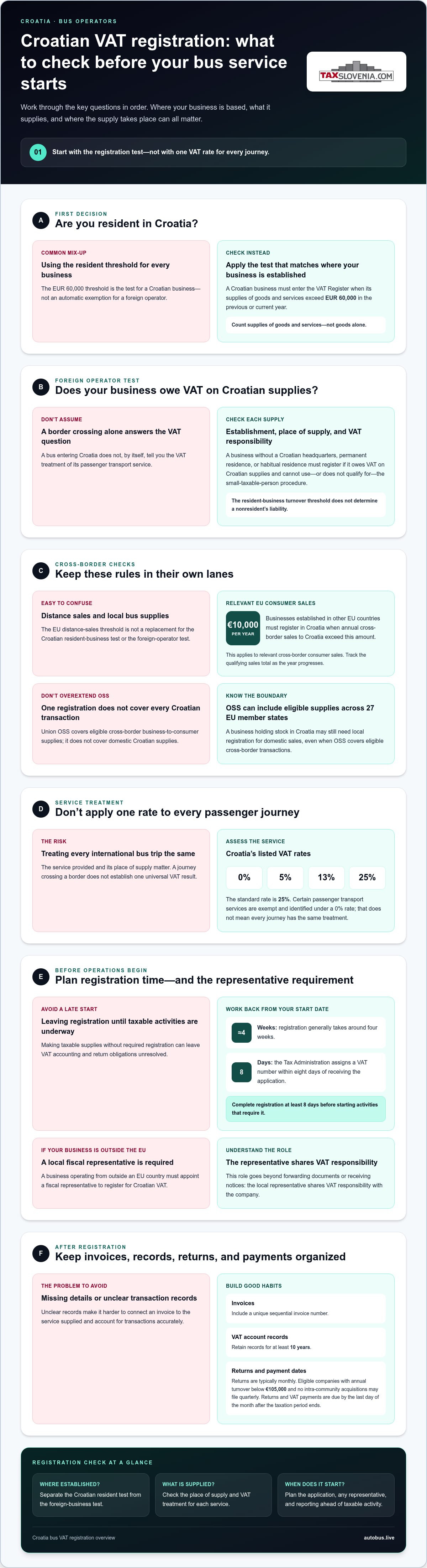
- First, identify whether your business is resident in Croatia. A Croatian business must enter the VAT Register if its supplies of goods and services exceed EUR 60,000.00 in the previous or current year. Compare the relevant supplies with this threshold, rather than looking only at sales of goods. For bus operators, the Croatia bus VAT registration process starts by identifying where the business is established and what it supplies.
- Apply the nonresident test separately. A business without a Croatian headquarters, permanent residence, or habitual residence must register if it owes VAT on Croatian supplies and cannot use, or does not qualify for, the small-taxable-person procedure. The resident turnover threshold does not determine a nonresident’s liability. Before planning Croatian operations, check where each supply takes place and who is responsible for accounting for its VAT.
- For EU cross-border distance sales, track annual sales to Croatia. Businesses established in other EU countries must register in Croatia when their annual cross-border sales to Croatia exceed EUR 10,000. This EU-wide distance-sales threshold applies to relevant cross-border consumer sales, rather than replacing Croatia’s resident-business threshold. Monitor the total across borders as the year progresses, and keep the transactions that count clearly recorded.
- Consider whether the Union One Stop Shop, or OSS, applies to eligible cross-border business-to-consumer supplies. Union OSS allows eligible supplies across the 27 EU member states to be reported through one registration. It does not cover domestic Croatian supplies. For example, a business holding stock in Croatia may still need local registration for domestic sales, even when OSS covers eligible cross-border transactions.
- Check the VAT treatment of each passenger transport service before applying a rate. Croatia’s listed VAT rates are 0%, 5%, 13%, and 25%, with a standard rate of 25%. Certain passenger transport services are exempt and identified under a 0% rate. That does not mean every international bus journey receives the same treatment; the service and its place of supply matter.
- Set up invoice and recordkeeping practices alongside the registration assessment. Croatian VAT invoices must include a unique sequential invoice number, and VAT account records must be retained for at least 10 years. Making taxable supplies without required registration can leave VAT accounting and return obligations unresolved. Keep records that connect each invoice to its supply, so the business can account for its transactions accurately.
When foreign businesses must register for Croatian VAT
- Identify where your bus business is established and what supplies it makes in Croatia. A foreign operator must register if it is liable for VAT on Croatian supplies and cannot use, or does not qualify for, the small-taxable-person procedure. The VAT treatment and place of supply matter more than the fact that a bus crosses the border.
- Keep the Croatian resident-business test separate. Businesses headquartered or resident in Croatia must enter the VAT Register when their supplies exceed EUR 60,000.00 in the previous or current year. That threshold does not automatically exempt nonresident sellers. A foreign business may have registration obligations based on taxable transactions in Croatia, even when its own country’s turnover is below its domestic threshold.
- Check whether your business is established inside or outside the EU. A business operating from outside an EU country must appoint a fiscal representative to register for VAT in Croatia. The representative is local and shares VAT responsibility with the company. Factor this into your registration plan: the representative’s role goes beyond forwarding documents or receiving notices.
- Review the Croatian VAT position before claiming a refund. A Croatian taxable person requesting repayment of excess VAT must receive it within 30 days after submitting the VAT return, and no later than 90 days after a tax inspection begins. This timing applies to the stated refund rule; it does not mean every foreign operator automatically qualifies for repayment.
- Set a return and payment calendar once registered. Croatian VAT returns are typically monthly. Eligible companies with annual turnover below €105,000 and no intra-community acquisitions may file quarterly. Returns and VAT payments are due by the last day of the month following the end of the monthly or quarterly taxation period. Use the assigned reporting period to schedule both obligations.
- Before starting taxable operations, map each service and transaction to its treatment. Certain passenger transport services are exempt and identified under a 0% rate, but that does not establish that every bus journey has the same treatment. Keep records that distinguish the services supplied in Croatia from other transactions, then apply the relevant VAT rate and reporting period to each taxable supply.
Documents and details required for registration
- Begin with the Croatian VAT registration application. Use the company’s official registration details consistently on the form and supporting documents. Before submitting, compare the company name and registration information across every document to catch mismatches early. Keep a copy of the completed application with the documents prepared for the Croatian Tax Administration.
- Prepare the OIB form as a separate registration document. OIB is the Croatian identification number used for tax administration; a company without one needs to obtain it. Allow several working days for the OIB to be issued. Include this step in your schedule, as the application package may require the company’s OIB details before processing can proceed.
- Obtain a current extract from the commercial register. It supports the company’s legal registration details and should match the information on the VAT application. Compare the company name and registration data on the extract, OIB form, and application. If the company’s records use different formats, identify the official details and use them consistently in the Croatian filing.
- Registration documents issued in another EU member state must be translated into Croatian. The required documents include translated registration papers from other EU countries and a commercial-register extract. Translation and legalisation are separate matters, so do not assume that translation alone meets any legalisation requirement. Prepare the documents in the form required for the application channel, and keep the originals with the translated copies.
- If your business operates from outside an EU country, appoint a fiscal representative in Croatia. The representative is local and shares VAT responsibility with the company. Treat this as a substantive part of the registration arrangement, not merely a contact address. Agree how company information and filing responsibilities will be handled, then include the representative’s details in your registration preparation.
- Organize the application, OIB form, translated registration papers, and register extract as one filing set. Check that every document refers to the same legal entity before submission. Preparing Croatia’s VAT registration form and annexes is estimated to take 1-5 working days, while obtaining a missing company OIB takes several working days. This preparation supports the later VAT return process, including monthly returns where that reporting period applies.
Submitting an application to the Croatian Tax Administration
Foreign bus operators apply for a Croatian VAT number through the Croatian Tax Administration’s prescribed electronic or written channels. Submit a complete application: the form, supporting documents, and company details should all relate to the same business.
- First, confirm that the application names the correct legal entity. Use the company’s registered name consistently on the form and supporting documents. If the business uses a trading name, distinguish it from the registered name so the application clearly identifies the legal company.
- Review the completed form before attaching the annexes. Compare company details across the application, OIB information, and registration documents. Correct spelling or formatting differences before submission. Consistent documents help the Croatian Tax Administration match the application to the company’s records.
- Submit the application through the applicable electronic or written channel. Send the form and annexes together rather than treating the supporting documents as a separate task. Keep a copy of the complete filing, including every attachment sent to the authority.
- Record when the Croatian Tax Administration receives the application. Keep the receipt confirmation with the filed documents and any later correspondence. This gives your team a clear reference if it needs to follow up or identify which version of the application was submitted.
- If your company operates from outside an EU country, include the Croatian fiscal representative arrangement in your preparation. The representative shares VAT responsibility with the company. Ensure that both parties use consistent business details in the application materials, and keep the related records together.
- After submission, review any communication from the authority and respond with information that matches the original filing. Keep updates with the application record so staff handling Croatian tax reporting can refer to the same details. This creates a clear handover from registration paperwork to ongoing compliance.
Keep the purpose of each registration clear when preparing related VAT filings. The Croatian Tax Administration’s ePorezna system is the portal for Union OSS registration. If your business is preparing for Union OSS, record that activity separately from the application for a Croatian VAT number. Use consistent company details in the relevant documents and keep them together, so staff can identify which registration each one concerns.
Also consider whether the company’s movements of goods create an Intrastat reporting requirement. Croatian businesses must submit Intrastat returns when their arrivals threshold exceeds €400,000 or their dispatches threshold exceeds €200,000. Check arrivals and dispatches separately against the applicable threshold, and keep the underlying business records available to support the company’s review. This is a separate reporting consideration from submitting the VAT number application.
For specified services and distance sales, Croatia’s special VAT taxation procedures have applied since 1 July 2021. Consider whether those procedures are relevant to the company’s activities, and keep related records with the company’s VAT materials. A clear separation between registration documents, Union OSS records, Intrastat information, and records for the special procedures can help staff use the correct information when handling Croatian tax matters.
Registration timing and VAT number issuance
- Work backward from the first activity that requires Croatian VAT registration. Businesses should complete registration at least 8 days before starting that activity. This is a planning deadline, not the estimated full processing time. For a bus operator, identify the first taxable Croatian supply and schedule the application before operations begin.
- Allow around 4 weeks for Croatian VAT registration overall. The estimate gives a useful planning window, while the application’s preparation and processing stages may affect the timeline. Prepare the form and annexes in advance, and include time for an OIB application if the company does not already have one. Obtaining a company OIB is estimated to take several working days.
- Track the application receipt date separately from the expected overall timeline. The Croatian Tax Administration assigns a unique Croatian VAT number within eight days of receiving a registration application. That assignment period does not replace the broader estimate of around 4 weeks. Keep the submission date and authority correspondence with the company’s compliance records.
- Use the issued number in the correct format. Croatian VAT numbers use the prefix HR for VIES verification. Once you receive the number, compare it with the company’s registration details before using it on invoices or VAT reports. This check helps prevent a mismatch between the number assigned by the Croatian Tax Administration and the business records.
- Distinguish local registration from the One Stop Shop route. OSS may cover eligible cross-border distance sales, but it does not cover domestic Croatian supplies. A business with stock in Croatia may still need local VAT registration for domestic sales. Assess the transactions and supplies involved before treating OSS as a substitute for Croatian registration.
- Build the next compliance dates into the operating calendar after the number arrives. Croatian VAT returns and payments follow the assigned taxation period, monthly or quarterly. A complete registration timeline therefore includes preparation, OIB issuance if needed, application receipt, VAT number assignment, and reporting setup. Arrange Croatian VAT registration support if you need help preparing for these steps.
Resident and nonresident registrants have the same Croatian VAT number format once they obtain an OIB for VAT purposes. The number’s format does not change according to whether a business is resident or nonresident. When checking registration records, match the assigned details to the company’s file rather than relying on different format assumptions. Record the basis for the check so staff handling invoices and VAT reports can use the same verified information.
Keep the VAT number and OIB for VAT purposes distinct in internal records, while ensuring the relevant details are accurately linked. Reviewing them before routine use can catch typing or copying errors and prevent inconsistencies from spreading between documents. If a detail does not match, pause use of the disputed entry and compare it with the registration correspondence before updating business records. This is especially useful when information moves between teams or administrative systems. A consistent review process records which details were checked and supports accurate handling after registration.
TaxSlovenia and TaxCroatia: VAT registration in Slovenia
TaxSlovenia and TaxCroatia helps foreign bus operators arrange VAT registration in Croatia when their activities create a registration obligation. Operators travelling through both countries can also use its VAT registration service in Slovenia, Croatia route reports, and Croatia monthly tax reports for relevant reporting needs.
Once you have assessed your Croatian VAT position, TaxSlovenia and TaxCroatia can help complete the registration step. Its services focus on tax requirements for foreign bus companies operating in Slovenia and Croatia, not passenger transport. This support is relevant when you need registration and reporting assistance for those countries as your operations continue.
For help with the next registration step, contact TaxSlovenia and TaxCroatia.
Plan your next compliance step
Once your Croatian VAT position is clear, connect the registration work with the tax tasks arising from your routes. Keep company records, route information, and reporting responsibilities organized together to make ongoing compliance easier to manage. A clear plan for the Croatia bus VAT registration process can also help you identify related requirements in Slovenia.
TaxSlovenia and TaxCroatia provides VAT registration in Slovenia, Slovenia route reports, and Slovenia tax reports. These services are relevant if your bus operations also involve Slovenia and you need registration or reporting support there.
For help with the next step, contact TaxSlovenia and TaxCroatia. A structured approach can make cross-border tax administration easier to manage.
Frequently Asked Questions
What happens after registration?
After registration, use your Croatian VAT number on relevant invoices and set up a process for recording taxable transactions. Keep VAT account records for at least 10 years, and make sure invoices have unique sequential numbers. Then follow the reporting period assigned to your business and reconcile the returns against your records. For bus operators, keep trip and transaction details organized so each supply can be matched to its VAT treatment.
What documents are required for Croatia VAT registration?
The application package includes a VAT registration application, an OIB form, and a commercial-register extract. Registration documents from another EU country must be translated. Use consistent company details throughout the documents, and keep copies of the submitted application and annexes together. A business operating from outside an EU country must appoint a Croatian fiscal representative who shares VAT responsibility with the company.
How long does Croatian VAT registration take and what does it cost?
Allow around four weeks for the overall registration process; the Croatian Tax Administration assigns a VAT number within eight days of receiving an application. Porezna uprava generally charges no administrative fee for Croatian registration. Professional service fees are separate, depend on the case, and are provided after a quote request. Relevant factors include the company’s circumstances and the registration work required.
Can EU bus operators use the OSS scheme instead of Croatian VAT registration?
No. OSS is not a general substitute for local Croatian VAT registration. The Union scheme covers eligible cross-border business-to-consumer supplies, but not domestic Croatian supplies. Bus operators should assess whether their specific passenger transport services qualify for OSS rather than assume the scheme applies. For example, a business making domestic Croatian supplies may still need local registration even if it reports eligible cross-border sales through OSS.


