
A Slovenian establishment is not the deciding factor: a foreign bus operator may need to register for VAT if it is responsible for passenger transport within Slovenia. For bus VAT registration without establishment in Slovenia, the key question is who is responsible for carrying the passengers. A non-EU operator required to register must appoint a VAT representative; an EU operator may appoint one voluntarily.
It may seem that operating across a border without a local base means local VAT rules do not apply. Passenger transport has its own rules, however, and responsibility for providing the service can determine whether registration is required and who must report VAT.
This article explains how Slovenian VAT identification works, when registration is mandatory or voluntary, and why a non-EU operator may need a tax representative. It also covers the special VAT arrangement for international occasional road passenger transport, helping you understand how the rules apply to your journeys.
Key Takeaways
- Assess who is responsible for carrying passengers in Slovenia, since this can determine which business must register and report VAT.
- Non-EU businesses required to register must appoint a Slovenian VAT representative, who shares liability for their VAT obligations.
- Slovenian VAT registration is submitted electronically before taxable activities begin, and the VAT number uses the prefix SI followed by 8 digits.
- Voluntary VAT registration can be useful in some cases, but it comes with a minimum commitment of 60 months before deregistration.
- The special arrangement for occasional international road passenger transport has its own rules, including record retention requirements for some operators.
Registration requirements for nonresident businesses
For a foreign bus operator, the main question is whether its activity creates a taxable supply in Slovenia. A local office is not required for Slovenian VAT obligations to apply. The registration threshold for non-residents does not apply, so an operator cannot rely on the turnover threshold available to businesses established in Slovenia.
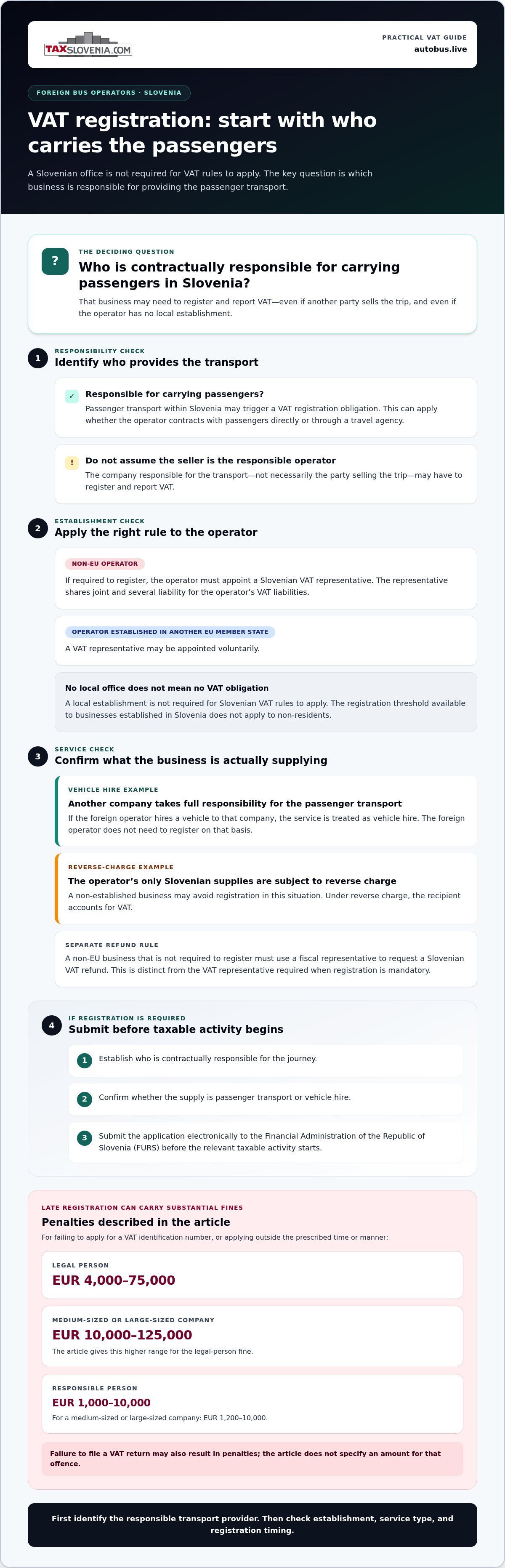
Passenger transport may trigger a registration obligation when a foreign company is responsible for carrying passengers within Slovenia. This applies whether the company contracts directly with passengers or through a travel agency. The company responsible for the transport, not necessarily the party selling the trip, may have to register and report VAT.
The requirement depends on where the operator is established. A non-EU taxable person required to register must appoint a Slovenian VAT representative. An operator established in another EU member state may appoint a representative voluntarily. The representative shares joint and several liability for the non-resident’s VAT liabilities, making the role a legal responsibility as well as an administrative one.
Submit the registration application electronically to the Financial Administration of the Republic of Slovenia (FURS) before taxable activities begin. First establish who is contractually responsible for the journey and whether the supply is passenger transport or vehicle hire. Then submit the application before starting the relevant activity. These distinctions help determine whether registration is mandatory.
For example, a foreign operator that hires a vehicle to another company, which takes full responsibility for transporting passengers, does not need to register on that basis. The service is treated as vehicle hire. A non-established business may also avoid registration if its only Slovenian supplies are subject to the reverse charge, under which the recipient accounts for VAT.
A separate representative rule applies to some VAT refund claims. A non-EU business that is not required to register for Slovenian VAT must use a fiscal representative to request a refund. This is distinct from appointing a VAT representative when registration is mandatory.
Late compliance can carry substantial penalties. A legal person may be fined EUR 4.000 to EUR 75.000 for failing to apply for a VAT identification number, or applying outside the prescribed time or manner. For a medium-sized or large-sized company, that fine may be EUR 10.000 to EUR 125.000. A responsible person may face EUR 1.000 to EUR 10.000, or EUR 1.200 to EUR 10.000 for a medium-sized or large-sized company. Failure to file a VAT return may result in penalties.
In short, EU operators may appoint a representative voluntarily, while non-EU operators required to register must appoint one. For late registration or returns, the applicable fine depends on the offence and, for some registration offences, the company’s size.
Slovenian VAT identification numbers
A Slovenian VAT identification number identifies a business registered for VAT in Slovenia. Its format is the prefix SI followed by 8 digits. For example, a number uses SI and then eight numerals; the prefix is part of the complete identification, not a substitute for the digits. Keep the number consistent across VAT records and returns so the business can be identified in its Slovenian filings.
Registration and a VAT number are related, but they answer different questions. Registration determines whether the foreign operator must account for Slovenian VAT. The identification number identifies the business once it is registered. Having a number does not, by itself, mean every journey or supply is taxable in Slovenia. The nature of the service and the operator’s responsibility for it remain relevant.
Allow approximately two to four weeks to obtain a Slovenian VAT number. This processing time matters when planning taxable activity, because you must submit the registration application electronically before the activity begins. Include the application period in your plans for the first journey rather than treating the number as paperwork to complete afterward. This also helps coordinate route records and the start of reporting.
For a taxable person without a seat in Slovenia, the tax period is one calendar month. The VAT return must be submitted by the last business day of the month following the end of that tax period. VAT payment is due by the same deadline, unless ZDDV-1 provides otherwise. For example, the calendar-month tax period means reporting follows monthly periods, with the filing and payment deadline falling in the next month.
The VAT identification number is also relevant to the records that support each return. From 1 July 2025, taxable persons in Slovenia must electronically submit records of charged VAT and VAT deduction for each tax period, no later than the VAT return filing deadline. This means the operator’s VAT calculations and supporting records need to align with the period covered by its return.
A separate threshold can matter if a foreign business makes intra-Community acquisitions of goods. A taxable person or non-taxable legal person must register when the value of those acquisitions exceeds EUR 10,000. This rule concerns goods acquired within the EU; it is not a general turnover threshold for every foreign operator providing bus services. Identify the activity first, then determine which registration rule applies.
For operators planning Slovenian journeys, VAT registration in Slovenia can support the registration process and help align identification with the start of taxable activity. The key planning points are the SI number format, the processing period, and the monthly filing cycle.
Special VAT arrangement for international occasional road passenger transport
International occasional road passenger transport can cross several tax territories during one journey. For VAT, the distance travelled in each territory matters. Article 48 of the Directive sets the place of taxation for passenger transport according to where the transport physically takes place and the distance covered. A journey that passes through Slovenia therefore needs to be considered in relation to its Slovenian route segment, rather than treated as a single supply located entirely in the operator’s home member state.
Passenger bus transport is not automatically exempt because a bus crosses a border. A foreign transport company responsible for passengers carried within Slovenia must register and report for Slovenian VAT. Slovenia’s standard VAT rate is 22%. The VAT treatment follows the passenger transport service and the distance travelled in Slovenia; it is not determined only by where the operator is resident or where passengers board.
The special arrangement for international occasional road passenger transport applies to qualifying journeys and their transaction records. A taxable person without a place of business within the EU using the relevant special scheme must retain transaction records for ten years after the end of the year in which the transactions took place. Keep journey and supply information identifiable by transaction and year to meet this record-keeping requirement.
For a clear record of a cross-border journey, keep route information with the related transaction details. For example, distinguish the Slovenian segment from the portions travelled in other member states. This helps connect the transport supply to the territory where the service takes place and supports VAT reporting. Also distinguish occasional passenger transport from vehicle hire, since the place-of-taxation rules differ.
A foreign operator can request a Slovenian VAT refund for eligible expenses through the applicable refund process. A non-EU business that is not required to register for Slovenian VAT must use a fiscal representative to request the refund. The refund rules do not mean that every fuel, toll, or other expense is recoverable: each expense must meet the applicable VAT refund conditions.
Refund timing depends partly on where the business is established. A Slovenian refund period generally covers at least three calendar months and no more than one calendar year, except when it covers the remainder of a calendar year. Businesses from other EU countries submit requests by 30 September of the following year. Businesses from third countries submit requests by 30 June of the following year. These deadlines are separate from monthly reporting obligations that may apply to a registered operator.
Mandatory and voluntary registration
In Slovenia, registration depends on the business’s establishment and taxable activities. A taxable person established in the country must register when its turnover in the preceding 12 months reaches or exceeds EUR 60,000. That threshold applies to established persons. It does not give a foreign bus operator without a Slovenian seat a general turnover allowance before registration becomes necessary.
For passenger transport, the key factor is who is responsible for carrying passengers within Slovenia. A foreign company responsible for that transport must register and report VAT, whether it contracts with passengers directly or through a travel agency. The obligation depends on the supply, not simply on the operator’s annual turnover or country of establishment.
Article 78 of Slovenia’s VAT Act, ZDDV-1, sets out the general VAT identification obligation. A taxable person or a non-taxable legal person must also register if the value of its intra-Community acquisitions of goods exceeds EUR 10,000. This is a separate goods-related threshold, not a general limit for bus transport services. Identify the relevant activity before applying either rule.
Voluntary registration is possible when a business does not have to register under a mandatory rule but chooses to obtain Slovenian VAT identification. That choice has a long commitment: a taxable person that registers voluntarily cannot deregister for at least 60 months. An operator should therefore consider its planned Slovenian activities and ongoing reporting obligations before choosing voluntary registration.
Registration does not make every supply subject to Slovenian VAT. The treatment depends on what the business supplies and where that supply is taxed. Passenger transport within Slovenia and vehicle hire, for example, can be subject to different place-of-taxation rules. Distinguish the transport service from vehicle hire before deciding whether registration is mandatory or whether a supply may be exempt or subject to another VAT treatment.
A practical assessment starts by recording the operator’s establishment, contract role, and activity in Slovenia. Then compare the facts with Article 78, the EUR 60,000 turnover threshold for established persons, and the EUR 10,000 acquisition threshold. For a foreign passenger carrier, document who is responsible for carrying passengers. These steps help separate a mandatory registration case from a voluntary choice and clarify which VAT obligations follow.
Does a foreign bus operator need VAT registration in Slovenia without a local establishment?
Often, yes. A foreign bus operator can have a Slovenian VAT obligation without a local office or other establishment. The central question is who is responsible for transporting passengers within Slovenia. If the foreign company provides that passenger transport, it must register and report VAT in Slovenia. Its country of establishment and turnover do not, by themselves, remove that obligation.
When assessing bus VAT registration without establishment in Slovenia, focus on the company’s role in each journey. A company that contracts with passengers and undertakes to carry them is different from one that only provides a vehicle. The contract, service description, and actual division of responsibilities help identify which business supplies the passenger transport. A travel agent’s involvement alone does not change the rule: the company responsible for the transport may still have to register.
Consider two arrangements. In the first, a foreign operator is responsible for passengers travelling within Slovenia, even if a travel agency arranged the booking. The transport company has the registration obligation. In the second, the foreign company hires out a vehicle, while another company takes full responsibility for transporting passengers. The service is treated as vehicle hire, and the foreign company does not need to register on that basis.
There is also an exception tied to the type of supply. Under section 78(2), a taxable person not established in Slovenia may not need Slovenian VAT registration if its only supplies into the country are supplies for which the recipient is liable for VAT, such as reverse-charge supplies. This is a narrow test. It concerns the business’s only Slovenian supplies, not one transaction considered separately from its other activities.
Before deciding, map each Slovenian activity to the business responsible for it. Identify who contracts for passenger transport, who is responsible for the passengers, and whether the foreign operator supplies transport or vehicle hire. Then assess whether any Slovenian supply is subject to reverse charge and whether other activities affect the “only supplies” condition. This analysis matters more than simply asking whether the company has an office in Slovenia.
Keep supporting records consistent. Compare the transport contract with the booking arrangement and the company’s description of its service. If the documents show that the foreign operator remains responsible for passengers, registration may be required despite an agency’s involvement. If another company takes full responsibility, the vehicle-hire distinction may apply instead.
For a foreign operator whose activities require Slovenian identification, start VAT registration in Slovenia before beginning taxable activities. Assessing bus VAT registration without establishment in Slovenia starts with the operator’s role, the actual supply, and the journey arrangements.
TaxSlovenia and TaxCroatia: VAT registration in Slovenia
TaxSlovenia and TaxCroatia provides VAT registration in Slovenia for foreign bus operators that need to meet Slovenian tax requirements. Its Slovenia route report supports route reporting before trips, while the Slovenia tax report supports reporting after journeys. These services can help operators coordinate registration and reporting for their Slovenian transport activities.
Turn to TaxSlovenia and TaxCroatia when your assessment shows that your company must register in Slovenia or needs support with route and tax reports. If your operations also involve Croatia, the company provides VAT registration there as well.
For VAT registration or reporting for your Slovenian journeys, contact TaxSlovenia and TaxCroatia or visit autobus.live.
Plan Your Next Slovenian Journey
Before scheduling your next journey, include VAT responsibility in the operating plan. Keep the transport contract, route details, and reporting records aligned so you can explain how your business handles each Slovenian trip. This preparation helps manage the administrative work alongside dispatch and passenger arrangements.
If you are assessing bus VAT registration without establishment in Slovenia, focus on your company’s role in the transport and the records that support it. TaxSlovenia and TaxCroatia assists with Slovenian VAT registration, route reports before trips, and tax reports after journeys. These services are relevant when your review shows that Slovenian registration or reporting support is needed.
For a clear next step, contact TaxSlovenia and TaxCroatia to discuss your Slovenian transport activity and the related registration or reporting process. A well-organized approach can help you move forward with the administrative side of your journeys.
Frequently Asked Questions
Is there a registration limit for the tax?
There is no general turnover threshold for a nonresident bus operator’s Slovenian VAT registration. The EUR 60,000 threshold applies to taxable persons established in Slovenia, based on turnover in the preceding 12 months. For a foreign operator, assess the activity and who is responsible for the passenger transport instead of relying on turnover alone. This distinction helps separate local threshold rules from obligations arising from services in Slovenia.
How long does it take to get a VAT number?
Obtaining a Slovenian VAT number generally takes approximately two to four weeks. Include that processing period in your transport schedule, especially if journeys are already being planned. Keep the planned start of taxable activity, route details, and registration application timing aligned. A Slovenian VAT number uses the prefix SI followed by 8 digits, which can help you identify the correct number once it is issued.
How often do returns have to be submitted?
A taxable person without a seat in Slovenia has a calendar-month tax period, so VAT reporting follows monthly periods. The return is due on the last business day of the month following the end of the tax period. Organize trip and transaction records by calendar month so you can match the figures to the correct return period and prepare them before the filing deadline.
Is a fiscal representative necessary?
A non-EU business required to register for Slovenian VAT must appoint a fiscal representative. A business established in another EU Member State may appoint one voluntarily. This distinction matters when planning who will support local compliance. In Slovenia, the VAT representative also shares joint and several liability for the non-resident business’s VAT liabilities.
What documents do I need to provide when I register?
Prepare company and transport information for the electronic application to the Financial Administration of the Republic of Slovenia (FURS). Useful working records include information identifying the business, its planned Slovenian activity, and the arrangements showing who is responsible for passenger transport. Keep journey and contract details consistent. These records help explain the activity being registered, although the exact documents depend on the application and the business’s circumstances.
What is the Slovenian VAT registration threshold for non-established businesses?
Slovenia does not apply its general registration threshold to a nonresident taxable person. The EUR 60,000 turnover threshold is for taxable persons established in Slovenia, not a safe allowance for a foreign bus operator. A foreign company should instead assess whether its Slovenian activity creates a taxable supply and whether it is responsible for passenger transport within the country.
Does Slovenia require non-EU bus operators to appoint a fiscal representative for VAT?
Yes. A taxable person established outside the EU that is required to register for Slovenian VAT must appoint a VAT representative. This requirement follows from the registration obligation; it does not apply to every non-EU operator in every situation. The representative shares joint and several liability for the operator’s Slovenian VAT liabilities, so the role carries legal responsibility.
How do foreign bus companies register for Slovenian VAT, and which documents are required?
Foreign bus companies must submit a VAT registration application electronically to FURS before taxable activities begin. First, establish which company is responsible for carrying passengers in Slovenia and describe the activity accurately in the application. Prepare company details and transport records that explain the business arrangement. Non-EU operators required to register must appoint a representative. The VAT number generally takes two to four weeks to obtain.


