
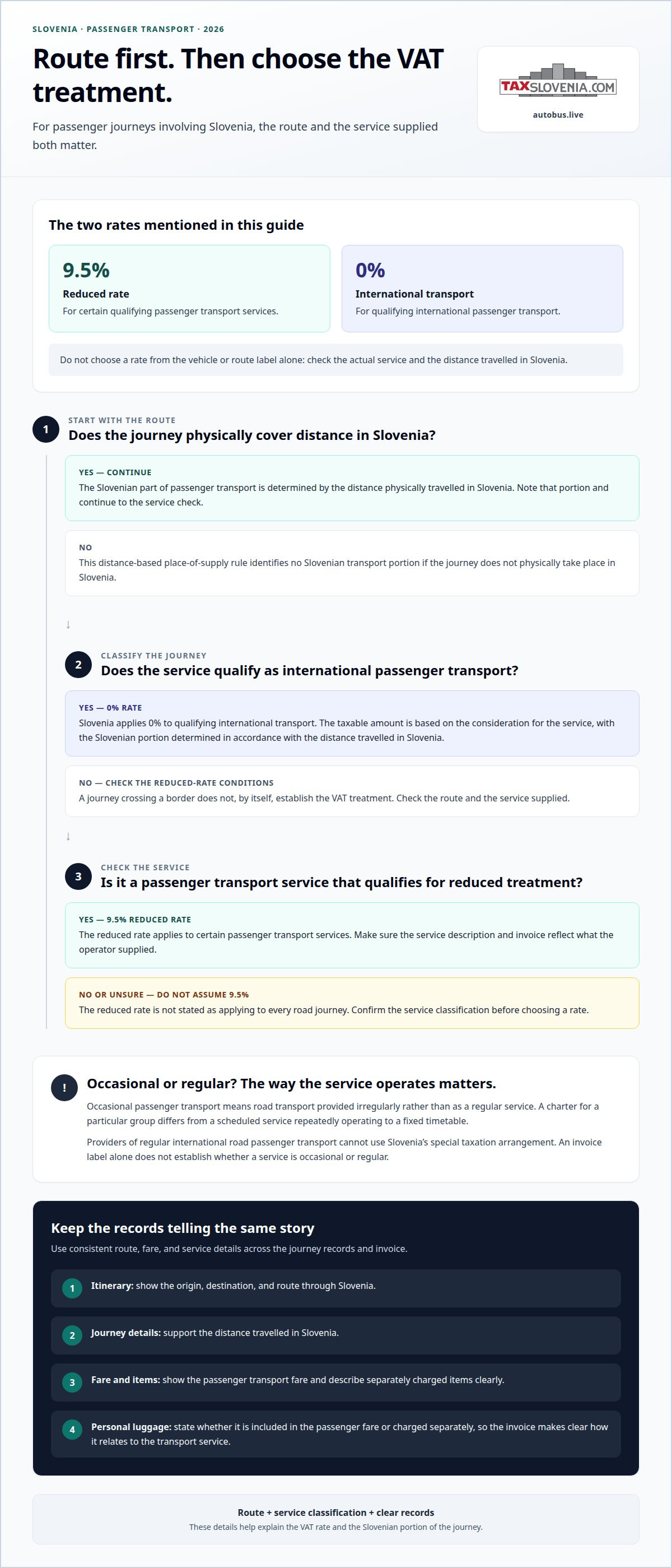
The VAT rate for occasional passenger transport in Slovenia in 2026 depends on the type of journey. Slovenia applies a 9.5% reduced rate to certain passenger transport services, while international transport is subject to a 0% rate. The route and the part of the journey taking place in Slovenia matter when determining the VAT treatment.
Before operating a route or issuing an invoice, it helps to know how Slovenian VAT applies. This guide explains how the rules treat passenger transport and personal luggage, when international journeys may be zero-rated, and who is responsible for reporting and paying VAT. It also covers the special arrangement for non-resident operators providing occasional international road passenger transport.
Key Takeaways
- Learn when Slovenia’s 9.5% reduced VAT rate applies to passenger transport and how personal luggage fits into the treatment.
- Understand when international journeys may qualify for the 0% VAT rate and why the route matters.
- Identify who must account for VAT by looking at which business is responsible for providing the passenger transport.
- See how the special arrangement affects non-resident operators providing occasional international road passenger transport in Slovenia.
- Know about the EU deemed supplier measure for road passenger transport platforms, scheduled to apply from 1 July 2028, with a possible delay by Member States until 1 January 2030.
Reduced VAT treatment of passenger transport and personal luggage
Slovenia applies a reduced VAT rate to certain passenger transport services, but the correct treatment depends on the service and its route. The description of the service also matters when the fare includes personal luggage.
Occasional passenger transport qualification
For VAT purposes, occasional passenger transport means road transport provided irregularly rather than as a regular service. The distinction matters because providers of regular international road passenger transport cannot use Slovenia’s special taxation arrangement.
A charter arranged for a particular group differs from a scheduled service that repeatedly operates to a fixed timetable. Describe the actual service consistently in contracts, itineraries, bookings, and invoices. These records help establish whether the journey is occasional or regular, which affects the available VAT treatment. An invoice label alone does not show how the transport operates.
Place of supply for passenger transport
For VAT purposes, passenger transport is supplied in Slovenia to the extent that the transport physically takes place there, measured by distance. A cross-border route passing through Slovenia therefore includes a Slovenian transport portion.
For example, a coach journey from Croatia to another country may cover part of its distance in Slovenia. The route, not the operator’s headquarters or the passenger’s starting point alone, determines the Slovenian portion. Keep the itinerary and route details consistent with the service reported for VAT. This territorial rule distinguishes the Slovenian part of the journey from sections travelled elsewhere.
Applicable rate for occasional transport
Slovenia’s reduced VAT rate is 9.5% for certain passenger transport services. For occasional passenger transport in Slovenia in 2026, the rate depends on whether the service qualifies for that reduced treatment. Article 48 of the Directive is identified as applying to the described passenger transport service, but the rate should not be assumed for every service simply because passengers travel by road.
Personal luggage needs clear treatment in the service description. State whether it is included in the passenger fare or charged as a separate item, so the invoice shows what the operator supplied. The 9.5% rate relates to qualifying passenger transport; the description should make clear how luggage relates to that service.
VAT paid on costs connected with transport may also be relevant to a refund claim. EU-established businesses may generally claim Slovenian VAT refunds through the EU VAT refund procedure by 30 September of the following year. Keep cost documents connected to the Slovenian activity and use the applicable refund procedure. The refund process is separate from deciding which VAT rate applies to the passenger fare.
The wider VAT reporting context is also changing. The EU ViDA e-invoicing and digital reporting changes are estimated to reduce VAT fraud by up to €11 billion per year. The EU ViDA e-invoicing changes are estimated to reduce administrative and compliance costs for EU traders by over €4.1 billion per year over ten years. These projected effects describe wider expected impacts and do not specify a passenger transport rate.
Zero-rating for intra-Community and international transport
Slovenia applies a 0% VAT rate to international transport. For a cross-border passenger journey, the operator must distinguish the international service from the distance physically travelled in Slovenia. The route and the service supplied provide the practical basis for assessing the Slovenian VAT treatment. An international itinerary alone does not explain how the journey is recorded or which part relates to Slovenia.
A coach travelling from Croatia through Slovenia to another country is one example. The itinerary identifies the route, and journey records can show the distance covered in Slovenia. These details help link the invoice to the transport provided. Keep the route description and fare information consistent, particularly when a journey crosses several borders.
The taxable amount for international passenger transport is based on the consideration for the service, with the Slovenian portion determined in accordance with the distance covered in Slovenia. The 0% rate means no VAT is charged on qualifying international transport, but the amount and route still need clear records for VAT reporting.
Intra-Community transport describes a journey between EU Member States, while international transport can also involve a destination outside the EU. For Slovenia, the key practical detail is whether the journey qualifies as international transport for the stated 0% treatment. The route must therefore be reviewed alongside the service classification, rather than assuming that every trip crossing a border receives the same treatment.
For a route from Slovenia to another country, the itinerary can show the full journey and the distance travelled in Slovenia. For a route that only transits Slovenia, it can identify the section travelled there. In both cases, the fare, route, and journey records should describe the same passenger service. Identify separate charges clearly so the transaction can be understood from the documentation.
A practical records set can include:
- The itinerary showing the journey’s origin, destination, and route through Slovenia.
- The fare charged for the passenger transport and any separately described items.
- Journey records that support the distance travelled in Slovenia.
These records help explain both the 0% treatment and the taxable amount used for the Slovenian part of a journey. They also support a clear distinction between international transport and a service that does not meet that description. If a journey’s itinerary or service changes, update the supporting records so they continue to describe the transport performed.
For occasional passenger transport in Slovenia, route details are central to applying the international VAT treatment consistently. A route report organises journey information used to assess the Slovenian distance and prepare related tax reporting.
The Slovenian Financial Administration clarified the special taxation arrangement for non-residents providing occasional international road passenger transport services on Jan. 16. This is a distinct point to check when reviewing who provides an occasional international road passenger service and whether the provider is a non-resident. Keep that arrangement in view alongside the route, fare, and distance records, so the treatment of the service is assessed with its provider status and journey details together.
Slovenia VAT rates
Slovenia has a standard VAT rate of 22%, alongside reduced rates of 9.5% and 5%. The correct rate depends on the supply being made, not simply the business activity or the customer’s location. For passenger transport, the key distinction is whether the service qualifies for a reduced rate or international zero-rating. A rate should therefore be assigned after identifying the actual service and its route.
The 9.5% rate applies to certain passenger transport services. It is the relevant reduced rate for qualifying passenger transport, including an occasional journey that meets the applicable conditions. It does not follow that every service involving a passenger or vehicle receives that rate. An operator should distinguish the transport service from other supplies shown on the same invoice and describe each charge clearly.
Slovenia also has a 5% reduced rate for certain publications and other qualifying goods and services. Physical and electronic books and newspapers are listed among those publications. This rate is useful context when reviewing Slovenia’s VAT structure, but it is not the passenger transport rate. A coach fare should not be assigned 5% merely because a business also supplies goods or services that may qualify for it.
The standard 22% rate provides another important comparison. Carbonated and sweetened drinks with added sugar or sweeteners have been taxed at 22% since January 2025. That example shows why the type of supply matters: Slovenia’s rates are not determined by a business’s general label, such as “transport operator.” For each transaction, identify what the customer receives and whether a specific reduced or zero rate applies.
For passenger journeys, separate the rate decision into clear questions. First, identify whether the invoice concerns passenger transport or a distinct supply. Next, consider whether the transport qualifies for the 9.5% reduced rate or the 0% international treatment. If neither applies, the 22% standard rate is the general benchmark. These categories help prevent rates for publications or other qualifying supplies from being confused with transport rates.
- 9.5%: certain passenger transport services.
- 5%: certain publications, including physical and electronic books and newspapers.
- 22%: Slovenia’s standard rate, including qualifying carbonated and sweetened drinks from January 2025.
- 0%: international transport, where the service qualifies for that treatment.
For a 2026 invoice, match the rate to the service description and route evidence. A clear description helps explain why a passenger fare uses the reduced rate or why an international journey receives zero-rating. Keep other invoice items identifiable rather than treating the whole transaction as one undivided passenger fare. That distinction supports consistent rate application across journeys and reporting periods.
VAT collection and remittance responsibilities
The business responsible for providing passenger transport generally handles the related Slovenian VAT obligations. For foreign operators, registration, reporting, payment, and record-keeping depend on the service and the applicable reporting arrangement.
Operator VAT collection and remittance
An EU or non-EU operator responsible for passenger transport in Slovenia must account for its Slovenian VAT obligations. Non-resident businesses must register from their first taxable transaction in Slovenia; the domestic turnover threshold does not apply.
Non-residents providing occasional international road passenger transport can use Slovenia’s special taxation arrangement. It simplifies registration, calculation, and payment, but each journey must be registered before it takes place. Providers of regular international road passenger transport cannot use this arrangement.
VAT returns and payments are generally due by the last working day of the month after the reporting period. Most registered businesses file monthly, and businesses in their first year of VAT registration must file monthly regardless of turnover. Certain smaller taxpayers may qualify to file quarterly.
Transport invoices and records
Invoices and records should identify the passenger service, fare, and route clearly enough to support the reported VAT treatment. For a journey crossing Slovenia, retain the itinerary and route details showing the distance travelled in Slovenia, along with documents recording the transport charge.
Keep the transport documents, invoices, and VAT records together so the reported transaction can be traced to the journey. Slovenian VAT records must generally be retained for 10 years. For occasional journeys under the special arrangement, retain the record of each transport registration made before departure.
Responsibility depends on who actually provides the service. If a foreign transport company carries passengers in Slovenia and is fully responsible for the transport, it must register and report for Slovenian VAT. If it only hires out a vehicle and another company assumes full responsibility for passenger transport, the vehicle hire alone does not create the registration obligation described here. A travel agency responsible for the passengers may instead be required to register.
Late payment has a direct daily consequence: Slovenia applies a penalty of 0.0247% of the outstanding amount per day of delay. Timely returns and payments matter, including when an operator uses the special arrangement.
For platform-mediated road passenger transport, the European Union requires platforms to apply the deemed supplier measure from 1 July 2028, although Member States may delay implementation until 1 January 2030. Under this measure, platforms collect and remit VAT when suppliers using them do not do so. This future rule changes who accounts for VAT in relevant platform transactions, not the need to identify the responsible party under current arrangements.
Occasional passenger transport VAT in Slovenia 2026
For Slovenian VAT purposes, occasional passenger transport means non-regular road passenger journeys, rather than regular international road services. This distinction matters because Slovenia’s special taxation arrangement is available to non-residents providing occasional international road passenger transport, but not to providers of regular international road transport.
How the service actually operates matters more than its label on a booking or invoice. A journey arranged for a specific group and itinerary may be occasional, while repeated services operating as regular transport fall outside the special arrangement. Calling a service a charter does not determine its VAT classification. Contracts, itineraries, and trip records should reflect how the service operates.
For a foreign operator, the key question is whether the company is responsible for carrying passengers. A transport company fully responsible for the service must register and report for Slovenian VAT when it carries passengers there. If it only hires out a vehicle and another company takes full responsibility for passenger transport, the vehicle-hiring company is not required to register in the situation described.
Non-resident operators providing occasional international road passenger transport can use Slovenia’s special taxation arrangement. It simplifies registration, calculation, and payment, but each journey must be registered before it takes place. Providers of regular international road passenger transport cannot use this arrangement. Determine which type of service applies before using the special arrangement.
Registration timing depends on the operator’s status and the activity. Non-resident businesses must register from their first taxable transaction in Slovenia. Slovenian-established businesses must register when annual taxable turnover exceeds €60,000 within a 12-month period. Businesses must register at least 8 days before starting activities requiring VAT payment, while registration applications typically take up to 15 days after correct documents are submitted.
For each occasional journey, organise the relevant records around these details:
- The trip itinerary and route, including the Slovenian portion.
- The company responsible for providing passenger transport.
- The date when the journey is registered under the special arrangement.
- The transport charge and records supporting the related VAT calculation.
Slovenia’s special arrangement also sets the tax period and the procedures for submitting and correcting the special VAT statement. Keep journey records aligned with each statement so every trip can be traced from advance registration through reporting and payment. This is especially useful if the schedule or route changes after the original details have been recorded.
Use the route reporting process to organise trip information for Slovenia before each journey.
TaxSlovenia and TaxCroatia: VAT registration in Slovenia
TaxSlovenia and TaxCroatia helps foreign bus companies with Slovenian VAT registration and reporting for passenger transport. Operators can use the service when their journeys create a Slovenian VAT registration or reporting obligation.
A Slovenia route report organises journey details, while a Slovenia tax report supports the related reporting process. Companies operating in both countries can also arrange VAT registration in Croatia. These services cover administrative requirements connected with transport activity in Slovenia and Croatia.
Contact TaxSlovenia and TaxCroatia to arrange VAT registration and reporting for your passenger transport operations in Slovenia.
Prepare your next Slovenian journey with clear VAT records
For VAT planning around occasional passenger transport in Slovenia in 2026, make the next step operational: align the route information, service description, and responsibility for the journey before the relevant reporting work begins. A consistent record helps connect the transport performed with the VAT treatment applied, especially when a route crosses borders or several businesses are involved.
TaxSlovenia and TaxCroatia provides VAT registration in Slovenia, Slovenia route reports, and Slovenia tax reports to support foreign operators with the administrative requirements for passenger transport. These services address transport-related compliance, not the provision of the journey itself.
If you’re preparing for Slovenian operations, contact TaxSlovenia and TaxCroatia to discuss the registration and reporting support relevant to your routes. A clear starting point can help you plan the administrative work with confidence.
Frequently Asked Questions
What VAT registration requirements apply to foreign passenger transport operators in Slovenia?
Foreign operators must register for Slovenian VAT from their first taxable transaction in Slovenia. Non-residents providing occasional international road passenger transport can use the special taxation arrangement, which requires each journey to be registered before it takes place. Registration responsibility depends on which business provides the passenger transport. A company that only hires out a vehicle is treated differently when another company is fully responsible for the transport.
How do Slovenian VAT rules apply to passenger transport by bus, coach, taxi, or minibus?
The vehicle type alone does not determine Slovenian VAT treatment. The key factors are the passenger service supplied, the route, and which business is responsible for providing the transport. For example, a coach journey crossing Slovenia includes transport physically carried out there, while a service provided under another operator’s full responsibility may place the VAT obligation with that operator. The applicable rate depends on the service’s classification and whether the journey qualifies as international transport.


