

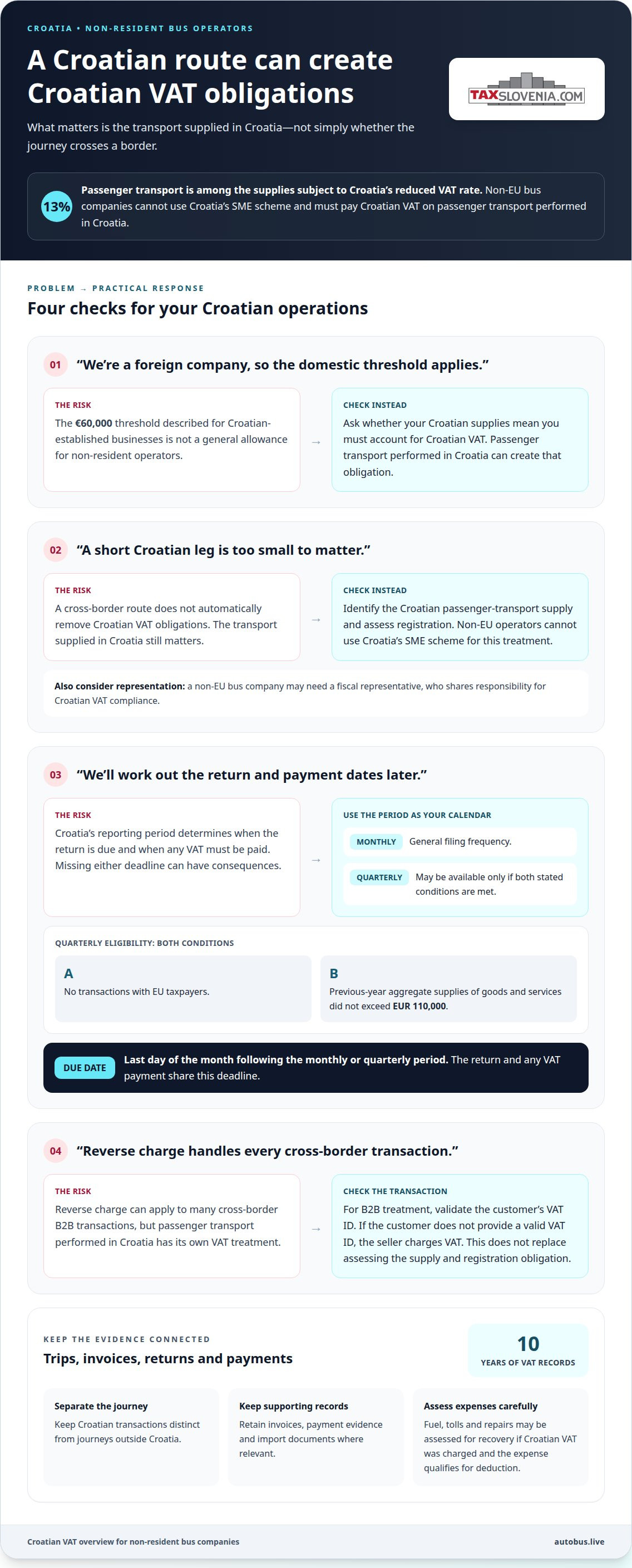
A cross-border route does not automatically remove Croatian VAT obligations. According to the Croatian Tax Administration, non-EU bus companies cannot use Croatia’s SME scheme and must pay Croatian VAT on passenger transport performed in Croatia. Fiscal representation may also be relevant to non-resident businesses’ Croatian VAT obligations.
The rules do depend partly on where your company is based, but the transport supplied in Croatia matters too. This guide explains how Croatia VAT rules apply to non-resident bus companies, when registration and a fiscal representative are required, and when the reverse charge may apply.
You’ll also find the VAT return and payment deadlines, plus an explanation of how the rules apply to passenger transport across borders. These details can help you identify the reporting obligations for your routes and what to account for before operating in Croatia.
Key Takeaways
- For a non-resident operator, the key registration question is whether its Croatian supplies create an obligation to pay Croatian VAT, not simply whether it has crossed a domestic turnover threshold.
- Non-EU bus companies selling in Croatia may need a fiscal representative, who shares responsibility for Croatian VAT compliance.
- Check whether monthly or quarterly reporting applies and align both VAT returns and payments with the relevant filing period.
- Reverse charge can affect cross-border B2B transactions, while passenger transport performed in Croatia has its own VAT treatment.
- Keep Croatian VAT records for 10 years, as required according to the Croatian Tax Administration.
VAT registration for non-resident businesses
A foreign bus company’s registration obligation depends on whether it must account for Croatian VAT on its supplies. The domestic turnover threshold and special rules for cross-border services do not automatically determine a non-resident operator’s position.
Registration Requirements for Foreign Bus Companies
Croatian VAT registration is the entry in the VAT register for a business required to account for Croatian VAT. A non-resident taxable person must register if it has to pay Croatian VAT on goods or services, unless the small-taxpayer procedure applies or its conditions are not met. This matters because passenger transport performed in Croatia can create a Croatian VAT obligation.
For non-EU bus companies, the distinction is direct: according to Porezna uprava, they can’t use Croatia’s SME scheme and must pay Croatian VAT on passenger transport performed in Croatia. Passenger transport is among the supplies subject to Croatia’s 13% reduced VAT rate. A foreign operator therefore shouldn’t assume that a short Croatian leg is outside the VAT rules.
Registration Documents, Steps, and Penalties
To obtain a Croatian VAT number, a foreign company applies to enter the Croatian VAT register and provides information identifying its business and taxable activity. The application should explain which Croatian supplies create the registration obligation. Processing typically takes no more than two weeks after the application is received.
Late Croatian VAT returns can incur fines from €265 to €66,400, and late VAT payment incurs 5.89% interest. These consequences make it important to address registration alongside return filing and payment, rather than treating registration as a separate administrative formality.
Croatian-established businesses must enter the VAT register when taxable supplies exceed €60,000 in the previous or current calendar year. That domestic threshold is not a general allowance for foreign businesses. A non-resident operator’s obligation instead turns on whether it owes Croatian VAT, so a foreign company may need registration without relying on the domestic turnover threshold.
Digital services have a separate cross-border threshold. The EU-wide threshold for cross-border B2C digital, telecoms, and broadcasting services is €10,000; above it, Croatian VAT must be charged directly or the supplier may elect to use OSS. This threshold concerns those digital services, not passenger transport, and shouldn’t be used to assess bus-route sales.
In many cross-border B2B transactions, the Croatian business customer accounts for VAT under the reverse-charge mechanism. The seller should validate the customer’s VAT ID; if the customer doesn’t provide a valid VAT ID, the seller charges VAT. This treatment can change who accounts for tax, but it doesn’t replace the need to assess the actual supply and registration obligation.
Keep records after registration. According to the Croatian Tax Administration, businesses in Croatia must retain VAT records for 10 years. For a bus operator, consistent records help connect Croatian passenger transport, invoices, VAT returns, and payments across reporting periods.
VAT return filing deadlines
Croatian VAT reporting follows the taxpayer’s assigned period, which may be monthly or quarterly. This period determines when the return must be submitted and any VAT due paid. For a non-resident bus operator, matching trip invoices and expense records to each reporting period helps keep the return complete.
For a monthly or quarterly period, Croatian VAT returns must be submitted by the last day of the month following the period. VAT payment is due by the same deadline. For example, the return and payment for a monthly period are due by the last day of the following month. Track both obligations in a filing calendar.
Monthly filing is the general frequency, but some taxpayers may qualify to file quarterly. A taxpayer may submit quarterly returns if it had no transactions with EU taxpayers and its previous-year aggregate supplies of goods and services did not exceed EUR 110,000. Both conditions matter; turnover alone does not establish eligibility.
Quarterly eligibility should be considered against the company’s transaction history and reporting status, not assumed from its size. A bus operator handling Croatian journeys should identify whether it has transactions with EU taxpayers during the relevant period. If it does, the stated quarterly eligibility conditions are not met, even if its previous-year supplies are below EUR 110,000.
Can non-resident bus companies reclaim Croatian VAT on fuel, tolls, repairs, and other expenses? Recovery depends on whether Croatian VAT was charged and whether the expense qualifies for deduction under the applicable rules. Keep invoices and supporting records so each expense can be assessed and included in the appropriate VAT return or refund process.
Record expenses and passenger transport income by reporting period. Separate Croatian transactions from journeys outside Croatia, and retain invoices, payment evidence, and import documents where relevant. This makes it easier to reconcile amounts entered in the return with the underlying records. Businesses must retain VAT records for 10 years according to the Croatian Tax Administration.
What are Croatia’s VAT return filing and payment deadlines for non-resident companies? Returns and any VAT due are generally due by the last day of the month following the monthly or quarterly tax period. The reporting frequency determines the relevant period, so record the return deadline and payment date together in the company calendar.
A Croatia monthly tax report can support the ongoing work of organizing Croatian journey information for reporting periods.
VAT registration for non-resident taxable persons
For a foreign taxable person, Croatian VAT registration depends on whether the business must account for Croatian VAT on its supplies. The key questions are where the supply takes place and who accounts for the tax. A non-resident’s status alone does not settle the obligation.
A taxable person without a registered seat, permanent residence, or habitual residence in Croatia must enter the Croatian VAT register if obliged to pay Croatian VAT on supplied goods or services. The small-taxpayer procedure may affect this requirement, subject to its conditions. Bus operators should distinguish passenger transport performed in Croatia from services supplied elsewhere before assessing registration.
The domestic threshold is a different test. A business with a registered seat, permanent residence, or habitual residence in Croatia must enter the register if its supplies exceed EUR 60,000 in the previous or current year. That threshold applies to businesses established in Croatia. It isn’t a general turnover allowance for foreign operators, whose obligation follows whether they must pay Croatian VAT.
Passenger transport performed in Croatia is subject to the 13% reduced VAT rate. This rate helps explain why identifying the place of a transport supply matters, but it does not replace the registration test. For example, a foreign operator should distinguish a Croatian passenger journey from the parts of a route supplied outside Croatia, then assess the Croatian supply under the applicable rules.
The EU One-Stop Shop (OSS) is relevant to certain digital businesses, not a general registration route for bus transport. Businesses selling digital products can register in one EU member state through OSS on behalf of the entire EU. For cross-border B2C digital, telecommunications, and broadcasting services, the EU-wide threshold is €10,000. Above it, the supplier must charge Croatian VAT directly or may elect to use OSS.
The digital threshold should not be applied to passenger transport. A bus company should first classify its supply: passenger transport, digital services, and other taxable supplies follow different rules. Using OSS for eligible digital sales does not, by itself, remove a separate Croatian VAT obligation for passenger transport.
For a practical assessment, list each supply made in Croatia, identify whether the company must account for Croatian VAT, and distinguish digital sales from transport. Compare the result with Croatia’s establishment threshold only if the business has a registered seat, permanent residence, or habitual residence there. This keeps the foreign-company registration question separate from domestic turnover rules.
B2B reverse-charge treatment
Reverse charge changes which party accounts for value-added tax in a qualifying transaction. In many cross-border B2B transactions, the Croatian customer accounts for VAT instead of the supplier charging it. For a non-resident bus operator, the first task is to distinguish a sale to a business from passenger transport supplied to passengers.
The treatment does not apply automatically to every invoice involving a Croatian company. Identify the customer, the goods or services supplied, and whether the transaction is cross-border. A transport ticket sold to a passenger and a separate service supplied to a Croatian business are different transactions, so do not treat them as one VAT category.
For a B2B transaction, validate the Croatian customer’s VAT ID before applying reverse charge. If the customer doesn’t provide a valid VAT ID, the seller should charge VAT. This step matters because the customer’s business status and the transaction details affect who accounts for the tax.
A practical review can follow a short sequence:
- Identify whether the customer is a business or a passenger.
- Record what goods or services the invoice covers and where the transaction takes place.
- Validate the customer’s VAT ID for a B2B sale.
- Apply the treatment that fits the transaction, then retain the invoice and supporting records.
For example, if a foreign operator invoices a Croatian business for a qualifying cross-border B2B service, the Croatian recipient accounts for VAT under reverse charge. If that same operator sells a passenger journey, the buyer is not the Croatian business recipient in that example. The reverse-charge treatment for a B2B transaction shouldn’t be carried over to the passenger sale without assessing its separate VAT treatment.
The reverse charge does not mean a supply is exempt. It changes who accounts for VAT, but does not remove the need to analyse the tax treatment or issue accurate invoices. Keep the customer’s VAT details, the description of the supply, and the basis for the treatment together so the return can be reconciled with the transaction.
VAT registration and reverse charge are related, but they answer different questions. Registration concerns whether the foreign supplier must enter Croatia’s VAT register. Reverse charge concerns who accounts for VAT on a particular B2B transaction. A Croatian business customer accounting for VAT on one supply doesn’t establish the treatment of the operator’s other goods and services.
Annual turnover alone doesn’t decide whether reverse charge applies to an individual invoice. The transaction type, customer status, and valid VAT ID are the practical checks. Apply them to each B2B sale, and keep passenger transport supplies separate from services invoiced to businesses inside or outside Croatia.
Cross-border and international transport
A bus crossing several countries needs a country-by-country view of its passenger transport supplies. For Croatia, the key distinction is whether the passenger transport is performed there. A journey continuing beyond the Croatian border does not make every part of its route subject to the same VAT treatment.
How does Croatian VAT treatment compare for EU and non-EU bus companies? According to the Croatian Tax Administration, non-EU bus companies cannot use Croatia’s SME scheme and must pay Croatian VAT on passenger transport performed in Croatia. EU operators should not assume the same SME restriction applies to them; their treatment still depends on their supplies and registration obligations.
Croatia’s VAT rules align with EU VAT directives, but international travel still requires attention to the actual transaction. Croatia applies a 13% reduced VAT rate to passenger transport. The presence of another country on the itinerary doesn’t itself establish a zero rate for Croatian road transport. A listed zero-rate treatment for international passenger transport excludes rail and road transport.
For example, an operator running a route between two countries should identify the passenger transport activity performed in Croatia and record it separately. The route’s endpoints, countries crossed, passenger service, and recipient all help describe the transaction. These details support accurate Croatian reporting and prevent a general international label from replacing the correct VAT treatment.
For each journey, keep route and transaction records that show:
- The countries included in the scheduled route and the Croatian transport activity.
- The passenger service supplied and the related journey documentation.
- The recipient or customer information recorded for the transaction.
- The invoices and reporting records associated with the Croatian activity.
These records help separate Croatian operations from transport outside Croatia. They also give the tax administration a clearer account of the supplies included in Croatian VAT reporting. Keep route documentation consistent with invoices and reporting periods, especially when the same vehicle serves multiple countries or makes separate journeys.
International passenger transport should therefore be assessed by supply and territory, not by route label alone. Non-EU operators face the specific SME-scheme restriction described above, while EU operators must assess their own Croatian VAT position. A route report can help organize the journey details used for Croatian reporting. Use a Croatia route report to structure route information for this process.
TaxSlovenia and TaxCroatia: VAT registration in Slovenia
TaxSlovenia and TaxCroatia helps foreign bus operators with VAT registration in Croatia and Slovenia. If your routes include both countries, its Slovenia route report and Slovenia tax report support the route and tax reporting work for journeys there. For Croatian operations, its services include VAT registration and tax reporting.
Use these services when you need VAT registration or reporting support for operations in Croatia, or route and tax reports for journeys in Slovenia. They are a practical next step after identifying the Croatian VAT obligations that apply to your transport activity.
Contact TaxSlovenia and TaxCroatia or visit autobus.live to discuss the registration or reporting support relevant to your routes.
Prepare your next Croatian route with a clear VAT process
Before adding a route or changing how passengers are served, include a VAT review in your operational planning. Keep route details, customer information, invoices, and reporting records aligned so your team can explain how each Croatian transaction was treated. This provides a clearer starting point when routes, recipients, or services change.
The practical next step is to apply the rules to your company’s actual operating pattern, rather than rely on a general cross-border assumption. A focused review of Croatia VAT for non-resident bus companies can help identify the registration and reporting work for your planned activity. If your routes also involve Slovenia, consider how records for both countries fit into the same reporting workflow.
TaxSlovenia and TaxCroatia supports foreign bus companies with the relevant VAT and reporting services for Croatia and Slovenia. Contact TaxSlovenia and TaxCroatia to discuss the next step for your routes and VAT process. With the route details organized, you can move forward with a clearer compliance plan.
Frequently Asked Questions
Do foreign businesses need a fiscal representative in Croatia?
Foreign businesses should check whether they need local VAT representation before making taxable supplies in Croatia. For a bus operator, this requirement applies alongside the assessment of VAT on passenger transport performed in Croatia. The representative requirement and VAT registration obligation are related but distinct. An EU-based operator should not assume the non-EU rule applies simply because it is foreign.
How often must VAT returns be filed in Croatia?
Croatian VAT returns are generally filed monthly, with quarterly filing available to eligible taxpayers. Eligibility includes having no transactions with EU taxpayers and previous-year aggregate supplies of goods and services not exceeding EUR 110,000. Returns are due by the last day of the month following the monthly or quarterly period. Identify the reporting period first, then calendar its return and payment deadline.
What is the Croatian VAT rate?
Croatia’s VAT rates are 0%, 5%, 13%, and 25%. The correct rate depends on the goods or service supplied, so the standard rate shouldn’t be assumed for every invoice. Passenger transport is subject to the 13% reduced rate. For a mixed invoice, identify each supply separately and apply the rate that corresponds to its classification rather than treating the full invoice as one item.
When do I need to register for VAT in Croatia?
A Croatian-established business must enter the VAT register when its taxable supplies exceed €60,000 in the previous or current calendar year. A non-resident follows a different test: registration is required when it must pay Croatian VAT on supplied goods or services, subject to the small-taxpayer procedure and its conditions. Assess Croatian taxable activity separately rather than relying on the domestic threshold.
When must a non-resident bus company register for Croatian VAT?
The registration rules for Croatia VAT for non-resident bus companies depend on whether the operator must account for Croatian VAT on its supplies. Passenger transport performed in Croatia can create that obligation, subject to the small-taxpayer procedure and its conditions. For a planned route, identify the Croatian transport activity and distinguish it from services supplied elsewhere before determining the company’s registration position.
What Croatian VAT rates apply to bus passenger transport and related services?
Passenger transport is subject to Croatia’s 13% reduced VAT rate. Related services shouldn’t automatically be assigned the same rate, because the applicable rate depends on what each service supplies and how it is classified. For example, separate transport and ancillary service lines on an invoice should be reviewed individually. Croatia also has 5% and 25% rates, so classify each taxable supply before invoicing.
How is Croatian VAT calculated on international bus journeys that pass through Croatia?
For international road passenger journeys, identify the transport performed in Croatia and apply the Croatian passenger-transport treatment to that activity. Croatia’s 13% rate applies to passenger transport; a general zero-rate description for international transport doesn’t include road transport. Keep route and journey records that distinguish the Croatian segment from travel in other countries, and use them to support Croatian transaction reporting.
Are passenger transport services supplied entirely outside Croatia subject to Croatian VAT?
No. Passenger transport supplied entirely outside Croatia is not Croatian passenger transport, so that service alone does not create Croatian VAT. For example, distinguish a journey completed outside Croatia from another service that includes travel within Croatia. Operators handling journeys in multiple countries should keep separate journey records and invoices so the territorial scope of each service is clear.


