

For bus operators, Croatia’s monthly VAT return requirement generally begins when a foreign taxpayer receives a Croatian VAT identification number. Monthly Croatian VAT reports are due from that date. However, filing requirements for foreign taxpayers carrying out occasional international road passenger transport may differ from the general monthly pattern. This distinction is central to understanding a monthly tax return for bus operations in Croatia.
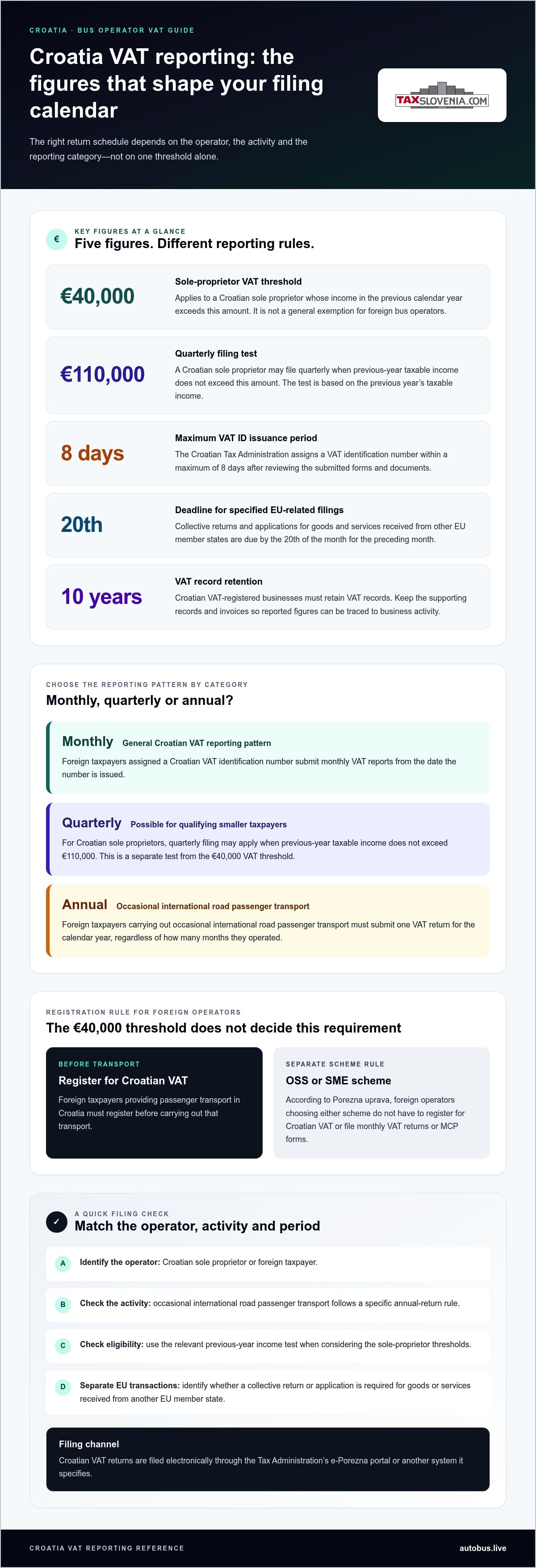
The EUR 40,000 threshold applies to Croatian sole proprietors whose income in the previous calendar year exceeds that amount. It doesn’t remove the separate registration requirement for foreign taxpayers providing passenger transport in Croatia, who must register for Croatian VAT before carrying out that transport.
It’s understandable to focus on the threshold when planning tax returns, but the operator type and applicable reporting category matter too. This article explains how the threshold affects registration, when monthly or annual returns apply, and what Croatian VAT reporting involves, so you can identify the filing pattern relevant to your bus operations.
Key Takeaways
- The EUR 40,000 threshold applies to Croatian sole proprietors based on income in the previous calendar year; it doesn’t replace the VAT registration requirement for foreign bus operators providing passenger transport in Croatia.
- Identify whether monthly or annual reporting applies to your operation: foreign taxpayers with a Croatian VAT identification number submit monthly reports from the date it is issued, while occasional international road passenger transport has an annual return requirement.
- Check the reporting period before preparing a return, since filing frequency can depend on the operator category and the type of activity.
- Croatian VAT returns are filed electronically through the Tax Administration’s e-Porezna portal or another system it specifies.
- Understand how VAT registration and reporting fit together before operating in Croatia; the article also explains where Croatia-specific registration and reporting support can help.
VAT registration threshold and returns
A VAT registration threshold is an income level that may help determine whether a business needs to register for VAT. For Croatian sole proprietors, the threshold is income above EUR 40,000 in the previous calendar year. This threshold applies to sole proprietors; it is not a general exemption for every foreign bus operator in the country.
VAT registration is the process of entering the Croatian VAT system before making taxable supplies. Foreign taxpayers providing passenger transport in Croatia must register before carrying out that transport. Their obligation depends on the activity, not on whether their income exceeds the sole-proprietor threshold. As a result, a foreign bus company should not use the EUR 40,000 threshold alone to decide whether registration is required.
A Croatian VAT identification number is the identifier assigned after the registration documents are reviewed. The Croatian Tax Administration assigns the number within a maximum of 8 days after reviewing the submitted forms and documents. The date of issue also matters for reporting: foreign taxpayers assigned a Croatian VAT identification number must submit monthly VAT reports from that date. Keep the registration decision and its issue date with the company’s taxation records.
An annual VAT return reports VAT for the preceding year, and filing requirements can depend on the taxpayer and activity. Foreign taxpayers carrying out occasional international road passenger transport must submit one for the calendar year, regardless of how many months they operated. This differs from monthly reporting, so both the operator’s category and its activity matter when determining the return schedule.
VAT records are the documents and accounting information used to support VAT reporting. Croatian VAT-registered businesses must retain VAT records for 10 years. Keep the records and invoices that support the transactions entered in each return, so figures can be traced back to the relevant business activity. This answers a practical question for bus companies: retain VAT records and supporting invoices for the reporting period, and preserve them for the required 10-year period.
The OSS or SME scheme can affect a foreign operator’s registration and reporting requirements. According to Porezna uprava, foreign operators choosing either scheme do not have to register for Croatian VAT or file monthly VAT returns or MCP forms. This is separate from income tax, annual income, personal allowances, and contributions, which are different areas of national taxation. Before choosing a reporting approach, identify the applicable scheme and whether the operation involves occasional passenger transport or another category. This distinction helps determine whether Croatian registration and an annual or monthly return apply.
VAT return filing frequency
A filing frequency is the interval covered by a VAT return, such as a month or quarter. Croatian VAT returns are generally filed monthly, but some smaller taxpayers may qualify for quarterly filing. For Croatian sole proprietors, the previous year’s taxable income is a key test: quarterly returns may be filed when it does not exceed EUR 110,000.
Quarterly filing groups VAT activity into a three-month reporting period instead of separate monthly returns. The EUR 110,000 test refers to taxable income in the previous year, not the number of journeys in the current period. A sole proprietor should therefore identify the correct previous-year figure and compare it with the threshold before planning quarterly reporting. If the income exceeds EUR 110,000, this specific quarterly eligibility rule does not apply.
Monthly filing covers transactions for each reporting month and is the general pattern for Croatian VAT returns. For foreign bus operators, the monthly or annual route depends on the taxpayer’s reporting category and activity. For occasional international road passenger transport, filing may follow a different schedule from ordinary monthly VAT returns. This is a distinct rule, not a reason to assume every operator can choose annual filing.
A collective tax return is a filing concerning relevant transactions with other EU member states. When those transactions occur, Croatian collective tax returns and applications for goods and services received from other EU member states are due by the 20th of the month for the preceding month. For example, the filing relates to the prior month’s transactions, rather than the current month’s activity. The Tax Administration distinguishes these reports from the ordinary VAT return, so operators should identify which filing corresponds to each transaction.
Use a simple period check before preparing each return:
- Identify whether the taxpayer is a Croatian sole proprietor or a foreign operator.
- For a sole proprietor considering quarterly filing, compare previous-year taxable income with EUR 110,000.
- Separate EU goods and services received from other VAT activity, then identify any collective return or application required for those transactions.
- Record the reporting period and filing category so that amounts are grouped consistently.
VAT filing frequency is separate from income tax, employment reporting, pension contributions, personal allowances, and income-tax rates. Those topics follow different rules and should not determine whether a VAT return is monthly or quarterly. The practical steps are to classify the taxpayer, check the previous year’s taxable income where the sole-proprietor rule applies, and sort transactions by reporting period before filing.
Which Croatian taxes must bus operators report and pay monthly?
Monthly tax reporting means submitting required information for a reporting month. For bus operators, Croatian VAT is the main monthly tax obligation when monthly reporting applies. Other monthly filings depend on whether the company has employees or operates as a sole proprietor.
Value added tax (VAT) is a tax reported on taxable transactions. Foreign taxpayers with a Croatian VAT identification number must submit monthly Croatian VAT reports from the date that number is issued. The standard form is the PDV‑R return. Croatian VAT returns and payments are due by the 15th day of the month following the reporting period.
For example, a return for one reporting month covers that month’s relevant transactions, and the corresponding payment has the same deadline. Keep the return figures aligned with the transactions and supporting records for that period, rather than mixing amounts from different months.
Output VAT is VAT charged on taxable supplies, while input VAT is VAT paid on business purchases. For passenger transport in Croatia, the tax base is the levy received in proportion to the kilometres travelled in Croatia. Foreign taxpayers may deduct Croatian input VAT on goods and services used for their business, including tolls and fuel. If input VAT exceeds output VAT for a reporting period, the credit may be carried forward against future VAT liabilities or refunded under Croatia’s refund procedures.
Social security contributions are payments connected with self-employment or employment. Croatian sole proprietors must pay their social security contributions before the 15th day of the month following the reporting month. This payment is separate from a VAT return, so a sole proprietor should track both obligations independently.
Payroll reporting is the monthly filing of employee tax and social contribution information. Croatian employers must file monthly payroll reports using Form JOPPD. This applies when the bus company is an employer; it is separate from the PDV-R VAT return.
Use this distinction to organize the month’s reporting:
- Prepare the PDV‑R return and related VAT payment for the applicable reporting period.
- For sole proprietors, schedule social security contributions before the 15th of the following month.
- For employers, prepare the monthly JOPPD payroll report separately from VAT reporting.
A bus operator may therefore have more than one monthly obligation, but each form serves a different purpose. Separating VAT, sole-proprietor contributions, and employer payroll reporting helps ensure each filing reflects the right activity, amounts, and deadline.
Separating monthly obligations such as VAT, social security contributions, and payroll reporting from annual and quarterly income-tax obligations can help keep each filing distinct. Croatian sole proprietors under the basic tax scheme must submit the DOH income-tax return before the end of February in the year after the reporting year. Croatian sole proprietors using the flat-rate tax scheme must pay quarterly income-tax installments before the last day of each quarter: March 31, June 30, September 30, and December 31. Self-employed taxpayers using lump-sum taxation pay any assessed annual tax due when they file the annual reporting form through services provided by TaxSlovenia and TaxCroatia.
How do you file a monthly tax return in Croatia through the e-Tax system?
Electronic filing means submitting a tax return online rather than on paper. Croatian VAT returns must be submitted electronically through the Croatian Tax Administration’s e-Porezna portal or another system it specifies. For a bus operator, start by identifying the reporting month and assembling the figures for that period.
The reporting period is the month covered by a return. Foreign taxpayers assigned a Croatian VAT identification number submit monthly VAT reports from the date the number is issued. Before filing, separate each month’s transactions and match the amounts to invoices and other supporting VAT records.
The PDV-R return is the standard form for Croatian VAT reporting. Prepare it using the taxable transactions, output VAT, and deductible input VAT for the relevant period. For passenger transport, the Croatian tax base relates to the levy received in proportion to the kilometres travelled in Croatia. Link the calculation to the transport activity and records supporting the reported figures.
Use this sequence to prepare an electronic submission:
- Confirm the reporting period and collect the invoices and transaction records for that month.
- Separate the Croatian passenger transport activity and calculate the relevant taxable amounts.
- Complete the PDV-R return with the figures for that reporting period.
- Submit the return electronically through e-Porezna or another system specified by the Croatian Tax Administration.
- Keep the submitted return and supporting records together for later reference.
Submission confirmation is the record that an electronic return has been sent. Retain the return and any available submission record with the monthly VAT documents. This links the figures filed to the reporting period and source records. Keep VAT filing separate from payroll reporting and sole-proprietor contributions, which are different obligations.
VAT payment is the transfer of any amount due for the reporting period. Croatian VAT payments are made by bank transfer using payment instructions provided by the Croatian Tax Administration. The payment deadline is the same as the VAT return deadline, so follow the instructions for the relevant liability and period. If input VAT exceeds output VAT, the return may instead show a credit that can be carried forward or refunded under Croatia’s refund procedures.
For a monthly tax return for bus operations in Croatia, keep the filing and payment steps tied to the same reporting month. The Croatian VAT return is generally due by the 15th day of the month following its reporting period. Before submitting, compare the return with the underlying invoices and transport records, then retain the filed form, submission record, payment details, and supporting documents together.
What penalties apply for late or incorrect monthly tax returns in Croatia?
A tax penalty is a consequence of failing to meet a tax obligation. Croatian rules also create a specific risk for company shareholders: they can be held liable for a company’s tax liability if it fails to submit monthly or annual tax returns. A missed filing may have consequences beyond the filing itself.
A tax audit examines a taxpayer’s records and tax position. The Croatian Tax Administration generally sends notice no later than eight days before an audit. An audit may involve reviewing the records behind submitted returns, including documents supporting reported amounts. Keeping each filing linked to its supporting records helps explain how the figures were calculated.
A tax-audit resolution is the Tax Administration’s formal outcome after the audit process. It is issued within 60 days after the deadline for objections to the minutes expires or supplementary minutes are provided. This timeframe describes the resolution process, not a fine amount or an automatic result for every late return.
An appeal is a formal challenge to a tax-audit resolution. In Croatia, a taxpayer may file an appeal within 30 days of receiving that resolution. The appeal period is tied to receipt of the resolution, so retain the document and its delivery details. An audit finding and a late filing are different events; the applicable steps depend on the action the Tax Administration takes.
The statute of limitations sets the period governing tax assessment and collection rights. In Croatia, the Tax Administration’s rights to assess and collect taxes, and a taxpayer’s right to a refund, are subject to a six-year limitation period. The Tax Administration may initiate an audit within three years from the day the limitation period commences, subject to exceptions. These periods concern assessment and audits, not a schedule of late-filing fines.
For a bus company reviewing a missed or inaccurate return, take practical steps in order:
- Identify the reporting period and the return that was due.
- Compare the filed figures with the invoices and records supporting that period.
- Keep the return, correspondence, and any Tax Administration notice together.
- If an audit resolution arrives, note its receipt date and the 30-day appeal period.
The available rules establish shareholder liability for failure to submit returns and set out audit, resolution, and appeal procedures. They do not provide a specific fine amount here, so no figure should be assumed. Distinguish a missed filing from an audit or formal resolution, then follow the deadline attached to the relevant document.
TaxSlovenia and TaxCroatia: VAT registration in Slovenia
TaxSlovenia and TaxCroatia supports foreign bus companies with VAT registration in Croatia and monthly tax reporting in Croatia. These services apply when your operations require Croatian registration and recurring tax reporting. For journeys involving Slovenia, the company also provides VAT registration, route reports, and tax reports in Slovenia.
Choose the service that matches the country and task: Croatian VAT registration addresses registration in Croatia, while a Croatia monthly tax report supports reporting after journeys. Registration and reporting in Slovenia are separate, country-specific services. This distinction helps identify the next administrative step after reviewing the filing rules.
For help with VAT registration or bus-company tax reporting in Croatia or Slovenia, contact TaxSlovenia and TaxCroatia through its website.
Make your next reporting cycle easier to manage
Use the next reporting cycle to establish a clear process for gathering journey information and checking records before tax preparation begins. A monthly tax return for bus operations in Croatia can be one step in that workflow, with records organized by country and reporting period.
Assign responsibility for collecting documents, reviewing figures, and keeping filing records together. A consistent handoff helps your team spot missing information early and prepare for the next reporting cycle without unnecessary last-minute work.
When you’re ready to discuss the administrative work for your bus operations, contact TaxSlovenia and TaxCroatia. A clear starting point can help you plan the next steps with confidence.
Frequently Asked Questions
How often are Croatian VAT returns required?
The filing interval depends on the taxpayer’s reporting category, so establish that category before setting a calendar. Note the operator’s legal form, registration position, and whether its passenger transport is occasional. Then record the applicable filing cycle alongside other tax tasks. This avoids basing the schedule solely on trip frequency, which may not determine the VAT reporting category.
What is the monthly tax return obligation for bus companies in Croatia?
For a company required to report monthly, close each reporting period with consistent transport and accounting records. Coordinate dispatch and finance so journey records can be matched to invoices and amounts recorded for the same period. Assign someone to review the figures before submission, then retain the filed return with its supporting documents. This creates a clear record trail for each cycle.
What are the monthly VAT filing deadlines and rates in Croatia for bus services?
Use the reporting period to identify the relevant deadline, and determine the VAT treatment of each transaction before preparing totals. Don’t assume the rate simply because a service involves a bus. Keep transaction categories clear in your records, then apply the relevant treatment when preparing the return. This helps avoid applying one assumed rate to services that may need separate classification.


