
For a foreign bus operator, Slovenia’s VAT filing calendar is monthly, not annual. The international bus transport tax rules in Slovenia also require businesses without an establishment there to register for VAT before starting taxable transactions. Knowing the reporting schedule in advance helps you prepare for operations.
VAT treatment and vehicle fees follow different rules, so one set of requirements does not apply to every bus journey. This article explains how Slovenia treats vehicles used for public-line and special-line transport, who is liable for the annual motor-vehicle fee, and how VAT registration and returns work for businesses without an establishment in Slovenia.
Understanding how these obligations fit together helps you separate VAT reporting from the fee on registered vehicles and plan your Slovenian tax compliance around each requirement.
Key Takeaways
- Plan for monthly VAT returns if your business is not established in Slovenia, and register before beginning taxable transactions there.
- Understand how the VAT deduction rules treat vehicles used for public-line and special-line transport.
- Separate VAT reporting from the annual motor-vehicle fee, which applies to registered vehicles and is calculated for buses by passenger seat.
- Use the relevant law as the basis for understanding when the annual vehicle fee applies and how it is paid.
- For cross-border journeys, identify which part of the transport takes place in Slovenia to understand the local VAT obligations.
VAT treatment of public and special-line transport vehicles
Public-line transport means passenger transport operated on a public route, while special-line transport refers to passenger transport on a designated line. For VAT purposes, Slovenia treats vehicles used for these services differently from other passenger vehicles: the restriction on deducting VAT for passenger vehicles does not apply to vehicles used for public-line or special-line transport.
The distinction depends on how the vehicle is used, not simply its size or registration as a bus. Identify the service each vehicle performs and keep records linking it to that service. For example, a bus used on a public route falls within the stated category because of its transport use. The exception removes that specific restriction, but does not automatically make every purchase-related VAT amount deductible. The transaction and applicable VAT rules still matter.
Slovenia’s standard VAT rate is 22%. Reduced rates of 9.5% and 5% apply to some goods and services, but these general rates alone do not establish the rate for a particular bus fare or vehicle expense. Keep the rate applicable to each transaction separate from the rule on passenger-vehicle deductions. This helps avoid treating vehicle eligibility and the VAT rate as the same question.
How do Slovenia’s tax rules for international bus transport compare with neighboring countries? Slovenia’s distinction concerns vehicle use for public-line and special-line transport. Other countries may classify transport and vehicle deductions differently, so assess each country’s rules separately rather than applying Slovenia’s treatment across a border.
What excise duties or fuel taxes affect international bus transport in Slovenia? The VAT deduction rule for vehicles used on public-line and special-line services does not set an excise duty or fuel-tax rate. Treat fuel taxation separately from VAT on the vehicle, and retain fuel documents with the relevant journey records.
What tax documentation and records must international bus operators keep in Slovenia? From 1 July 2025, businesses identified for VAT purposes in Slovenia must keep records of charged VAT and VAT deductions and submit them with their VAT return. Operators can organize supporting documents by transaction, vehicle, and journey to connect entries with their VAT reporting.
What penalties apply for tax noncompliance by international bus operators in Slovenia? Consequences depend on the requirement breached, such as registration, return filing, or VAT recordkeeping. Keep evidence of vehicle use and VAT records organized, and submit required returns with supporting information.
Legal basis for the fee
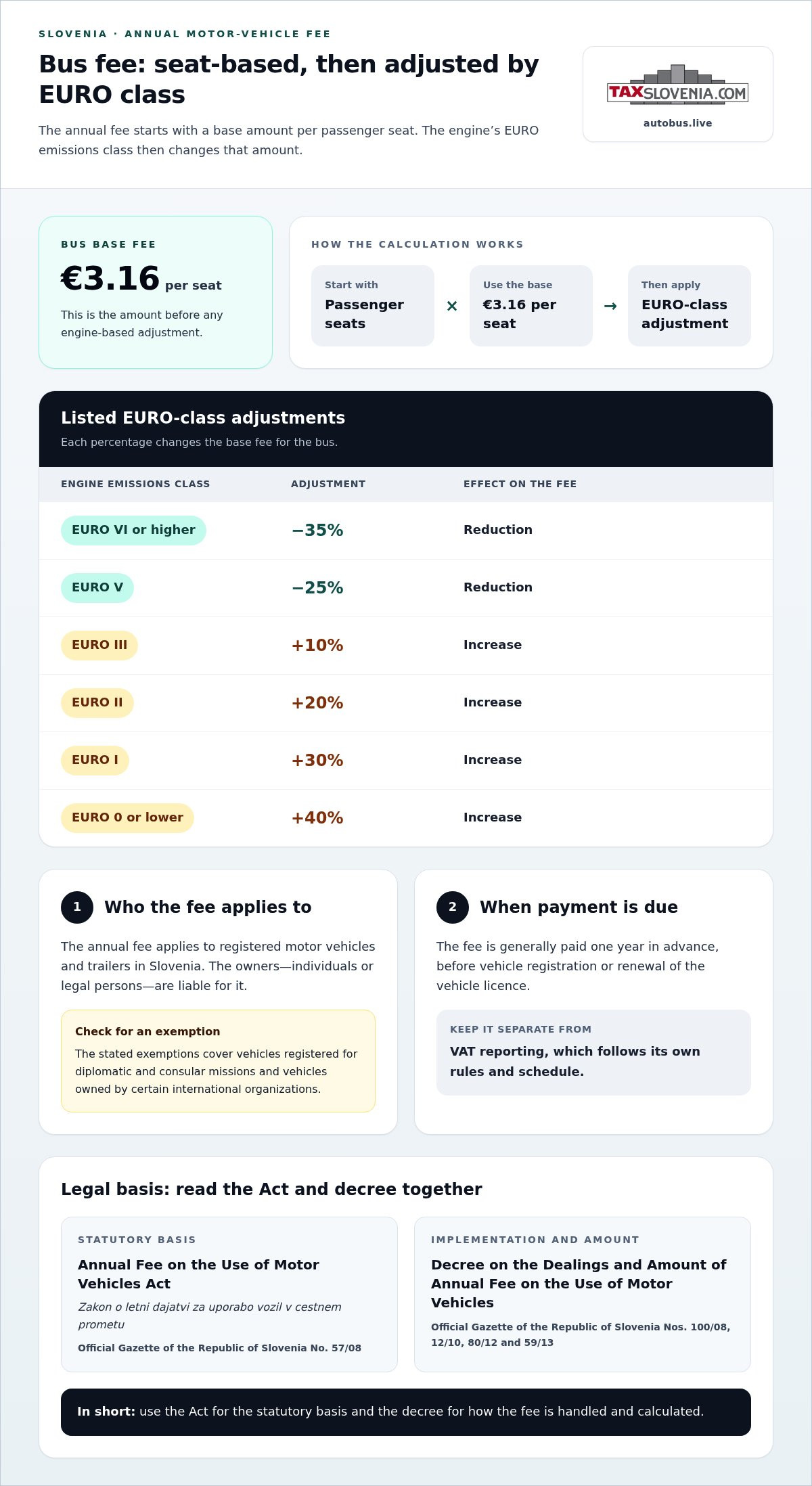
The Annual Fee on the Use of Motor Vehicles Act is the Slovenian law that establishes the annual vehicle-use fee. Its full title is Annual Fee on the Use of Motor Vehicles Act, Zakon o letni dajatvi za uporabo vozil v cestnem prometu, published in Official Gazette of the Republic Of Slovenia No. 57/08.
The annual motor-vehicle fee applies to registered motor vehicles and trailers in Slovenia. Their owners, whether individuals or legal persons, are liable for the fee. The fee applies across Slovenia, and operators should check whether an exemption applies to their vehicle. The stated exemptions cover vehicles registered for diplomatic and consular missions and vehicles owned by certain international organizations.
The implementing decree sets the dealings and amount of the annual fee. The Decree on the Dealings and Amount of Annual Fee on the Use of Motor Vehicles was published in Official Gazette of the Republic of Slovenia Nos. 100/08, 12/10, 80/12 and 59/13. Read the Act and decree together: the Act provides the statutory basis, while the decree specifies how the fee is handled and calculated.
For buses, the annual fee is EUR 3.16 per passenger seat before any engine-based adjustment. The engine’s EURO emissions class changes that amount: EURO VI or higher receives a 35% reduction, and EURO V receives a 25% reduction. EURO III increases the fee by 10%, EURO II by 20%, EURO I by 30%, and EURO 0 or lower by 40%.
To understand the fee for a specific bus, use this sequence:
- Identify whether the vehicle is registered and whether an exemption applies.
- Use the number of passenger seats to calculate the bus’s base amount.
- Apply the adjustment matching the engine’s EURO emissions class.
- Account for payment before vehicle registration or licence renewal.
The annual fee is generally paid one year in advance, before registration or renewal of the vehicle licence. Slovenia’s annual fee on the use of motor vehicles has been in force since 25 June 2008. These dates and payment steps help operators separate the vehicle fee from VAT reporting, which follows its own rules.
For trip planning alongside vehicle-fee administration, a Slovenia route report provides route-related documentation for journeys in Slovenia.
VAT rules for non-established businesses
A non-established business is a business without an establishment in Slovenia. If it plans taxable transactions there, it must register for Slovenian VAT before starting them. Slovenia does not set a VAT registration turnover threshold for these businesses. The requirement depends on whether the planned activity is taxable in Slovenia, not on reaching a particular revenue level. This is a key point in the international bus transport tax rules in Slovenia.
VAT registration identifies a business for VAT purposes in Slovenia. Before operating, a foreign bus company should identify its planned transactions and establish whether they are taxable there. The domestic threshold of €60,000 in a 12-month period does not give a non-established business a waiting period. It applies to domestic taxable persons, while non-established businesses must register before beginning taxable transactions.
A VAT return period is the span covered by a VAT filing. Non-resident taxable persons must file returns monthly in Slovenia. Organize Slovenian transactions by reporting month and prepare each return using the records for that period. Registration timing is separate: register before taxable activity begins, then file according to the applicable reporting cycle. Keeping these steps distinct helps you plan for the international bus transport tax rules in Slovenia based on your journeys.
A VAT refund period is the period covered by a request to recover eligible Slovenian VAT. It cannot exceed one calendar year or be shorter than three calendar months, except when it covers the remainder of a calendar year. EU businesses submit refund requests electronically through the VAT refund portal. Track refund periods separately from monthly VAT returns because the procedures and deadlines differ.
Refund deadlines depend on where the business is established. An EU business must submit its request by 30 September of the year following the year in which the VAT was incurred. A business established in a third country must submit by 30 June of the following year. These dates apply to refund requests, not monthly returns, so record each deadline separately.
For a bus company organizing Slovenian VAT administration, follow this sequence:
- Identify taxable transactions planned in Slovenia.
- Register before starting those transactions, without applying a turnover threshold.
- Prepare monthly VAT returns as a non-resident taxable person.
- Track refund periods and deadlines according to the business’s place of establishment.
For example, an operator established outside Slovenia can set separate calendar reminders for monthly returns and any refund request. Organize transaction records by reporting period and link refund documents to the relevant VAT incurred. This makes it easier to distinguish registration, filing, and refund obligations instead of treating them as one deadline.
How is Slovenian VAT calculated for cross-border bus journeys through Slovenia?
Slovenian VAT calculation means identifying the taxable amount and applying the rate relevant to the supply. For an international bus journey, separate the Slovenian section of the route from its other country legs before calculating VAT. The route alone does not determine which rate applies.
The taxable amount is the amount used to calculate VAT on a transaction. Start with the fare or other consideration for passenger transport, then determine what portion relates to the Slovenian journey. Keep route details and fare records together so the calculation can be traced. If a fare covers multiple legs, use a clear, consistent allocation method.
The applicable VAT rate is the rate assigned to the specific taxable supply. Slovenia’s standard VAT rate is 22%, while reduced rates of 9.5% and 5% apply to some goods and services. These general rates do not, by themselves, establish the rate for every passenger transport service. Identify the service’s VAT treatment before using a rate in the calculation.
A practical worksheet can keep the steps distinct:
- Record the journey’s starting point, destination, and route through Slovenia.
- Separate the Slovenian leg from any legs outside Slovenia.
- Identify the taxable amount attributable to the Slovenian transport service.
- Determine the applicable rate for that supply, then calculate VAT on its taxable amount.
- Carry the result into the relevant VAT records and return.
For example, if a ticket covers a journey from another country, through Slovenia, and onward across a further border, first record each leg. Use the ticket and route documentation to support how the fare has been allocated. Then apply the rate established for the relevant supply. Do not automatically apply 22% to the whole ticket just because Slovenia’s standard rate is 22%.
Route documentation links a transport service to the places served and the fare charged. Keep journey schedules, ticket records, route details, and calculation workings together by service or reporting period. These records help explain why an amount was included in the Slovenian calculation and how the applicable rate was selected.
Non-resident taxable persons must file Slovenian VAT returns monthly. Organize calculations by reporting period and reconcile them with the relevant transaction records before filing. This helps separate three decisions: which service to report, what amount relates to it, and which VAT rate applies.
What tax rules apply to buses entering Slovenia from another EU country?
An EU-established operator is a transport business established in an EU country other than Slovenia. Entering Slovenia alone does not determine the VAT treatment of every journey or vehicle. Identify which activities are taxable in Slovenia, separately from the vehicle’s presence.
A taxable transaction in Slovenia is an activity that falls within Slovenian VAT rules. For an operator based elsewhere in the EU, first identify whether its planned Slovenian activity includes such transactions. If it does, the business must register for Slovenian VAT before starting them. The domestic turnover threshold does not allow non-established businesses to wait before registering.
Consider a coach travelling from another EU country, through Slovenia, and onward to a destination outside Slovenia. Record the route and passenger service separately from the bus’s registration details. The itinerary helps identify the Slovenian activity, while vehicle documents identify the bus and its owner. Keeping the records distinct makes it easier to show which obligations relate to the journey and which relate to the vehicle.
Vehicle-fee liability concerns the annual fee on registered motor vehicles and trailers, not VAT on passenger transport. For an incoming coach, distinguish crossing the border from determining who owns the registered vehicle and whether Slovenian vehicle-fee rules apply. A journey’s VAT calculation is not a substitute for assessing the vehicle-fee position.
For each Slovenian journey, organize the working documents in a consistent order:
- Keep the operator’s establishment details with its Slovenian VAT records.
- File the itinerary, route information, and passenger-service documents together.
- Keep vehicle registration and ownership documents separately identifiable.
- Match transaction records to the relevant VAT reporting period.
This approach separates an EU operator’s business location from where its transport activity takes place. It also keeps trip-specific evidence apart from documents relating to the bus. For example, a route schedule supports the journey record, while vehicle registration documents identify the owner. These records serve different purposes, so keep them organized accordingly.
Cross-border operators can use a Slovenia route report to organize route details for journeys entering or passing through Slovenia. Include the Slovenian itinerary in the transport file, then align that route information with the VAT records for the relevant activity.
TaxSlovenia and TaxCroatia: VAT registration in Slovenia
TaxSlovenia and TaxCroatia helps foreign bus operators register for VAT in Slovenia and manage related journey reporting. Use the service when your business must register before starting taxable transactions or needs route and tax reports for Slovenian operations.
A Slovenia route report organizes route information before a journey, while a Slovenia tax report supports reporting after trips. For operations in Croatia, TaxSlovenia and TaxCroatia also provides VAT registration and reporting services. These services support practical registration and reporting tasks for international passenger transport businesses.
For support with VAT registration or reporting for Slovenian bus journeys, contact TaxSlovenia and TaxCroatia or visit autobus.live.
Put your next Slovenian journey on a clear footing
Make tax administration part of your operating routine for each trip. Before departure, organize route records, vehicle information, and VAT documentation so each has a clear purpose. After the journey, keep related records together for the relevant reporting period. This sequence helps your team apply the rules consistently across repeat routes.
The international bus transport tax rules in Slovenia affect separate parts of an operator’s work, so assign responsibility for each task. A clear internal process helps staff distinguish journey documentation from VAT filings and vehicle-fee records. Review the process when routes or operating arrangements change, and keep supporting documents accessible to the people preparing reports.
For assistance with the next step in your Slovenian tax administration, contact TaxSlovenia and TaxCroatia. A well-organized process gives your team a practical starting point for future journeys.
Frequently Asked Questions
How often do returns have to be submitted?
Non-resident taxable persons file Slovenian VAT returns monthly. Treat each reporting month as a separate filing period, even when journey frequency varies. For example, organize several trips made in one month together for that period rather than waiting until year-end. Keep refund applications on a separate calendar from VAT returns because they follow different procedures and deadlines.
Is there a registration limit for the tax?
There is no turnover threshold for a business not established in Slovenia. It must register before starting taxable transactions there. The €60,000 threshold over a 12-month period applies to domestic taxable persons, not foreign operators relying on a threshold to delay registration. For a bus company based abroad, the practical trigger is the planned start of taxable activity in Slovenia, not the amount of revenue earned.
What VAT rules apply to international passenger bus transport in Slovenia?
Assess the Slovenian part of an international operator’s taxable activity separately from its other country legs. The treatment of a bus used for public-line or special-line transport also differs from the passenger-vehicle deduction restriction: that restriction does not apply to vehicles used for those services. Keep route and vehicle-use evidence distinct. Journey records explain the transport activity, while vehicle records support the vehicle’s classification.
What VAT rates apply to international bus tickets sold in Slovenia?
Slovenia’s standard VAT rate is 22%, and reduced rates of 9.5% and 5% apply to some goods and services. The rate for a bus ticket depends on the VAT classification of the passenger transport supply. Don’t assume that every ticket uses the standard rate, or that a reduced rate applies simply because the ticket is for passenger transport. Base the calculation on the supply’s applicable classification.
Are international bus operators required to register for VAT in Slovenia?
Yes. An operator not established in Slovenia must register before carrying out taxable transactions there, whether it is established in another EU country or outside the EU. For example, a company planning taxable passenger transport in Slovenia should register before operating, rather than wait for Slovenian turnover to reach a domestic threshold.
What taxes or fees apply to non-EU bus operators in Slovenia?
A non-EU operator may need to consider both VAT obligations and the annual motor-vehicle fee. The fee applies to registered motor vehicles and trailers, and liability rests with the owner; the bus amount depends on passenger seats and the engine’s EURO class. A business established outside the EU must also register for Slovenian VAT before taxable transactions. Any VAT refund request follows the applicable third-country deadline.
How do Slovenia’s tax rules for international bus transport compare with neighboring countries?
For VAT deduction purposes, Slovenia distinguishes vehicles used for public-line and special-line transport. Other countries may classify transport and vehicle deductions differently, so assess each country’s rules separately.
What excise duties or fuel taxes affect international bus transport in Slovenia?
The VAT deduction rule for vehicles used on public-line and special-line services does not set an excise duty or fuel-tax rate. Treat fuel taxation separately from VAT on the vehicle, and retain fuel documents with the relevant journey records.


