

A cross-border coach journey is not treated as one taxable stretch in a single country. Foreign coach operator VAT in Croatia depends in part on where passengers are carried: according to Narodne novine d.d., VAT on passenger transport is allocated to each place where the transport occurs, in proportion to the distances travelled.
It is sensible to establish the applicable rule before planning a Croatian journey. The route matters, as do the type of service and whether the operator’s transactions are domestic or cross-border business-to-business services.
This article explains when foreign coach operators may need to register for Croatian VAT, how returns and payment deadlines work, and how passenger transport is treated differently from other cross-border services. It also covers the records and reporting obligations involved, helping you identify the compliance steps that apply to your operations in Croatia.
Key Takeaways
- Understand how Croatian VAT return frequency is determined and the filing deadline that applies to monthly and quarterly returns.
- See how electronic filing and the required registration documents fit into compliance for foreign passenger transport operators.
- Learn why VAT on passenger transport is allocated according to the distances travelled in each place.
- Compare the VAT treatment of qualifying international passenger transport with cross-border B2B transactions and Croatian charters.
- Find out how VAT registration in Croatia can support your reporting obligations when your operations require it.
VAT return filing frequency and deadlines
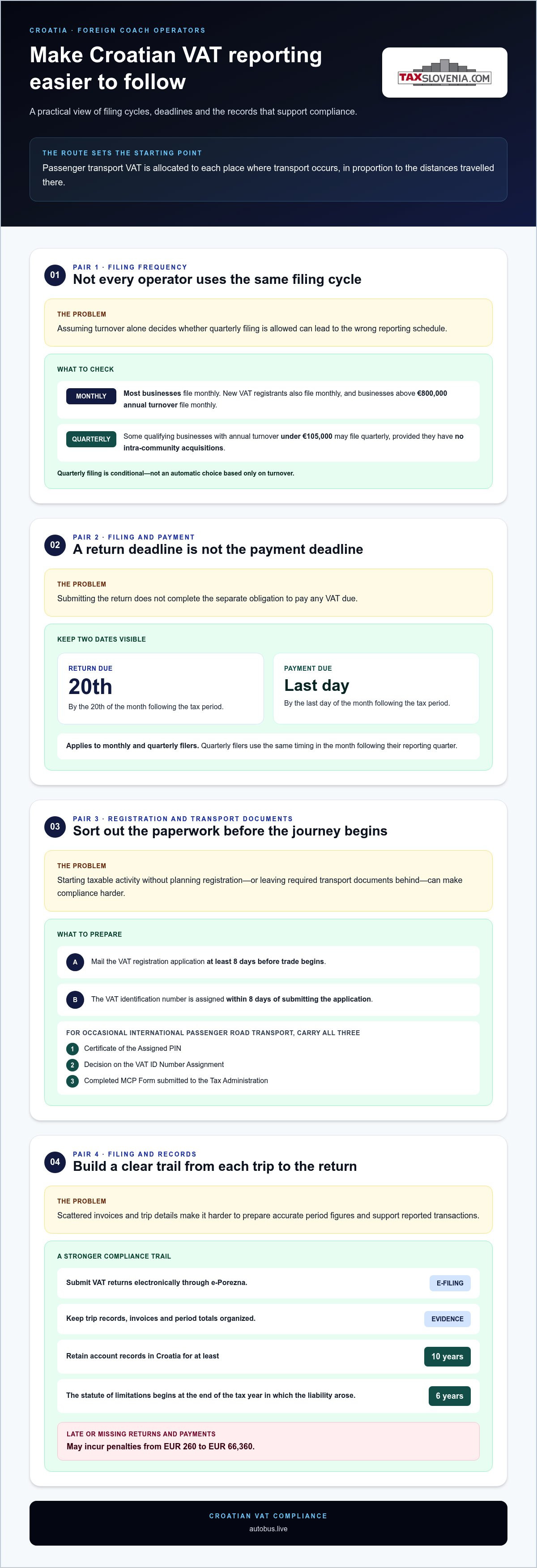
Croatian VAT returns are generally filed monthly, although some businesses can file quarterly. Returns are due by the 20th of the following month, while payment is due by the last day of the month following the tax period.
For a foreign coach operator, the filing period determines how often Croatian transactions must be reported and when the related VAT must be paid. The operator’s registration status and eligibility for quarterly filing affect the schedule.
Return filing frequency
Return filing frequency is the required interval for reporting VAT, usually monthly or quarterly. Most Croatian businesses file monthly, and new VAT registrants also file monthly. Qualifying businesses with annual turnover under €105,000 and no intra-community acquisitions may file quarterly, while businesses above EUR 800,000 annual turnover file monthly.
The filing cycle affects how often you report, not the VAT rate for a particular supply. A monthly filer reports the relevant activity for each month, while a quarterly filer groups activity by quarter. Monthly filing requires more frequent return preparation and payment planning.
Quarterly filing is conditional, not an automatic choice based only on turnover. Eligibility also requires that there be no intra-community acquisitions. Consider your transactions alongside turnover when determining which filing cycle applies.
Filing and payment deadlines
A filing deadline is the date by which the VAT return for a tax period must be submitted. Croatian returns are due by the 20th of the following month, for both monthly and quarterly filers. Payment follows a separate deadline: it is due by the last day of the month following the tax period.
For example, a return covering a monthly period is due on the 20th of the next month, and payment is due by that month’s last day. Quarterly filers apply the same timing to the month following their reporting quarter. Keeping the filing and payment dates separate helps prevent a submitted return from being mistaken for payment completion.
The return records the VAT position for the period, including any resulting liability. Keep trip records, invoices, and period totals organized before preparing each return. Separating Croatian passenger transport from other transaction types, such as imports, also helps prevent different supplies from being treated as the same.
For foreign operators, a practical reporting calendar should show the tax period, return due date, and payment due date as separate entries. That makes the recurring obligations visible across busy operating periods and supports consistent reporting, whether the applicable cycle is monthly or quarterly.
Croatian tax administration
Foreign operators handle Croatian VAT registration and reporting through Croatia’s Tax Administration. The registration application must be mailed at least eight days before trade begins, and the VAT identification number is assigned within eight days of submitting the application. Plan registration before starting taxable activity in Croatia.
For occasional international passenger road transport, foreign taxable persons must carry three documents in their vehicles: the Certificate of the Assigned PIN, the Decision on the VAT ID Number Assignment, and a completed MCP Form submitted to the Tax Administration. These documents relate to the operator’s Croatian tax status and transport activity. Keep them in the vehicle so they are available during checks.
Croatian VAT returns must be filed electronically through the e-Porezna portal. Electronic submission is part of the recurring administration, alongside preparing accurate period figures and paying any VAT due. Croatia’s Ministry of Finance conducts enhanced controls on taxable persons providing occasional international passenger road transport, focusing on compliance with VAT regulations.
Records support both regular reporting and later reviews. Businesses must retain account records in Croatia for at least 10 years. The statute of limitations for Croatian VAT obligations is six years, beginning at the end of the tax year in which the liability arose. Maintaining organized invoices and account records helps connect reported figures with the underlying transactions.
Invoice administration also includes reporting requirements. Croatia’s Tax Administration has required real-time invoice reporting since January 2013. For business-to-government transactions, Croatia has required e-invoicing since July 2019, using UBL 2.1 format. These requirements concern different parts of invoice handling, so operators should distinguish transaction reporting from the format used for government invoices.
Late or missing VAT returns, and late or missing payments, may incur penalties between EUR 260 and EUR 66,360. Fiscalization has been mandatory in Croatia for point-of-sale B2B, B2C, and B2G transactions since July 2019. These rules make correct classification and complete records relevant beyond the return itself. A charge recorded for passenger transport should be traceable to its invoice and supporting account entries.
The administration process links registration, vehicle documents, electronic returns, invoice handling, and record retention. It begins before trade with the mailed application, continues with the required transport documents and e-Porezna filing, and includes keeping records available for the required retention period.
Croatian businesses must notify Porezna uprava within 8 days of crossing the EUR 40,000 annual turnover threshold, a turnover-based notification requirement distinct from VAT registration timelines.
VAT treatment of charters starting in Croatia
For international coach journeys, Croatian VAT is allocated to the distance travelled in Croatia, in proportion to each place where transport occurs, according to Narodne novine d.d. Croatian VAT invoices may also need a travel-agent margin-scheme reference, while qualifying simplified invoices cannot exceed EUR 100.
VAT calculation for international journeys
For an international journey, transport is allocated according to where each part takes place. If a coach crosses Croatia, the Croatian share relates to the distance travelled within Croatia, not the entire international route. This allocation matters when a journey crosses several countries, each with its own territorial share.
Record the route and identify the Croatian segment before calculating the Croatian VAT treatment. The total journey distance alone does not show how much transport took place in Croatia. Route details support the allocation and the figures used in tax reporting.
Passenger transport VAT rate
The VAT rate depends on the type and location of the passenger transport. Croatia applies a 0% VAT rate to some international and intra-community passenger transport. A 13% reduced rate applies to categories that include transport, so the rate cannot be selected from the word “charter” alone.
Separate the coach journey from charter services involving other forms of transport. For example, qualifying yacht charters with onboard accommodation that start in Croatia are subject to 13% VAT under Article 38(3)(a) of the Croatian VAT Act. That yacht-charter rule does not itself establish the rate for a coach journey.
A European itinerary can include domestic and international segments. Distinguish the Croatian distance from the rest of the route, then classify the passenger service. A service is not automatically exempt simply because the coach crosses a border; its treatment depends on the service and route.
Invoicing requirements for foreign operators
Invoicing requirements determine the details and references to record for a supply. A Croatian VAT invoice may need to refer to the travel-agent margin scheme. Where that scheme applies, the invoice should reflect the relevant treatment rather than describe every charter or transport service in the same way.
Croatia allows a simplified invoice when the total amount does not exceed EUR 100. That threshold is a condition for using the simplified format, not a VAT rate or a general exemption. Operators should connect each invoice with its route and service classification, so the recorded charge supports the VAT treatment reported for that journey.
Keep the distinctions clear: a coach journey’s Croatian VAT allocation follows distance, while the yacht-charter rate applies to qualifying yacht services. Invoice references and format also depend on the transaction. Recording the route, service type, and invoice basis together helps explain the VAT treatment used.
VAT treatment of cross-border B2B transactions
A cross-border business-to-business transaction needs to be classified by what the operator supplies. Croatia applies a 0% VAT rate to exports and intra-EU B2B goods supplies. That rule concerns goods, so it should not be treated as a blanket 0% rate for every service sold to a business customer.
For a coach operator, passenger transport is distinct from a goods transaction. A journey booked by a company remains a transport service, even when the customer is another business. The customer’s business status alone does not turn coach transport into an intra-EU goods supply.
This matters when preparing reporting. A 0% VAT rate on qualifying goods does not, by itself, determine the treatment of a coach journey. Keep the service type and the customer transaction distinct in records, rather than applying a goods treatment to a transport amount simply because both parties are businesses.
An operator might sell coach transport to a business customer while also handling a separate goods transaction. Make the distinction clear in transaction descriptions: one should record passenger transport, the other goods. This helps explain the amounts assigned to each transaction and supports consistent VAT classification in the accounts.
Passenger transport also has a territorial element. According to Narodne novine d.d., Croatian VAT on passenger transport is allocated to each place where the transport occurs, in proportion to the distances travelled. This remains relevant when the customer is a business: B2B status does not replace the route-based allocation for the transport service.
For instance, a business booking does not make the whole international journey a Croatian supply. The operator’s records should identify the transport service and the route information used to support its allocation. This is separate from the 0% treatment described for exports and intra-EU B2B goods supplies.
When reviewing a cross-border invoice, separate three questions: what was supplied, whether it concerns goods or passenger transport, and what amount relates to the transaction. The answers help prevent a goods rate being applied to a service without support and provide a clearer basis for reporting to the Croatian authorities.
A practical record set can connect the customer contract, invoice description, and relevant route details. For a B2B coach booking, those records should identify passenger transport rather than goods. For a qualifying goods supply, the records should identify the goods transaction and its 0% treatment. Clear distinctions help make the reported VAT position traceable to the underlying activity.
Under EU distance-selling rules, businesses with cross-border sales exceeding €10,000 per year must register for VAT in Croatia or use the One-Stop Shop.
What Croatian VAT rate applies to passenger coach transport?
Croatia applies a 0% VAT rate to some international and intra-community passenger transport. A 13% reduced rate applies to categories that include transport, while the standard rate is 25% for taxable supplies not covered by a reduced rate, the 0% rate, or an exemption. The applicable rate depends on the transport service and its treatment.
These rates should not be treated as interchangeable options for every coach fare. The 0% rate applies to some international and intra-community passenger transport, not automatically to every journey crossing a border. Likewise, the fact that transport appears among categories eligible for the 13% rate does not establish that every passenger coach service qualifies.
For an international journey, the route is an important part of the VAT analysis. According to Narodne novine d.d., Croatian VAT on passenger transport is allocated to each place where the transport occurs, in proportion to the distances travelled. This means the Croatian portion of a journey must be considered separately from the distance travelled elsewhere.
Consider a coach service that begins outside Croatia, crosses Croatia, and continues into another country. The operator should identify the Croatian distance and classify the passenger transport before applying a rate. The route allocation explains the Croatian share; it does not, by itself, decide whether that share qualifies for 0%, 13%, or the standard 25% rate.
A practical review separates three factors:
- Service type: record whether the transaction is passenger coach transport or another supply.
- Route: identify where the transport takes place, including the Croatian distance.
- Rate category: determine whether the service falls within some international or intra-community passenger transport covered by 0%, a qualifying 13% category, or the standard 25% treatment.
The invoice and supporting route records should describe the same service. For example, a passenger fare should not be classified as a goods supply simply because a business customer purchased it. Similarly, a coach operator should not use the 13% rate solely because transport is mentioned among reduced-rate categories.
Classification also affects reporting. Connect the journey description, route information, and VAT rate used for the Croatian portion in your records. If a journey includes Croatian and non-Croatian distances, retaining route details supports the allocation and helps explain the amount reported.
For foreign operators, the central distinction is between the rate category and the territorial allocation. The journey’s international character may be relevant to the 0% treatment, while the Croatian distance determines the portion connected with Croatia. Assessing both points helps avoid applying one rate to an entire cross-border route without considering its segments.
TaxSlovenia and TaxCroatia: VAT registration in Slovenia
TaxSlovenia and TaxCroatia supports foreign coach operators with Croatian VAT registration and related reporting services. The team also prepares route reports before trips and tax reports after journeys, helping operators organize their reporting process.
For journeys that also involve Slovenia, services include Slovenian VAT registration, route reports, and tax reports. These services help operators address country-specific administrative requirements while keeping Croatian and Slovenian reporting distinct.
If you’re preparing to operate in Croatia or need support with VAT administration, contact TaxSlovenia and TaxCroatia or visit autobus.live.
Prepare your next cross-border operating period
Before your next operating period, bring your route information, service records, and tax reporting responsibilities together. This gives you a clear basis for handling country-specific administration as your coach services cross borders. For a foreign coach operator, Croatian VAT is one part of a broader compliance process, particularly when operations also involve Slovenia.
TaxSlovenia and TaxCroatia can support Slovenia-related work with VAT registration, route reports, and tax reports. These services are relevant when trips include Slovenia and you need help with registration or reporting there. Keeping route and tax records aligned makes administrative tasks easier to organize.
Set out the countries where you operate and the reporting tasks you need to address, then take the next step with a focused plan. Contact TaxSlovenia and TaxCroatia to discuss your cross-border tax administration needs and move forward with clarity.
Frequently Asked Questions
When must a foreign coach operator register for VAT in Croatia?
A foreign operator should assess Croatian VAT registration when it makes passenger transport supplies connected with Croatia. For non-EU businesses, the stated rule is registration from the first Croatian taxable supply, with no threshold. The application must be mailed at least eight days before trade begins. Plan the timing so registration precedes the start of taxable activity.
What VAT rules apply to occasional coach trips and tourist excursions in Croatia?
For occasional international coach trips, Croatian VAT treatment depends on the transport service and where the journey takes place. VAT on passenger transport is allocated by distance travelled in each place, so an excursion crossing Croatia requires the Croatian segment to be considered separately. Croatia applies a 0% rate to some international and intra-community passenger transport, but that treatment does not automatically apply to every tour or excursion.
Which Croatian VAT registration thresholds or exemptions apply to nonresident businesses?
The domestic turnover threshold should not be assumed to protect a nonresident operator from Croatian registration. Non-EU sellers must register from their first Croatian taxable supply, with no threshold. The €60,000 annual turnover threshold applies to businesses based in Croatia, not as a general exemption for foreign coach companies. Registration depends on the nature and location of the supply, so an international route’s Croatian passenger-transport segment is relevant.
How can a foreign coach operator register for Croatian VAT, and what documents are required?
Mail the Croatian VAT registration application at least eight days before trade begins. A VAT identification number is assigned within eight days of submitting the application. For occasional international passenger road transport, the vehicle must carry the Certificate of the Assigned PIN, the Decision on the VAT ID Number Assignment, and a completed MCP Form submitted to the Tax Administration. Keep these documents available during the Croatian journey.


