

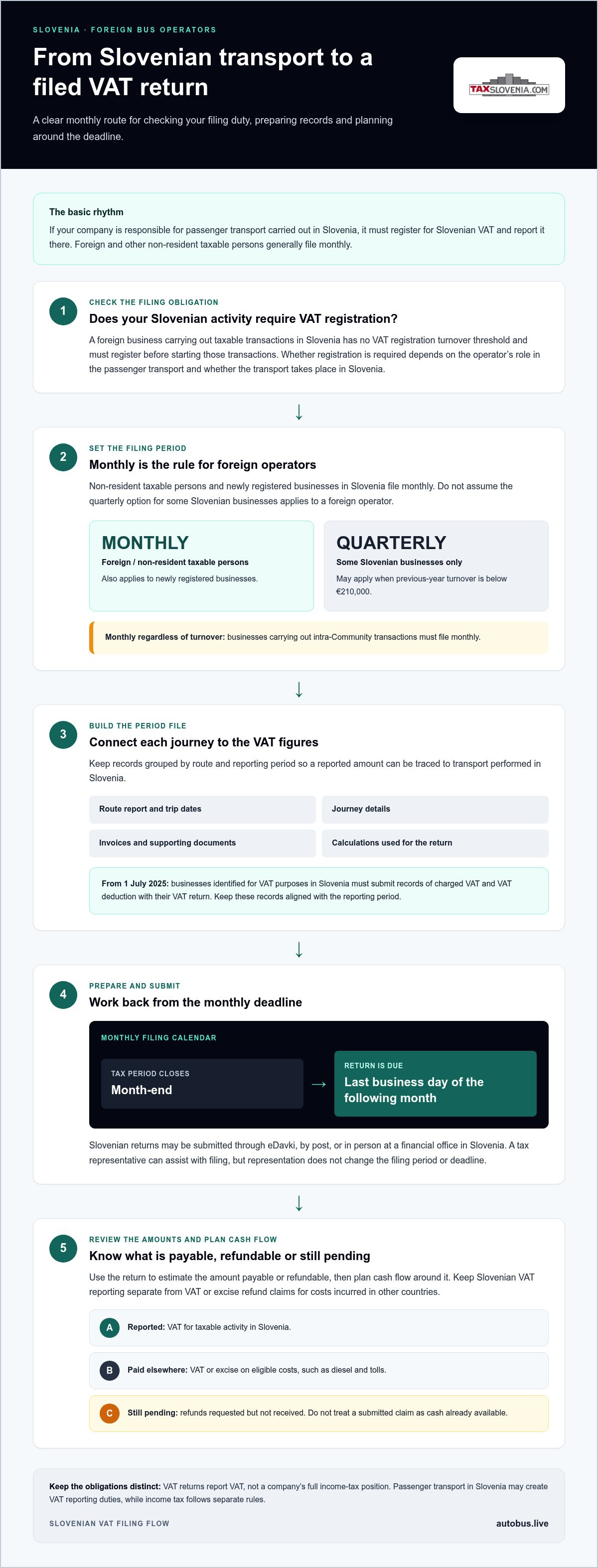
For a foreign bus operator, a tax return in Slovenia is generally filed monthly, with the return due by the last business day of the month after the VAT period ends. If your company is responsible for passenger transport carried out in Slovenia, it must register for Slovenian VAT and report it there. Knowing the filing schedule helps you plan for compliance and for when money is paid or returned to your business.
The deadline is only part of the workload. Operators also need clear journey and VAT records and must account for cash tied up between reporting and payment or refund. Filing frequency depends on whether the business is resident or non-resident and on its activity.
This article explains how often foreign operators file, when returns are due, and how regular reporting can affect cash flow. It also covers the records that support your filings and the key differences between residents and non-residents, so you can identify what applies to your operations in Slovenia.
Key Takeaways
- Non-resident taxable persons in Slovenia file VAT returns monthly, generally by the last business day of the month after the tax period ends.
- Filing frequency affects when VAT is reported and paid, so include reporting dates in cash-flow planning.
- Clear journey and VAT records help support reporting and responses to questions from tax authorities.
- Slovenian tax residents and non-residents are treated differently: residents are taxed on worldwide income, while non-residents are taxed on income sourced in Slovenia.
- Whether a foreign operator must register depends on its role in the passenger transport and whether the transport takes place in Slovenia.
How often do returns have to be submitted?
Foreign bus operators registered for Slovenian VAT generally file monthly returns. This recurring period sets a regular deadline and helps operators plan reporting alongside payments or refund claims.
VAT Filing Frequency
VAT filing frequency is the period covered by each return. Non-resident taxable persons and newly registered businesses in Slovenia must file monthly, while some Slovenian businesses may file quarterly.
The quarterly option applies to Slovenian businesses with previous-year turnover below €210,000. Businesses carrying out intra-Community transactions must file monthly regardless of turnover, so a foreign operator should not assume the quarterly option applies to its operations. A foreign business has no VAT registration turnover threshold and must register before starting taxable transactions in Slovenia.
VAT Return Deadlines and Payments
A Slovenian VAT return is generally due by the last business day of the month after its tax period ends. For monthly filers, the period closes at month-end, and the following month contains the filing deadline.
Use the deadline to schedule return preparation and review the amount reported as payable or refundable. Use the return to estimate the amount payable or refundable and plan cash flow accordingly.
VAT returns report VAT, not a company’s full income-tax position. Keep these obligations separate in your filing calendar: passenger transport in Slovenia may create VAT reporting duties, while income tax follows separate rules. An EU business must also follow the Slovenian filing period if it is a non-resident taxable person.
Late or inaccurate filings can have consequences under Slovenian tax rules. The outcome depends on the issue, such as a missed deadline or an incorrect amount. Prepare each return using consistent journey and VAT records, and address any errors promptly.
Slovenian tax returns may be submitted through eDavki, by post, or in person at a financial office in Slovenia. A foreign operator can appoint a tax representative to assist with filing, but representation does not change the monthly VAT period or return deadline.
Since 1 July 2025, businesses identified for VAT purposes in Slovenia must submit records of charged VAT and VAT deduction with their VAT return. Keep those records aligned with each reporting period, so the return and its supporting figures can be reviewed together before the deadline.
Administrative burden and liquidity for transport companies
VAT administration involves more than filing a return. Transport companies also manage refund claims, supporting records, and cash tied up across countries. A refund may recover eligible costs, but the claim period and processing time affect when the funds return to the business.
Bus companies can request VAT refunds for purchases such as diesel and tolls in European countries where tax registration isn’t required. In principle, companies can also reclaim VAT or excise duties paid abroad in Europe. These claims are separate from reporting VAT on taxable activity in Slovenia, so distinguish local reporting from refunds for costs incurred elsewhere.
For Slovenian VAT refund requests, the refund period can’t exceed one calendar year or be shorter than three calendar months, except when it covers the remainder of a calendar year. Match the claim period to your purchase records, then group supporting documents by country and tax type.
Refund timing can affect liquidity. Most countries follow refund deadlines set out in EU directives, but delays occur in practice. Every year, thousands of European transport companies face lengthy and inconsistent procedures when reclaiming taxes paid abroad. Don’t treat a submitted claim as cash already available for fuel, tolls, or other operating needs.
For cash-flow planning, separate three amounts: VAT reported for Slovenian activity, VAT or excise paid in other countries, and refunds requested but not received. This helps your finance team see what is due, what may be reclaimed, and what remains pending. For example, diesel purchased abroad may belong in a refund file, while taxable Slovenian transport belongs in local VAT reporting.
Use a consistent process for each country where the company incurs eligible tax:
- Record diesel and toll purchases by country and retain the related supporting documents.
- Keep refund claims distinct from Slovenia VAT returns and track the claim period.
- Include pending refunds in cash planning as amounts still awaiting payment.
Income-tax cash flow is a separate issue from VAT refunds. In Slovenia, advance income-tax payments are made monthly when the advance payment exceeds €400, and installments must be paid within twenty days of maturity. That obligation can affect working capital alongside transport costs, so a company’s cash forecast should show tax payments and refund interest or expected recovery separately, without treating them as interchangeable amounts.
Documentation and responding to foreign tax authorities
Organized records connect each taxable passenger journey with the VAT figures reported for Slovenia. Group documents by route and reporting period so the company can explain how a reported amount relates to transport performed in Slovenia. This also helps separate local activity from purchases or refund claims involving another country.
Create one file for each reporting period and arrange the records consistently. It can include the route report, trip dates, journey details, invoices, and calculations used to prepare the VAT return. This makes it easier to trace a return figure to a specific journey or document if an authority requests clarification.
Foreign tax authorities typically communicate about refund applications in the local language, which can make a request harder to handle when that differs from the operator’s working language. Assign someone to monitor tax correspondence, record when it arrives, identify the claim or period involved, and gather the relevant evidence before drafting a response.
For example, a German transport company seeking a French VAT refund submits its application through the German Federal Central Tax Office, which forwards it to the foreign authority. Keep the original purchase documents and claim details together, even when an authority in another country handles the review.
A clear response file can include:
- The authority’s message and the refund application or return it concerns.
- Invoices and supporting records linked to the relevant route, purchase, or reporting period.
- A short explanation that connects each requested figure to its supporting document.
- A copy of the response and the documents sent through the relevant portal or other stated channel.
Before replying, compare every amount in your explanation with the source documents. If a question concerns a diesel purchase abroad, match the invoice to the relevant refund claim, not to Slovenian passenger transport reporting. Address the authority’s specific question and retain the sent response with the original correspondence.
Consistent record keeping is especially useful for monthly reporting. Using the same route names, document labels, and period references each month helps staff locate supporting evidence without rebuilding files across separate systems. This does not replace invoices or journey records; it makes them easier to retrieve when an authority requests support.
For a Slovenian VAT return, keep the figures and records for charged VAT and VAT deduction aligned. For questions from abroad, retain the original-language message with the response you submitted. This helps you track the issue through to its outcome and distinguish an open authority query from a completed filing or refund request.
Taxation of residents and non-residents
Tax residence affects which income Slovenia may tax. A person is generally treated as a Slovenian tax resident if they spend more than 183 days in Slovenia in a year. Slovenian residents are taxed on worldwide income, while non-residents are taxed only on income sourced in Slovenia. These are individual income-tax rules, distinct from a transport company’s VAT reporting obligations.
For an international bus route, a driver’s income-tax treatment may depend on tax residence and applicable cross-border rules, rather than simply on every country the route crosses. Slovenia has an extensive network of double-tax treaties addressing taxation across borders. A treaty may help coordinate taxing rights, but crossing a country does not make the driver a resident there.
This distinction matters when reviewing payroll and personal tax obligations. A driver who lives outside Slovenia and crosses the country during a journey is not automatically a Slovenian tax resident for that reason alone. The relevant residence test concerns the person’s presence in Slovenia during the year, while non-resident taxation concerns income sourced in Slovenia.
Income type also matters. Slovenian residents must report rental income from any country, while non-residents must report rental income sourced in Slovenia. A Slovenian resident, for example, reports foreign rental income under the stated rule, while a non-resident’s Slovenian rental income remains within the Slovenian reporting scope.
For specified 2025 income not reported during the year by withholding agents, Slovenian residents and non-residents must file returns by 2 March 2026. This applies to the specified income categories, including rental income, income from capital, and gains from derivative financial instruments. It is separate from a company’s monthly VAT return calendar.
Identification details help distinguish the person filing from the company operating the route. A Slovenian tax identification number consists of 8 digits. Keep the number with the relevant individual’s tax records, and don’t confuse it with a foreign company registration number or a driver’s route documents.
When reviewing cross-border taxation, separate records by person, income type, and country before preparing a filing. A useful review can identify:
- Whether the driver is a Slovenian tax resident under the 183-day test.
- Whether the income is worldwide income or income sourced in Slovenia.
- Whether a treaty is relevant to taxation across the countries involved.
- Whether specified 2025 income falls under the 2 March 2026 filing deadline.
This approach keeps residence, income source, and route location separate. A driver’s tax residence and an operator’s VAT reporting obligations concern different tax questions, even when both relate to one journey through Slovenia.
Does a foreign bus operator need to file a tax return in Slovenia?
A foreign bus operator must register and report for Slovenian VAT when it is fully responsible for passenger transport carried out in Slovenia. The route’s location matters because passenger transport is taxed according to the distance covered in each country. But crossing Slovenia alone does not determine every operator’s position: responsibility for the passengers and the transport arrangement also matter.
A foreign business has no Slovenian VAT registration turnover threshold. If it carries out taxable transactions in Slovenia, it must register before starting them. A low amount of Slovenian activity or a short route segment does not remove the need to consider registration.
The key question is who is fully responsible for getting passengers to their destination. Under the described circumstances, a foreign transport company that hires another company fully responsible for the transport does not need Slovenian VAT registration. If the foreign company remains responsible for passengers on a journey through Slovenia, registration and VAT reporting may apply.
For example, a Croatian company supplying passenger transport for a Slovenian tourist agency must register for Slovenian VAT when part of the route is in Slovenia and the Croatian company is fully responsible for the transport. It does not matter whether the company contracts with the agency or directly with passengers. The decisive facts are responsibility for the transport and the route segment in Slovenia.
A travel agency may also be required to register if it is responsible for the passengers. Identify the responsible party from the actual transport arrangement, not only from the company named on a ticket or invoice. Italian carriers and travel agencies operating international passenger transport services are required to register for tax purposes and pay VAT in Slovenia when transiting the country.
For operators, separate the questions in this order:
- Does the journey physically cover distance in Slovenia?
- Which company is fully responsible for transporting the passengers?
- Is the responsible company a foreign taxable person carrying out transactions in Slovenia?
- Does that company need to register and report Slovenian VAT before the activity begins?
Slovenia’s tax office issued a VAT Notice about passenger transport services performed in Slovenia and related registration and reporting obligations in August 2016. The rule concerns VAT on passenger transport, not a blanket conclusion about every tax return a foreign company might have. A company should keep its route details and transport responsibilities clear when assessing the filing obligation.
If your company is responsible for passenger transport in Slovenia, start your Slovenian VAT registration before beginning taxable activity.
TaxSlovenia and TaxCroatia: VAT registration in Slovenia
TaxSlovenia and TaxCroatia supports foreign bus operators with Slovenian VAT registration and related reporting. If your company is responsible for passenger transport in Slovenia, registration is the practical next step before taxable activity begins. A Slovenia route report documents the route, while a Slovenia tax report supports reporting after journeys.
The right support depends on where your buses operate and which reporting obligations apply. For companies operating across Slovenia and Croatia, TaxSlovenia and TaxCroatia also provides VAT registration in Croatia. Its services address transport-company compliance in those countries, not passenger transport or personal tax matters.
Contact TaxSlovenia and TaxCroatia to discuss VAT registration and reporting for your routes.
Build a filing routine around your routes
A reliable process starts before paperwork reaches the reporting stage. Assign someone to connect route information with finance records, and agree how journey changes will be documented. This gives dispatch and administration consistent details to work from.
If your foreign bus operator files tax returns in Slovenia, match current routes with the records your team already keeps. Decide where journey details are stored, who reviews them, and how supporting documents reach the person preparing the report. A repeatable handover helps your team spot gaps early.
TaxSlovenia and TaxCroatia can support your Slovenian reporting workflow. If you’d like help with your route records and reporting, contact TaxSlovenia and TaxCroatia for support. A clear starting point can help your team move forward with confidence.
Frequently Asked Questions
Is there a registration limit for the tax?
There is no Slovenian VAT registration turnover threshold for a business not established in Slovenia. A foreign operator carrying out taxable transactions there must register before starting those transactions, even if its Slovenian turnover is low. Assess a planned route before its first taxable passenger journey in Slovenia. The key question is whether the activity is taxable in Slovenia, not whether the operator has reached a domestic turnover limit.
Where do you deal with the tax office?
Slovenian tax matters can be handled through the eDavki portal, by post, or in person at a financial office in Slovenia. For online filing, keep the return and supporting records organized together so you can refer to the same figures if questions arise. If correspondence concerns a foreign refund claim, keep the authority’s message with the application and relevant documents.
Which Slovenian taxes apply to nonresident bus operators?
Slovenian VAT is the main tax obligation discussed here for a non-resident operator responsible for taxable passenger transport in Slovenia. Drivers’ personal income tax is a separate question, based on tax residence and income source. Review the company’s VAT reporting and an individual driver’s tax position separately, even when both relate to the same international journey.
How is Slovenian corporate income tax calculated for a foreign bus company?
Corporate income tax is separate from the VAT return for passenger transport. A route or VAT return alone does not establish a company’s corporate income tax amount; that calculation depends on taxable profit and the rules applicable to the company. Keep corporate accounting records separate from route and VAT records so a VAT figure is not mistaken for an income-tax calculation.
Does Slovenia require foreign bus operators to register for VAT?
Yes. When a foreign operator is fully responsible for passenger transport carried out in Slovenia, it must register and report for Slovenian VAT. The Slovenian route section and allocation of responsibility matter. If another company is fully responsible for the transport, the registration outcome can differ under the described circumstances. Review contracts and operating arrangements together, not just the ticket issuer or the name on an invoice.
Are foreign bus operators subject to Slovenian withholding tax or permanent establishment rules?
VAT registration alone does not determine whether withholding tax or permanent establishment rules apply. These are separate questions from VAT on passenger transport. Keep the company’s contracts, payment records, and operating arrangements available for the relevant tax review. Slovenia’s presence on a route can determine where passenger transport is taxed for VAT, but should not be used alone to decide other tax issues.
What tax registrations and documents does a foreign bus operator need in Slovenia?
A foreign operator making taxable transactions in Slovenia must register for VAT before starting those activities. Keep route details, journey records, invoices, and VAT calculations accessible to support reporting. Organize documents by trip and reporting period, then link each reported amount to its source record. This makes it easier to distinguish passenger transport in Slovenia from purchases or refund claims involving other countries.


