
Cross-border bus tours can create tax administration that continues after the journey. A bus tour tax compliance service in Slovenia helps organize the country-specific steps, which may include Slovenian registration, route reports, tax filings and payments, VAT returns, and refund claims. The work depends on the operator’s activities and the journeys it makes in Slovenia.
For international operators, it can be difficult to know which tasks apply and when to handle them. This guide explains how registration, route reports, tax reports, payments, VAT returns and refunds fit into the process, so you can prepare before and after a tour.
It also explains how specialist support can help manage these administrative obligations in Slovenia and when to include that support in your operating process.
Key Takeaways
- Map Slovenian tax filings and payments to each tour’s route and reporting stage so you can plan the administrative work alongside operations.
- Understand how VAT returns and refund claims fit into the process, and which trip and transaction records help support accurate reporting.
- Separate the VAT considerations for passenger transport from those for sightseeing services before deciding how a tour should be reported.
- For cross-border journeys, consider how the route and the countries involved affect tax reporting across Slovenia and the wider EU.
- Use VAT registration, Slovenia route reports, and Slovenia tax reports to organize the relevant compliance steps for your operations.
Tax filings and payments
Corporate income tax concerns company profits, while withholding tax can apply to certain cross-border payments. Bus operators should assess these separately from VAT, taking account of income, payment type and recipient.
Slovenia’s aggregate tax compliance costs have been evaluated at about 1% of GDP. That figure describes the wider economy, not a bus company’s bill. For an operator, useful planning begins with a clear record of each Slovenian journey and its financial transactions.
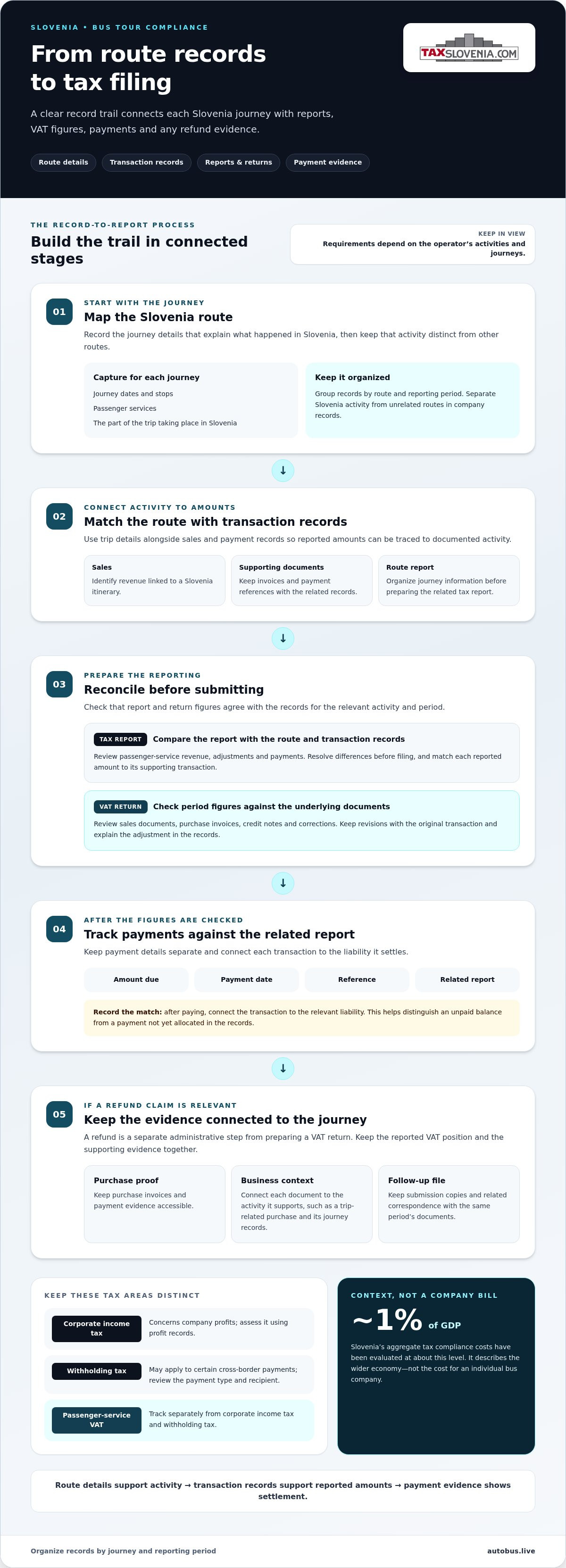
Start with the route. Record journey dates, stops, passenger services and the part of the trip taking place in Slovenia. Match those details to sales and payment records. A route report organizes trip information before the related tax report is prepared.
Separate operating records by journey or reporting period. For example, identify revenue linked to a Slovenia itinerary rather than combining it with unrelated routes. Keep supporting invoices and payment references together so each reported amount can be traced to a transaction.
Before submitting a tax report, reconcile its figures with the underlying records. Review passenger-service revenue, adjustments and payments, then resolve any differences before filing. The report should reflect documented activity, not an estimate assembled from incomplete trip data.
- Group journey records by route and reporting period.
- Match each reported amount to its supporting transaction.
- Separate Slovenia activity from other routes in company records.
- Compare report totals with payment records before submission.
Track payments separately. Record the amount due, payment date, reference and report it relates to. After paying, match the transaction to the relevant liability. This helps distinguish an unpaid balance from a payment that has not yet been allocated in the records.
Corporate income tax and withholding tax need separate attention because they concern different transactions from passenger-service VAT. Profit records help assess corporate income tax. Payment records can identify transactions that may require withholding analysis, especially when a foreign recipient is involved.
For each reporting cycle, keep the route report, tax report, invoices and payment evidence together. This creates a practical audit trail: route details support activity, transaction records support reported amounts, and payment evidence shows settlement. Clear records also make later corrections easier to trace.
Corporate income tax concerns company profits, so bus tour businesses should assess it using their profit records. Withholding tax may apply to certain cross-border payments. Review those payments by type and recipient, separately from VAT.
VAT returns and refunds
A VAT return brings together the VAT figures for a reporting period. For a bus operator, the underlying records should connect each Slovenian journey with its sales and business purchases. Organized records make it easier to prepare a return and explain how its figures were calculated.
Start by separating transactions connected with Slovenia from other operations. For example, a coach itinerary crossing borders may involve activity in more than one country. Keep route details and transaction documents together so the information used for Slovenian reporting can be distinguished from the rest.
Before preparing a return, reconcile the figures with the relevant records. Review sales documents, purchase invoices, credit notes and corrections for the period. Check that the amounts entered in the return match the supporting documents. If a transaction changes, retain the revised record and a clear explanation of the adjustment.
A refund is a separate administrative step from preparing a return. The reported VAT position and supporting evidence provide the basis for assessing a claim. Keep purchase invoices and payment evidence accessible, and connect each document to the business activity it supports. For example, identify an invoice for a trip-related purchase alongside the relevant journey records.
- Group records by reporting period and Slovenian activity.
- Match sales and purchase documents to the figures reported.
- Keep credit notes and corrections with the original transaction.
- Organize refund evidence so each document has a clear business context.
Consistency matters across the return, route records and accounts. If a sales document is corrected after the original entry, record the adjustment so it can be followed later. If a purchase relates to several journeys, retain enough detail to show how the amount was assigned in the company’s records.
Before submitting, check that the return covers the intended period and that its totals agree with the prepared figures. Confirm that supporting records are complete and accessible. This review can identify missing invoices, duplicate entries or adjustments not reflected in the return.
Refund administration may require follow-up records if figures need clarification. An organized file lets the operator trace a reported amount from the return to its invoice, payment and journey context. Keep copies of submissions and related correspondence with the documents for the same period. This creates a practical record for later reviews and supports consistent reporting across future tours.
What VAT rules apply to bus tours and passenger transport in Slovenia?
For a bus tour in Slovenia, first identify what the customer buys. A transfer between stops may differ from a guided sightseeing package or a tour with separately sold services. The itinerary, customer invoice and service description help define what the transaction includes. Keep these details together before deciding how to report the sale.
Next, map the journey by country and service segment. For example, a coach may collect passengers outside Slovenia, travel through Slovenia and continue to another destination. Record where each passenger service begins and ends, and distinguish transport from separately charged activities. These facts support the VAT analysis; the route alone does not determine the treatment.
Compare the customer contract and invoice with the actual journey. If the invoice combines transport, sightseeing or another service, show the components clearly in your records. If each component has a separate charge, retain the pricing breakdown. This makes it easier to explain what the operator supplied and how each amount entered its reporting.
- Keep the dated itinerary and country-by-country route details.
- Describe the passenger service and any separately supplied activity.
- Match invoices to the relevant route and service description.
- Retain amendments when a booked itinerary changes.
For instance, an operator might sell a city sightseeing trip and an onward coach transfer on one invoice. The records should show whether these are presented as one package or distinct services. Keep the booking terms, trip schedule and invoice together to give the person preparing the return a consistent basis for reviewing the transaction.
Apply the same review to purchases linked to the tour. A supplier invoice should identify the service purchased and connect it to the operator’s records. For a journey involving several countries, assign documents to the relevant activity rather than filing everything under one general trip folder. Clear allocation helps prevent unrelated transactions from being treated alike.
VAT registration and reporting are separate questions. Registration concerns the operator’s administrative position in Slovenia; reporting concerns how its transactions are recorded and declared. Review the service, journey details, invoices and business activity together. A registration decision does not replace transaction-level analysis, and a completed return does not by itself explain the service classification.
Before finalizing records, compare the itinerary, contract, sales invoice and purchase documents. Resolve mismatched dates, route changes or descriptions, then preserve the corrected documents. This sequence gives the operator a traceable file for each tour and a clearer basis for managing Slovenian VAT obligations.
What VAT rates apply to sightseeing tours and coach transport in Slovenia?
A coach tour does not fall into one VAT category simply because it uses a bus. Start by identifying what the operator sells: passenger transport, sightseeing or a combined package. The service description, booking terms and customer invoice help establish what the passenger receives. That classification guides the rate review for the Slovenian transaction.
Separate transport from any additional service in the booking records. For example, a sightseeing ticket might include a guided visit, while another booking may cover coach travel only. Record whether customers buy these elements together or separately. Keep the itinerary and invoice consistent with the service provided, rather than relying only on the tour’s marketing name.
Then examine the route and the service’s connection to Slovenia. A trip may begin outside Slovenia, cross the country and finish elsewhere. Keep the journey’s start and end points, stops and service segments in the same file. These details help distinguish the Slovenian part of an itinerary from activity in other countries.
For each type of booking, use a short classification review:
- Describe the service the passenger receives.
- Identify whether transport and sightseeing are combined or separate.
- Connect each charge to its service and route.
- Apply the VAT treatment relevant to that classified supply.
Consider two example bookings. One sells a coach transfer between named stops; another sells a city tour with a guide and transport. The vehicle may be the same, but the service descriptions differ. Keep separate records for these booking types so the rate review follows the transaction, not a broad label such as “bus tour.”
Check the invoice wording against the booking page and itinerary. If an invoice combines several elements, make sure the supporting records explain what the total covers. If the passenger pays separate charges, preserve the allocation. Clear descriptions help the person preparing the return assess each supply and avoid applying one assumption to different transactions.
Before finalizing a rate decision, compare the service description, route, contract terms and invoice. Note the classification applied to recurring tour formats. If the itinerary or package changes, review the changed supply again. For example, adding a separately sold guided visit may change the facts supporting the VAT treatment.
Do not use another country’s rate as a substitute for Slovenia’s treatment. Keep country-specific records for cross-border journeys and review the Slovenian service separately. This gives each tour a documented basis for its VAT rate while preserving the details needed for accurate reporting.
How are cross-border bus tours and passenger transport taxed in Slovenia and the EU?
A cross-border bus itinerary can involve several country segments. Start by mapping where each passenger service takes place. For a journey entering Slovenia from another EU country, record the route, stops and service boundaries. Then review the Slovenian activity separately from the other segments. This gives the operator a practical structure for assessing reporting and tax responsibilities without treating the entire itinerary as one transaction.
The route is only part of the review. Compare it with the service sold, customer contract and invoice. A coach transfer and a sightseeing package may describe different services, even on the same road. Record whether tours include additional activities or separate charges. These details help explain what the operator supplied in each country and provide context for country-specific VAT analysis.
For each journey, organize records by country and service. Keep booking details, sales documents, route schedules and changes together. If passengers board or leave at different points, preserve those details in the itinerary. If a tour changes after booking, retain the updated schedule and invoice. A consistent file connects the service sold with the route actually operated.
Keep social security questions distinct from VAT reporting. Slovenia coordinates social security with EU/EEA member states and Switzerland under Regulation (EC) No 883/2004. That coordination concerns social security, not the VAT treatment of a passenger ticket. For a tour involving staff across borders, keep employment records separate from passenger sales and route records.
- Map the route and identify each country segment.
- Describe the passenger service and any added tour activity.
- Match invoices and booking terms to the journey records.
- Keep social security documents apart from VAT sales records.
For example, a coach could travel from another EU country through Slovenia and continue onward. Keep the itinerary’s country segments clear, alongside the invoice and service description. If sightseeing is included, document whether it forms part of the same booking or appears separately. This file supports a focused review of each segment rather than an assumption based only on the starting point.
Before reporting, compare the route schedule with sales records and the customer invoice. Resolve differences in dates, destinations or service descriptions. Record any correction so the final file explains how the reported activity relates to the journey. Repeat this review when a route or tour package changes.
For operators running recurring routes, use the same record structure for each trip. Separate Slovenia from other country segments while keeping the complete itinerary available. This supports consistent reporting and makes it easier to identify transactions needing Slovenia-specific review within a wider EU operation.
TaxSlovenia and TaxCroatia: VAT registration in Slovenia
TaxSlovenia and TaxCroatia helps foreign bus operators with VAT registration in Slovenia, Slovenia route reports and Slovenia tax reports. These services support operators preparing to run Slovenian tours and organize the related route and tax documentation.
Consider registration support when your planned passenger transport activity requires you to address Slovenian VAT registration. Route reports organize journey details before trips, while tax reports support reporting after journeys. Keeping route and transaction records aligned makes it easier to connect each report with the relevant activity.
For operators whose routes also involve Croatia, VAT registration in Croatia is available as a separate country-specific service. The next step is to identify the countries where your tours operate and the reporting tasks you need to manage.
Contact TaxSlovenia and TaxCroatia to discuss Slovenian VAT registration and bus tour reporting support.
Prepare your next Slovenia tour with a clear process
Use each new itinerary as an opportunity to review how your team handles Slovenian tax records. Assign responsibility for collecting route changes, booking details and transaction documents, then keep those records in a consistent format. A repeatable process helps your finance team identify missing information before preparing future reports.
A bus tour tax compliance service in Slovenia can support operators who need help organizing country-specific registration and reporting tasks. Map your upcoming routes, identify the records already available and note where administrative support would fit into your workflow.
TaxSlovenia and TaxCroatia can support the Slovenia-related steps discussed in this guide. Plan your Slovenia compliance steps with a clear view of your routes and reporting needs. A structured approach gives your team a practical starting point for managing future tours.
Frequently Asked Questions
What tax compliance services are available for bus tour operators in Slovenia?
A bus tour tax compliance service in Slovenia can cover VAT registration, route reports and tax reports for foreign operators. For example, a company preparing a new itinerary can arrange route documentation before travel and organize the related tax report after the journey. These services address tax administration for passenger transport businesses, not bus transportation itself.
When must a foreign bus tour operator register for VAT in Slovenia?
A foreign operator should address registration before a planned trip when its Slovenian activities require VAT registration. TaxSlovenia and TaxCroatia can help with this step. The assessment depends on the service and its connection to Slovenia, not simply on a vehicle crossing the border. Review the planned itinerary and passenger service early so registration can be organized before operations begin.


