
A journey that crosses Slovenia’s border does not, by itself, settle how VAT applies. The Slovenia VAT rules for coach operators depend on where passenger transport takes place and how the journey is classified, so domestic and international segments may receive different treatment.
For foreign operators, the practical task is to separate Slovenian obligations from those in other countries and keep records that support the VAT assessment. The route, schedule and type of transport can all affect which requirements apply.
This guide explains how the territorial principle applies to passenger transport and which journey details to review before departure. It also covers compliance after the trip, including whether a simplified procedure may apply to occasional, non-scheduled international transport. You’ll see how pre-trip route reports and post-trip tax reporting fit into separate compliance stages, what to assess for each journey and which records to retain.
Key Takeaways
- Assess the route and distance travelled in Slovenia to identify which part of a cross-border passenger journey may fall under Slovenian VAT rules for coach operators.
- First establish whether the transport is taxable, then check which rate or special treatment applies. These are separate questions.
- Before departure, review the service and route and identify any registration or route-report steps that apply.
- After the journey, retain relevant trip records and address the reporting requirements for the transport performed.
- Track VAT registration, pre-trip route reporting and post-trip tax reporting as separate compliance stages.
What Slovenia VAT Rules Mean for Foreign Coach Operators
Slovenian passenger transport VAT applies to a passenger transport service to the extent that the journey takes place in Slovenia. For coach operators, the assessment concerns the transport service and its taxable treatment, not the company’s entire business income or general corporate tax position. Keeping this distinction clear separates transport VAT from other taxes and obligations that may arise in the operator’s home country.
The Value Added Tax (VAT) principles provide general context, but an operator’s home-country VAT registration or reporting does not determine the Slovenian treatment of a journey. Assess the Slovenian rules for the relevant transport activity. Registration, journey documentation and tax reporting are related but separate: registration does not replace route evidence, and keeping records does not fulfil a reporting duty that applies.
Which coach operations should assess Slovenian VAT?
Assess both domestic journeys within Slovenia and international routes that include a Slovenian segment. The place and extent of the transport matter, so an international itinerary may need to be considered country by country. A border crossing, passenger stop or transit through Slovenia does not automatically give every part of the service the same treatment. Assess the actual service and route.
For example, a journey wholly within Slovenia has different route facts from a coach travelling through Slovenia between two other countries. Neither the itinerary label nor the operator’s home-country VAT position determines the outcome. Keep the planned route, passenger-service details and actual journey information together so the treatment can be assessed against the transport performed.
How EU rules connect to Slovenia's national VAT rules
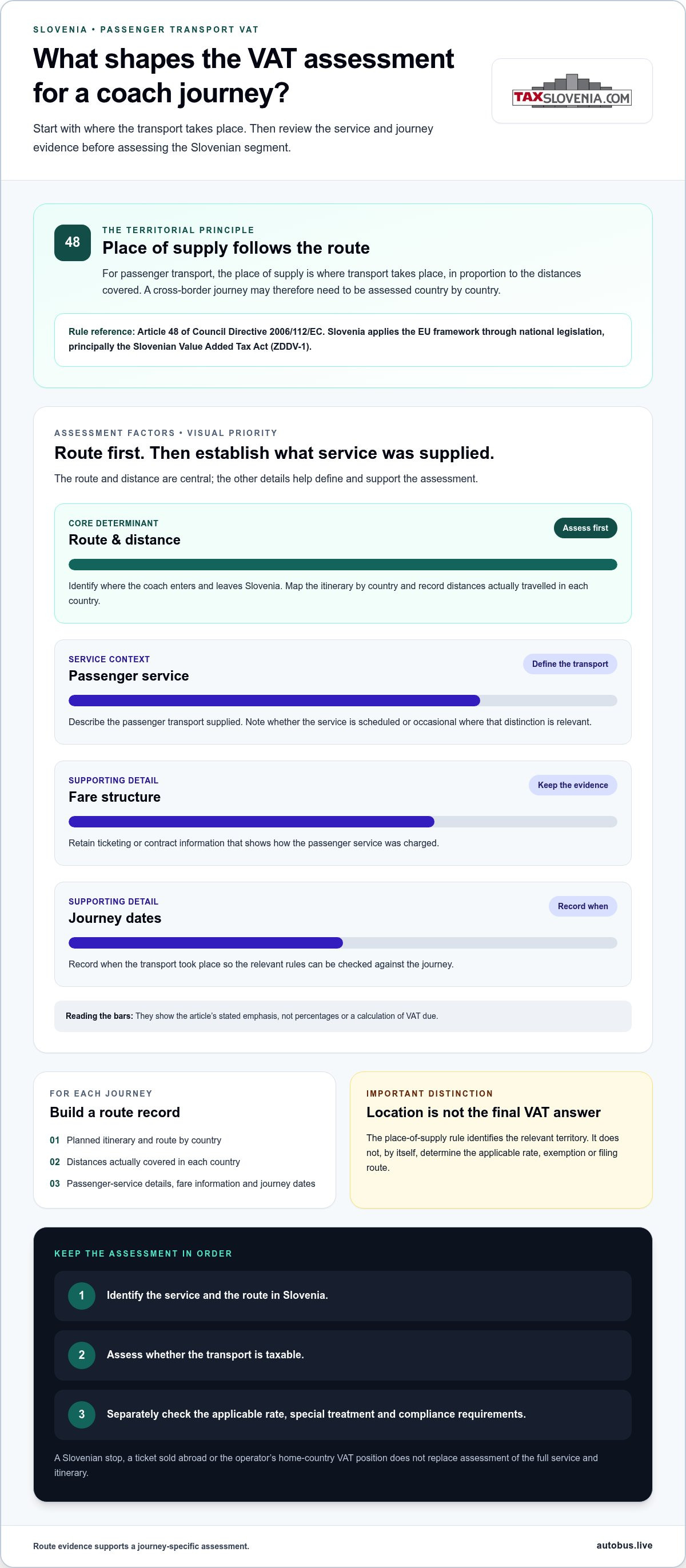
Slovenian VAT sits within the EU VAT framework, including Council Directive 2006/112/EC. Article 48 addresses the place of supply for passenger transport: the place is where the transport takes place, in proportion to the distances covered. Slovenia applies this framework through national legislation, principally the Slovenian Value Added Tax Act, commonly known as ZDDV-1. Read the EU framework and national rules together.
The place-of-supply principle identifies where a transport service is treated as supplied. It does not, by itself, determine the applicable rate, exemption or filing route. Check the current Slovenian provisions for the service and circumstances before applying a VAT treatment. The general EU principle alone does not answer every route-specific question.
As an initial review, separate these questions:
- Service: What passenger transport is being supplied?
- Route: Which parts of the journey take place in Slovenia?
- Compliance: Does the activity require Slovenian registration, journey records, reporting, or more than one of these?
This first assessment gives operators a clear basis for checking the treatment of each journey before considering rates and compliance steps.
How Place of Supply Affects Cross-Border Coach Journeys
For passenger transport, the EU place-of-supply rule generally follows where the transport physically takes place. Article 48 of Council Directive 2006/112/EC states that the place of supply is where the transport occurs, in proportion to the distances covered. Under this territorial principle, a cross-border coach journey may need to be assessed by country rather than treated as one undivided service. The official text of the VAT Directive sets out the rule.
This principle identifies the relevant territory, not the final VAT rate or reporting outcome. Apply the Slovenia VAT rules for coach operators to the Slovenian part of the service and check current national provisions for any applicable calculation or documentation requirements.
How to distinguish Slovenian and foreign route segments
Map the itinerary by country using the actual route and distance records. Note where the coach enters and leaves Slovenia, and retain route plans or journey records that support the distances used. The passenger’s residence and the place where a ticket was purchased do not replace this location-based analysis. Check the Slovenian apportionment method against current national rules rather than assuming a particular mileage calculation is sufficient.
Hypothetical route example: A coach carries passengers from one country, through Slovenia, and onward to another country. The operator records the route and distances travelled in each country, then assesses the Slovenian segment under the applicable rules. This illustrates how to organise the analysis. It does not determine whether VAT is due or which rate applies.
Which journey facts can affect the VAT assessment?
Route and distance are central, but they are not the only facts to review. The service supplied, fare arrangements and journey dates can help establish what transport was provided and which rules applied at the time. A single detail, such as a Slovenian stop or a ticket sold abroad, is not a complete answer without considering the full service and itinerary.
- Route and distance: Keep the planned itinerary and evidence of the distances actually covered in each country.
- Passenger service: Describe the transport supplied, including whether the journey is scheduled or occasional where that distinction is relevant.
- Fare structure: Retain ticketing or contract information showing how the passenger service was charged.
- Journey dates: Record when the transport took place so the relevant rules can be checked.
Also distinguish passenger transport from any separately supplied service where the legal treatment may differ. Don’t assume that an item included in a fare automatically follows the transport’s VAT treatment. Assess its relationship to the journey under the applicable rules.
Organising route evidence before departure makes the later assessment more reliable. A Slovenia route report supports pre-trip planning, while trip records remain important for the subsequent tax assessment and reporting.
How Slovenia VAT Treatment, Rates, and Exemptions Need to Be Checked
First establish whether the operator is making a taxable passenger-transport supply in Slovenia. Then determine the applicable rate or whether a specific exemption or special procedure applies. These are separate checks: identifying a Slovenian taxable activity does not automatically mean every journey is charged at the same rate.
For 2026, Slovenia’s standard VAT rate is 22%, while domestic passenger transport is subject to the reduced rate of 9.5%. International passenger transport is zero-rated under the treatment described in current Slovenian VAT guidance. Apply these figures only after classifying the actual service and checking the current Slovenian provisions for the route and circumstances. The EU framework establishes rules such as place of supply, but it does not set every national VAT rate.
When to verify a rate or exemption
Review the transport service, route type and taxable activity before applying a rate. A domestic passenger journey and an international journey crossing Slovenia may receive different treatment. Foreign operators performing occasional, non-scheduled international road passenger transport may also be able to use Slovenia’s special simplified procedure for settling VAT. This is a distinct question from whether the journey is exempt or which rate applies. Check the procedure’s conditions before relying on it.
Check the Slovenia VAT rules for coach operators against current national sources, including the Slovenian Value Added Tax Act (ZDDV-1) and guidance from the Financial Administration of the Republic of Slovenia (FURS).
| Issue | Question to resolve | Authoritative verification source |
|---|---|---|
| Taxable activity | Does the operator make a taxable passenger-transport supply in Slovenia? | ZDDV-1 and current FURS VAT guidance |
| Rate or zero-rate treatment | Is the service domestic or international, and which national provision applies? | ZDDV-1, including relevant rate provisions and annexes; FURS |
| Special procedure | Does the operator and journey meet the conditions for the occasional, non-scheduled transport procedure? | Current FURS guidance and applicable Slovenian rules |
| EU place of supply | Which country’s VAT territory covers the relevant transport segment? | Council Directive 2006/112/EC, including Article 48 |
How fares and additional charges may affect the review
Check what the fare covers and whether passengers pay separately for other items or services. An additional charge connected with transport may need a different analysis from a separately supplied service, depending on its legal classification and relationship to the journey. Don’t assume that separate invoicing automatically means separate VAT treatment, or that bundling automatically makes every item part of the transport supply.
Record the service description, fare structure and any separately charged items. Verify their treatment under current Slovenian law before issuing invoices or preparing reports. This ties the rate decision to the service actually supplied, rather than to a label or pricing format alone.
What Coach Operators Should Prepare Before and After a Slovenia Journey
Organise compliance in stages: assess the planned route, complete any required preparation before departure, keep records of the journey as operated, and address reporting afterward. Registration, a pre-trip route report and a post-trip tax report serve different purposes. One does not automatically replace another, and the steps that apply depend on the operator’s activity and current Slovenian requirements.
Before travel: identify the route and applicable obligations
Start with the itinerary and the passenger service being supplied. Record the expected route through Slovenia, planned distance, journey dates and fare information. Use these details to assess whether Slovenian VAT registration or a route report is required for the operation. Verify the applicable requirements before travel, particularly if the itinerary or service changes.
For a practical pre-trip review, check that the route information matches the coach’s intended itinerary and note any known changes to stops, passenger arrangements or pricing. Follow registration and route-report procedures separately, using current requirements for the activity. A completed route report supports preparation before travel; it is not the same as tax reporting after the journey.
After travel: retain evidence and address reporting
Once the trip is complete, compare the actual journey with the planned route. Retain records that show the service performed and route taken, such as itinerary information, journey dates, passenger-service details and fare records. Keep revised route information if the journey changed. Clear records let the operator assess the trip based on what happened, not only on the original plan.
Post-journey tax reporting may follow a different timetable from pre-trip requirements. Establish the applicable reporting period and submission requirements under current Slovenian rules. Preparing a route report does not complete any separate tax-reporting duty. Verify forms, deadlines and filing procedures against current official guidance rather than inferring them from another country’s process.
Use this checklist to organise the trip file:
- Route: Planned itinerary through Slovenia and any recorded changes to the actual route.
- Distance: Expected and actual journey distances, with the relevant route information.
- Passenger service: Description of the transport and journey dates.
- Fare details: Ticket, contract or other records showing how the service was charged.
- Compliance stages: Registration position, pre-trip route-report preparation and post-trip reporting requirements, assessed separately.
For foreign operators, applying the Slovenia VAT rules for coach operators is easier to manage when trip preparation and later reporting are kept separate. TaxSlovenia and TaxCroatia supports foreign bus companies with Slovenian VAT registration, route reports before trips and tax reports after journeys. Learn about Slovenian VAT registration and trip reporting support.
How to Apply Slovenia VAT Rules to Your Coach Operations
Make the VAT review a repeatable part of journey planning. Define the passenger service, map the route through Slovenia, verify its VAT treatment under current requirements, and organise any resulting compliance actions. This sequence separates the tax assessment from the administrative tasks that follow and gives operations and finance teams a shared record.
A short decision framework for each journey
For each planned operation, describe the transport service and identify the itinerary. Record the Slovenian portion and keep route information that supports the assessment. Then verify the treatment and determine whether registration, pre-trip preparation or post-trip reporting applies. Reassess if the service or route changes rather than relying on a previous journey’s conclusion when the facts differ.
- Identify the service: Confirm that the operation carries passengers and document the transport service being supplied.
- Map the route: Mark the Slovenian portion and retain the itinerary and distance information used for the review.
- Verify the treatment: Check current Slovenian rules against the service and route facts before applying a VAT position.
- Organise compliance: Separate any registration requirement from journey preparation and reporting tasks.
This framework is a starting point, not a fixed answer for every itinerary. A change in route, service structure or journey details may affect the assessment, so keep records tied to the specific trip.
Coordinate registration and journey reporting
VAT registration establishes the operator’s registration position in Slovenia. Consider it separately from repeated journey-related requirements. A route report supports preparation before travel, while a tax report addresses reporting after a journey. Track each task independently and verify the applicable requirements rather than treating one document as a substitute for another.
TaxSlovenia supports foreign coach companies with Slovenian VAT registration, route-report preparation before trips and tax reporting after journeys. The team offers support in English, German, Slovene and Croatian to help operators organise relevant information and administrative steps in a working language. This support does not replace the need to assess the route and service under current rules.
Use the Slovenia VAT rules for coach operators as a prompt to review each trip’s facts and compliance tasks, not as a blanket treatment for every journey. See how TaxSlovenia can support Slovenian registration and journey reporting.
Make Each Upcoming Journey Easier to Manage
Build the VAT review into trip planning rather than leaving it until after the journey. Assign responsibility for recording route changes, keeping journey information together and tracking open compliance actions. A consistent process makes it easier to apply the Slovenia VAT rules for coach operators to each operation using its own facts, including when schedules or service arrangements change.
For foreign bus companies operating in Slovenia and Croatia, TaxSlovenia and TaxCroatia provides administrative support for trip preparation and follow-up reporting. Services include Slovenian VAT registration, route-report preparation before trips and tax reporting after journeys, with support in English, German, Slovene and Croatian.
Planning upcoming operations? Contact TaxSlovenia and TaxCroatia about Slovenian VAT registration and journey reporting.
Frequently Asked Questions
Does a foreign coach operator need Slovenian VAT registration for every journey through Slovenia?
No. A journey through Slovenia does not automatically mean registration is required. Assess whether the operator makes a taxable supply there and whether a special procedure applies. Non-resident businesses generally don’t have a registration threshold for taxable supplies in Slovenia. Eligible foreign operators making occasional, non-scheduled international road passenger transport may use a simplified procedure, subject to its conditions. Check the Slovenia VAT rules for coach operators against the specific service and route.
Is VAT based on the passenger's country of residence or the route travelled?
For passenger transport, the place-of-supply analysis generally follows where the transport physically takes place, rather than the passenger’s residence. Under the EU rule, transport is attributed to the places where it occurs in proportion to the distances travelled. A passenger living abroad does not make the Slovenian portion of a journey foreign transport. Use the itinerary and supporting distance information to identify the relevant territory, then assess the applicable national treatment.
How should an operator assess a cross-border coach fare that covers several countries?
Start by identifying the transport service covered by the fare and the route used to provide it. Divide the itinerary into country segments and establish the distance travelled in each, then verify the treatment of the Slovenian portion under current Slovenian rules. Don’t divide a fare equally between countries or assume the ticket’s place of sale decides the VAT result. Keep the fare terms and journey records together to support the assessment.
What journey records can support a Slovenia VAT assessment?
Keep records that connect the passenger service, fare and route. Useful operational evidence can include booking or ticket information, a contract or invoice, the planned itinerary, dispatch records and notes of route changes. Distance records can help show which portions of the journey took place in Slovenia and elsewhere. This is a practical record set, not a statement that each item is a statutory requirement in every case. Confirm applicable record-keeping duties under current rules.
Does VAT registration mean Slovenian VAT is due on every coach trip?
No. Registration establishes a reporting position; it doesn’t by itself mean VAT is payable on every journey. The treatment depends on the specific supply, route and applicable Slovenian rules, including any relevant rate or special treatment. A registered operator may still have reporting responsibilities even when a particular transaction does not result in VAT payable. Keep the treatment analysis for each service separate from the question of whether registration is required.
Can a change to the planned route affect the VAT assessment?
Yes. If the coach takes a different route, the distance travelled in Slovenia may change, which can affect the territorial assessment. Record the actual itinerary and the reason for the change, then compare it with the route information used before departure. Review whether the change affects the VAT calculation or related reporting. Don’t assume the original assessment still fits if the service or route facts have materially changed.
Do the same Slovenian VAT rules apply to domestic and international passenger journeys?
No. The route and service classification can lead to different treatment. Current guidance identifies a reduced rate of 9.5% for domestic passenger transport and zero-rating for international passenger transport, but operators should verify the relevant conditions under Slovenian law before applying either treatment. A journey crossing a border also requires attention to the portion taking place in Slovenia. Don’t automatically apply one journey’s rate to another service with different route facts.


