
A single journey through Slovenia can involve separate tax steps before departure and after passengers have travelled. For foreign operators, Slovenia passenger bus tax compliance starts with identifying the type of transport and matching the journey to the relevant reporting stages. VAT registration, route reporting and tax reporting are connected, but they serve different purposes.
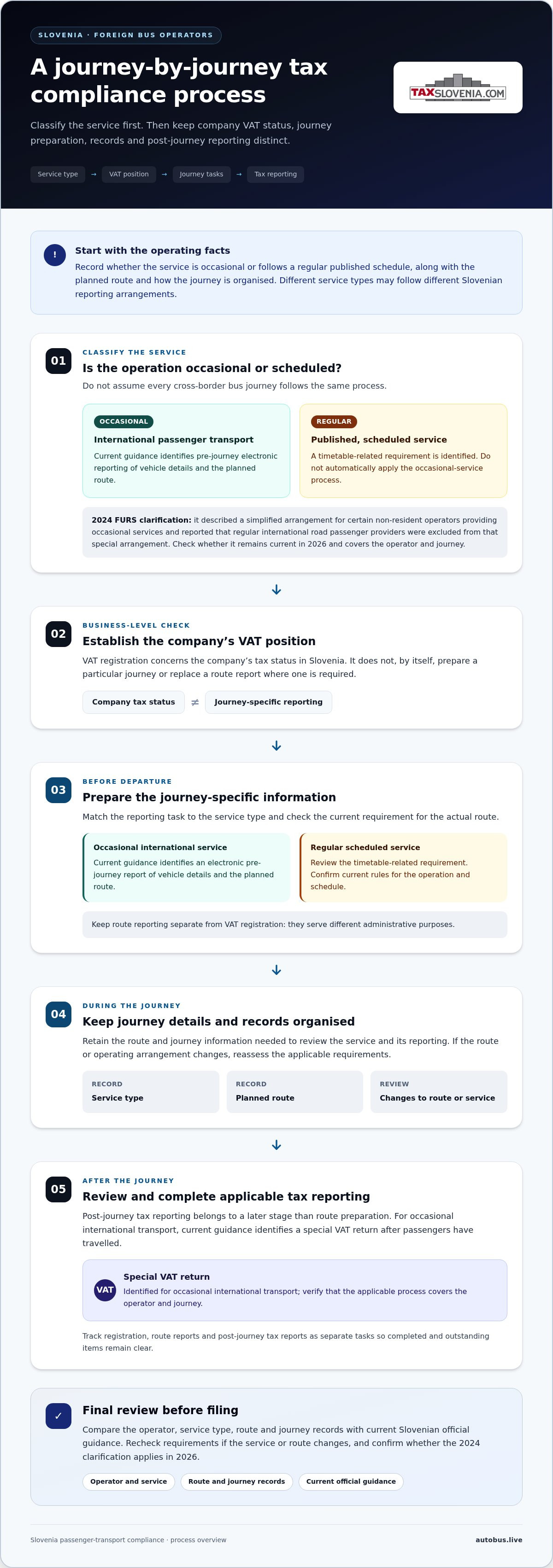
A clear process is especially useful when Slovenian requirements differ from those in your home country. For occasional international transport, current guidance identifies a pre-journey electronic report of vehicle details and the planned route, followed by a special VAT return. The applicable tasks can differ by transport type, so check current official guidance for the service you operate.
This checklist sets out what to review before, during and after a journey involving Slovenia. Use it to organise journey details and records, distinguish VAT registration from route and tax reporting, and identify when to verify a rule or arrange specialist administrative support. The sequence gives you a practical way to review each journey against Slovenian requirements for 2026.
Key Takeaways
- Use the Slovenia passenger bus tax compliance checklist to organise journey-related tasks by stage, from preparation through post-journey reporting.
- Identify whether a service is occasional or scheduled before deciding which reporting steps may apply.
- Keep VAT registration, route reports and post-journey tax reports distinct, and match each to its administrative purpose.
- Review route details, journey records and current Slovenian guidance before filing, especially if the service or route changes.
- TaxSlovenia and TaxCroatia support foreign bus companies with Slovenian VAT registration, route reports and post-journey tax reporting.
Slovenia passenger bus tax compliance: what the checklist covers
Slovenia passenger bus tax compliance is a sequence of journey-related administrative checks for foreign operators, not a single form or filing. It includes classifying the passenger service, establishing the operator’s VAT position, preparing any required journey-specific information, keeping relevant records and completing applicable tax reporting after the trip. Which steps apply depends on the service and operating facts.
This checklist is for foreign companies providing international passenger transport through or within Slovenia. It separates business-level tax status from individual journey tasks, making it easier to see what to address at each stage. The general Transport in Slovenia overview provides background on the country’s transport network, but it does not determine an operator’s tax obligations.
Use the checklist as a framework for review, alongside current Slovenian guidance. Procedures may depend on whether the service is occasional international transport or a regular scheduled service. For example, current guidance identifies pre-journey reporting for occasional international services, while regular services have a timetable-related requirement. Check official guidance against the service and journey you are planning.
Which operators and journeys should use this checklist?
Use it if your company is established outside Slovenia and carries passengers on an international journey that enters, crosses or operates within the country. Before applying a general summary, record the service type and operating facts: whether the service follows a regular published schedule or is occasional, the planned route, and how the journey is organised. These details help determine which reporting arrangements may apply.
Do not assume every cross-border bus journey follows the same process. Classify the service first, then assess its Slovenian obligations. If a journey combines different operating arrangements or its classification is unclear, check the current Slovenian rules against those facts before deciding which tasks to complete.
How VAT and journey reporting fit together
VAT registration concerns the company’s tax status in Slovenia. It does not, by itself, prepare a particular journey or replace a route report where one is required. Treat registration as a business-level question, then assess each journey separately for any pre-journey reporting obligation.
Route reports relate to journey preparation, while post-journey tax reports belong to a later stage. Track these tasks separately so it is clear what has been completed and what remains outstanding. For each service, organise the registration position, route information and journey records, then review the applicable reporting requirements against current Slovenian guidance before filing.
Slovenia’s passenger-transport tax rules depend on the service type
For Slovenia passenger bus tax compliance, classify the transport service before applying a reporting summary or VAT rate. Occasional international operations and regular scheduled services may follow different administrative routes. A 2024 clarification from Slovenia’s Financial Administration (FURS) described a simplified arrangement for certain non-resident operators. Check its current application in 2026 and its scope for the service against official guidance.
| Service type | Reported treatment | Practical review |
|---|---|---|
| Occasional international passenger transport | The 2024 finding described a simplified arrangement for certain non-residents, with registration and journey-related requirements. | Verify that the arrangement remains applicable in 2026 and covers the operator and trip. Check which registration and pre-journey reporting steps apply. |
| Regular scheduled international passenger transport | The reported clarification excluded regular international road passenger transport providers from that special arrangement. | Do not transfer the occasional-service process to a scheduled service. Confirm the current requirements for the actual timetable and operation. |
Service type can affect which Slovenian compliance route applies, including whether a reported special arrangement is relevant, what journey preparation is required and which tax reporting process to review. Use the table as a starting point, not a determination for a specific operator. The Slovenian Ministry of Finance outlines the directorate responsible for tax and public revenue systems. Check current official guidance for your journey.
Occasional international road passenger transport
The 2024 FURS clarification described a simplified arrangement for certain non-resident operators providing occasional international road passenger transport. It included registration and journey-related requirements, so registration alone was not the complete process. Do not assume every foreign company or occasional trip qualifies. Check whether the clarification remains current for 2026, then compare its scope with your service, vehicle, route and operating facts.
Regular scheduled international passenger transport
The same 2024 finding reported that regular international road passenger transport providers were outside the special arrangement described for certain occasional services. Check whether that distinction remains current before planning filings. A published timetable and recurring scheduled operation should not be treated as an occasional trip simply because the route crosses a border. Review the process for scheduled services separately.
Rate summaries also need careful handling. Slovenia’s reduced VAT rate for passenger transport is 9.5%, while the standard rate is 22%. These figures alone do not establish the correct treatment of a particular international service. Use current official guidance to confirm the service-specific VAT treatment and reporting route instead of choosing a rate solely because passengers are being carried.
When service classification or the 2024 clarification affects your planned filings, specialist administrative support can help organise the relevant registration, route-report and post-journey tax-report stages. Slovenia route reporting and tax reporting support is available through TaxSlovenia and TaxCroatia.
Use this before, during, and after a Slovenia bus journey checklist
Use this sequence to connect journey preparation, operational records and tax reporting without treating them as one task. Slovenia passenger bus tax compliance depends on the service and journey facts, so keep the information used for preparation available to compare with what actually happens. The checklist helps organise that review; it does not replace current Slovenian guidance on applicable forms, submission methods or deadlines.
- Before departure: classify the service, review registration status and identify any route-report task that applies.
- During the journey: keep operational details together and record material changes for later review.
- After the journey: reconcile planned and actual journey information, identify the applicable report and verify its current filing requirements.
Before departure: prepare the Slovenia journey
Start with the operating arrangement. Establish whether the service is occasional, regular or another type, then record the route and planned journey details. Review the company’s Slovenian VAT registration status separately from any journey-specific preparation. If a route report applies, identify the task for this trip and check its current requirements before departure.
- Record the service classification and the facts supporting it, such as whether the operation follows a regular schedule.
- Organise planned route and vehicle details in the format needed for the applicable administrative process.
- Note the registration position and any outstanding preparation, keeping business status separate from trip reporting.
During the journey: retain information about changes
Keep a working record of the journey as operated, including relevant route changes or differences from the original plan. Retain the operational information your company uses for its tax review, and make sure records can be connected to the correct service and trip. Not every detail listed here is necessarily a prescribed filing attachment; the required evidence depends on the applicable Slovenian process.
- Keep journey information identifiable by service and date.
- Record changes that could affect route details or the service classification.
- Preserve supporting records together so they can be reviewed after the trip.
After the journey: prepare for tax reporting
Compare the actual journey with the planned details and organise supporting records for review. Determine which post-journey tax report applies to the service, then check the current form, submission procedure and deadline through official Slovenian guidance. Do not assume that a process used for another service type or an earlier trip still applies. For detailed filing steps, consult the dedicated article on submitting tax reports after a Slovenia bus drive.
A clear record set makes it easier to spot missing information before filing. Keep the journey classification, route details, registration position and supporting records available for the relevant reporting review. If the route or service changed, assess whether the related report or procedure also needs review.
Check 2026 Slovenia records, deadlines, and route changes before filing
A final review helps catch mismatches between the journey as planned, the journey as completed and the information prepared for reporting. For Slovenia passenger bus tax compliance, check each trip against current requirements rather than relying on a process used for an earlier journey. The 2024 FURS clarification is a dated finding, so check which rules, forms and procedures apply in 2026.
Before submitting a report, confirm the following points:
- Route details: Compare the planned route with available records of the journey as operated, and identify changes that could affect the report.
- Supporting records: Organise journey and tax information so it can be matched to the correct service and reporting period. Check current Slovenian recordkeeping requirements rather than assuming a retention period.
- Applicable report: Check that the report corresponds to the service type and relevant journey facts.
- Filing requirements: Confirm the current form, submission procedure and deadline using official guidance before filing.
What to reconcile before submitting a report
Compare the route information prepared before departure with the records available after the trip. Check that the report reflects the actual service type and relevant Slovenian journey details, not just the operator’s usual route or a previous filing. Organise supporting evidence according to current requirements, with a clear connection between each record, journey and report. This review can reveal missing or inconsistent details before submission.
Make the comparison specific. If the planned itinerary changed during the trip, note the difference and gather the information needed to assess its effect. A route report or tax report should not be assumed accurate simply because it was prepared using the original plan.
How to handle a changed itinerary or corrected information
A changed itinerary, service arrangement or other relevant fact should prompt a review of the reports and procedures it may affect. Identify what changed, then compare the updated facts with the information already prepared or submitted. The correction method and any applicable deadline depend on current Slovenian procedures, so check them before acting rather than applying a process used for another filing.
Keep a brief internal record of the issue, the journey it relates to and the action taken. This helps explain why the information changed and makes it easier to assemble supporting records if the report needs review. For additional guidance, see the planned article on common Slovenia bus tax-reporting mistakes.
TaxSlovenia and TaxCroatia support foreign bus companies with Slovenian route reports and post-journey tax reporting. Arrange support with Slovenia route and tax reports for help organising these reporting stages.
Arrange Slovenia passenger bus tax support around each compliance stage
Registration, pre-trip route reports and post-journey tax reports address different administrative needs. Keeping them aligned with the journey stage helps foreign operators organise work without treating one task as a replacement for another. TaxSlovenia and TaxCroatia support foreign bus companies with Slovenia-related tax compliance, including VAT registration, Slovenia route reports and tax reporting after journeys. The service focuses on administrative support, not passenger transport.
Support can help when preparing an upcoming journey or managing reporting for recurring operations. The right starting point depends on what needs attention: the company’s VAT registration status, route preparation for a particular service or tax reporting after a completed journey. This stage-based approach connects each task with the relevant company and journey information.
- Registration: Organise company details and the information needed for Slovenian VAT registration.
- Before the journey: Bring together the planned service type and route information relevant to the Slovenia route report.
- After the journey: Assemble journey records for the applicable post-journey tax-reporting work.
When administrative support can help
Specialist support can help operators handle a specific compliance stage or coordinate recurring administrative tasks. For example, a company preparing for a Slovenia journey may need to address VAT registration and a route report, while a completed trip may require post-journey tax reporting. Requirements depend on the operator’s service and current Slovenian rules, so keep the journey facts connected to the task being handled.
TaxSlovenia and TaxCroatia provide support in English, German, Slovene and Croatian. Foreign bus companies can organise Slovenia-related administrative work in a supported language while keeping the focus on the relevant registration, route-report or tax-report stage.
Information to organise before starting a support request
Prepare company and journey details so the support can be matched to the relevant compliance stage. Include the company’s identifying details, the type of passenger service and the planned route if the journey is upcoming. For a completed trip, gather the relevant journey records and any reporting information already prepared. Keep planned and actual journey details distinct, especially if the itinerary changed.
- Company details and current VAT registration information.
- Service type and planned route information for the journey.
- Relevant journey records and reporting details for a completed trip.
Organised information helps separate business registration needs from trip-specific reporting and supports a focused review of the next administrative step. For operators managing Slovenia passenger bus tax compliance, TaxSlovenia and TaxCroatia provide support across these stages for foreign bus companies operating in Slovenia and Croatia. Review the Slovenia tax-compliance support available for your registration, route-report or post-journey reporting needs.
Put your next Slovenia journey through a clear review process
Make the checklist part of journey planning, not a task left until filing. Assign responsibility for confirming the service type, tracking route changes and assembling journey records, then review current Slovenian requirements before each relevant reporting step. A consistent process gives your team a clear way to identify questions early and keep journey information ready for administrative review.
For foreign operators, Slovenia passenger bus tax compliance is easier to manage when the next action is clear and tied to the journey stage. TaxSlovenia and TaxCroatia support foreign bus companies with relevant tax-compliance tasks for Slovenia operations. Review Slovenia tax support for your bus journeys and identify the support that fits your next step.
With current guidance and organised journey information, your team can approach upcoming Slovenia operations with greater clarity.
Frequently Asked Questions
Is Slovenian VAT calculated on the whole international bus route or only part of it?
Generally, passenger-transport VAT is allocated according to the distance travelled in each country, so the Slovenian portion of an international route may be relevant rather than the entire route. The correct treatment depends on the service and applicable rules, so do not apply a rate to the full ticket price without reviewing the route and service details. Keep the itinerary and journey records available for the VAT assessment.
Does a Slovenia VAT number cover passenger transport in Croatia too?
No. A Slovenian VAT registration does not, by itself, register a company for VAT in Croatia. Treat each country’s registration and reporting requirements separately when a journey involves both. For example, an operator travelling through Slovenia and Croatia should review the obligations in each country rather than relying on one country’s VAT number for the entire journey. TaxSlovenia and TaxCroatia provide VAT registration support in both countries.
Can a foreign bus company use the same Slovenia tax process for every journey?
No. The process can depend on the type of service and the facts of the journey. A scheduled service, an occasional trip or an operation that changes its arrangement may not follow identical steps. Before reusing a process from a previous trip, compare the current service, route and reporting period with the requirements that apply now. This distinction is central to Slovenia passenger bus tax compliance.
What should an operator do if the planned Slovenia route changes?
Review the route information and any report prepared for the journey as soon as the itinerary changes. Compare the new facts with what was submitted or is still being prepared, then check current Slovenian guidance to determine whether an update or other action is required. Do not assume a correction method or deadline. Keep a record of the change and updated journey details for the reporting review.
Does filing a route report replace the need for VAT registration?
No. A route report and VAT registration address different administrative matters. A report prepared for a journey does not establish the company’s VAT registration status, and registration alone does not complete any required journey-specific reporting. Review both questions independently for the operator and service involved. If your company’s registration position is unclear, check current Slovenian rules before treating a route report as the only required tax task.
Where can foreign bus operators check current Slovenian tax guidance?
Check current publications and filing information from Slovenia’s Financial Administration (FURS), including its eDavki portal for electronic tax procedures. The Slovenian Ministry of Finance also describes the responsibilities of its tax and public revenue directorate. Confirm that the guidance applies to your service type and journey, especially if relying on an older clarification.


